
Read the first chapter
The whole of chapter one, free. About 10 min. Turn the pages with the arrows, your keyboard, or a swipe.
Chapter 1
The Constitution That Starts With You
“A constitution is either a machine that preserves liberty or a machine that destroys it.”
There’s a paradox sitting at the heart of constitutional design: the more we treat government like the author of life, the easier it becomes to justify taking life from people. The less we ask government to design society, the more we have to define what it’s allowed to do - and what it must never touch. That boundary is not a slogan. It’s architecture.
This chapter is about the Constitutional Architecture of the Liquid Commons - the part of the design that decides whether sovereignty, dignity, and liberty flow upward from people, or downward from institutions that presume they know better. You can summarize the philosophy in one reversal: where many modern systems expect Government fixes society, the Liquid Commons expects Society creates government.
And that reversal isn’t just moral; it’s structural. The system is built to treat the state as a servant, not a designer of outcomes. It does that by tying political legitimacy to the people it claims to represent, then reinforcing that legitimacy with rules that prevent indefinite hoarding of power - financial power included - through a mechanism called capital-expiration.
If liberty is something government either preserves or erases, what exactly makes it preserve it - what does the design do, mechanically, to keep the state from becoming the architect of your life?
The Upward-Legitimacy Ladder: sovereignty as a flow, not a handoff
The Liquid Commons is built on LC- Liquid Commons - a system of constitutional design and capital-expiration intended to keep civic life moving instead of freezing into privilege. Its central constitutional claim is simple enough to sound almost wrong: strong individuals build healthy families, healthy families build healthy communities, and healthy communities build healthy regions - until you get a healthy civilization. In other words, the direction of causality runs upward through lived social units, not downward from the machinery of the state.
To make that claim real, the constitution starts with Human Dignity. Principle 1 - Human Dignity means every person possesses inherent worth, and government exists to protect dignity, not to grant it. Once you accept that, the legal question changes: the state no longer asks, “What can we regulate into people to make them better?” It asks, “What must we protect so people can live as themselves?”
Then comes Principle 2 - Liberty, stated bluntly as: Everything is permitted unless specifically prohibited by constitutional law. That sentence matters because it flips the default posture of governance. Many systems are built around permission - permission to speak, permission to organize, permission to exist in public life. The Liquid Commons starts with permission as the baseline, and makes restrictions a constitutional exception rather than a governing style.
But dignity and liberty aren’t meant to float free in the air like abstract ideals. They have to attach to obligations that don’t vanish the moment someone checks out of politics. That’s Principle 3 - Responsibility, where Rights and responsibilities are inseparable, and citizens have obligations to family, to community, to future generations. When responsibility is built into rights, you get a different kind of legitimacy: the public doesn’t just receive protection; it also participates in the continuity of the community that makes protection possible.
The plumbing behind that philosophy is what I call the Upward-Legitimacy Ladder. It’s not a catchy slogan; it’s a rule about where decisions belong and how power earns its way upward. The ladder uses Principle 4 - Subsidiarity, the idea that problems should be solved at the smallest competent level. The decision order is explicit: 1. Individual 2. Family 3. Neighborhood 4. Community 5. Municipality 6. Region 7. Federation 8. International cooperation. Power moves upward only when necessary. If that sounds close to the Swiss tradition, that’s not an accident; the Liquid Commons leans toward the decentralized logic that makes centralized states harder to capture.
This is also why the proposed constitutional structure makes a specific distinction that modern readers often miss: Branch Two Communities are “the primary political unit. Not states. Not provinces. Communities.” Communities become schools of citizenship, centers of participation, cultural homes. That means legitimacy isn’t abstracted into distant administrative territories. It’s anchored to the place where daily life is actually lived and where people can actually see whether decisions match the needs that decisions claim to serve.
And then the ladder has to end somewhere without turning into a vacuum. Branch One The Citizens is where ultimate sovereignty belongs to “the people.” Branch Three Regional Governments exist for functions that communities can’t perform alone. The point isn’t to invent a new hierarchy. The point is to make the hierarchy a last resort, not the default setting.
So the constitution becomes less like a blueprint drawn by officials and more like an agreement that binds officials to be servants of the social units that generate civic life.
Why “citizens create government” feels backwards - until you look at history
A lot of people inherit their sense of government the way they inherit a language: without noticing the rules until someone points them out. In the United States, the modern reflex is that government is the main engine of social change. Even when reforms aim at freedom, the governing culture tends to assume that the state will design the conditions under which freedom can exist.
That’s not a character flaw unique to America. It’s a structural temptation. When centralized power holds the purse, the courts, and the administrative machinery, it also becomes the natural suspect for every social problem. The result is a constitutional atmosphere where the state is treated like a primary actor rather than a constrained caretaker.
The Liquid Commons treats that reflex as dangerous - not because government is evil, but because government is capable of becoming an architect. And once it’s architecting, it starts to substitute its models of society for the messy reality of people. That substitution is what erodes dignity: dignity can’t be engineered the way a schedule can.
There’s a parallel in how money works when it’s treated as permanent. If capital is allowed to sit forever, it turns into leverage. Leverage turns into influence. Influence turns into policy that protects itself. This is why the Liquid Commons doesn’t separate constitutional legitimacy from economic behavior. It connects them through capital-expiration, a mechanism designed to keep power from freezing.
Here’s the heart of the machine, stated with the same clarity the constitution claims for liberty. In Liquid Commons Volume XVIII - The Countdown Capital Economic Model, the purpose is not to “prove” that the system works in some vague future. The purpose is specific and procedural: 1. To define the rules mathematically. 2. To test the assumptions. 3. To discover weaknesses. 4. To determine sustainability. A civilization should be simulated before it is implemented. That sentence is a constitutional attitude too: don’t declare a social design; test it.
The model begins with PART I THE THREE FORMS OF CAPITAL and assigns each form a different Countdown Period, each with a different reason to exist:
Individual Capital Countdown Period: 30 days.
Business Capital Countdown Period: 90 days.
Corporate Capital Countdown Period: 180 days.
Government Capital Countdown Period: 365 days.
Those numbers aren’t decorations. They encode a political belief about hoarding. Liquid money that can sit indefinitely tends to become political weight that doesn’t correspond to current needs. By making capital time-bound - without banning it - the system tries to reduce the incentive to treat civic life as a stockpile.
This is where the constitution’s “servant” posture gets teeth. When you connect the ladder of legitimacy to a ladder of circulating resources, it becomes harder for institutions to entrench themselves as permanent designers. In the Liquid Commons, the state’s budgeting horizon is real - Government Capital Countdown Period: 365 days - but it’s also bounded, so the state can’t treat public money like a lifetime entitlement.
The constitution isn’t merely telling government to behave. It’s shaping the conditions under which government can gain lasting power - and it restricts that gain through time.
The surprise: capital-expiration is a legitimacy rule, not just an economics rule
The counterintuitive finding is this: capital-expiration functions like a constitutional restraint on power, not like a quirky economic policy. Most people hear “expiration” and think of penalties, scarcity, or punishment. But in the Liquid Commons design, the expiration is built to prevent indefinite hoarding and to redirect unspent and undonated resources into a public trust.
At the end of each countdown period, Unspent and undonated capital automatically enters: The Commonwealth Trust. The formula gives it the clarity of a legal clause, not the vagueness of a political promise:
If C = Capital received.
S = Amount spent.
D = Amount donated.
Then: Expired Capital: E = C - S - D where E ≥ 0.
The rule matters because it turns “unused capacity” into a civic outcome. Not into a private cushion. Not into an institutional slush fund that can be carried across political cycles and used to buy stability. Instead, it flows into The Commonwealth Trust, a destination that reinforces the upward logic: resources are supposed to return to shared civic capacity rather than hardening into permanent leverage.
There’s a worked example - because policy without examples is just vibes. A citizen receives 10,000 units, spends 8,000, and donates what remains; the example states that the expired amount is 1,500, and that 1,500 automatically enters: The Commonwealth Trust. The point isn’t the number itself. The point is the mechanism: the system treats the difference between “held” and “used” as a constitutional difference.
This changes how you understand legitimacy. In a typical system, legitimacy often gets measured by formal authorization - votes, statutes, appointments. In the Liquid Commons, legitimacy also gets measured by whether the system can keep resources circulating in ways that align incentives with community life. It’s not only “who chose you,” but “what conditions your power operates under.”
Elena Voss and the ladder that begins at the block
Elena Voss is a community organizer, 34 years old, and the kind of person who hears “governance” and immediately asks, “Where does the decision actually land?” Her work lives at the scale where people feel the consequences before they feel the policies - school choices, local participation, neighborhood coordination, the everyday friction of collective life.
In practice, her organizing doesn’t start with a request to lawmakers. It starts with the social unit that can actually solve the problem: the community that shares time, geography, and relationships. That’s exactly the reason the Liquid Commons makes Branch Two Communities the primary political unit. If communities are schools of citizenship and centers of participation, then political legitimacy isn’t an abstract grant. It’s a daily practice that people can observe and participate in.
Elena’s experience also makes the “servant state” idea tangible. When government becomes the designer of life, people experience it as distance - forms that don’t match reality, rules that don’t understand local constraints, decisions that arrive already finished. When government is a servant, it becomes maintenance: protection of dignity, enforcement of constitutional boundaries, and support only where the smaller units can’t carry the load.
That’s how the Upward-Legitimacy Ladder reads in lived terms: decisions should rise only when local competence is exhausted. The constitution’s subsidiarity order - Individual → Family → Neighborhood → Community → Municipality → Region → Federation → International cooperation - isn’t a theoretical preference. It’s a map of where Elena’s kind of work belongs, and where it doesn’t.
Now connect that to capital-expiration. Community organizing is constantly threatened by the slow death of resources that don’t circulate. Grants that arrive and then get delayed. Funding that becomes a cushion. Money that stays still long enough to attract the politics of ownership. In a system with indefinite holding, the winners don’t always win because they serve the community. Sometimes they win because they can wait.
The Liquid Commons model tries to interrupt that pattern. By setting different countdown periods for different forms of capital - 30 days for Individual Capital, 90 days for Business Capital, 180 days for Corporate Capital, and 365 days for Government Capital - it makes circulation part of the civic expectation. Capital can’t coast forever. It must either move into spending and donation, or it must expire into The Commonwealth Trust.
Elena’s organizing, in other words, isn’t just about moral persuasion. It’s about whether the system’s incentives let communities act like communities, rather than forcing them to become dependent on distant institutional reservoirs.
What this tells us about liberty, dignity, and the state’s temptation
Human dignity is not something government can hand out like a permit. It’s something people already possess, and the constitution has to protect. Liberty, when treated as permission-based on constitutional exceptions, becomes a rule for restraint rather than a license for control. Responsibility ties the two together by insisting that rights come with obligations to family, community, and future generations.
The deeper lesson is that constitutions aren’t only about limits on state power; they’re also about the incentives that shape what power becomes. The Liquid Commons doesn’t rely on goodwill alone. It uses structure - subsidiarity that forces decisions to earn legitimacy upward, and capital-expiration that prevents resources from hardening into entrenched leverage.
If you want to understand whether a system preserves liberty, don’t only ask what it says about the people. Ask how the machinery behaves when people are busy living their lives - and whether the state is nudged to serve, or tempted to design. The mystery isn’t whether government can act. The mystery is whether the architecture can make “acting like a servant” the easiest path for power.
End of chapter one. 7 more chapters in the full book.
Swipe or use the arrows to turn the page
What's inside: 8 chapters
- 1. The Constitution That Starts With You
- 2. Rights With Teeth: Responsibilities Included
- 3. Communities Aren’t States-They’re Schools
- 4. Subsidiarity With a Burden of Proof
- 5. Digital Democracy Without Coercion
- 6. Invisible Borders: The Community Passport Layer
- 7. The Family Principle as Constitutional Design
- 8. Countdown Capital and the Commonwealth Trust
About this book
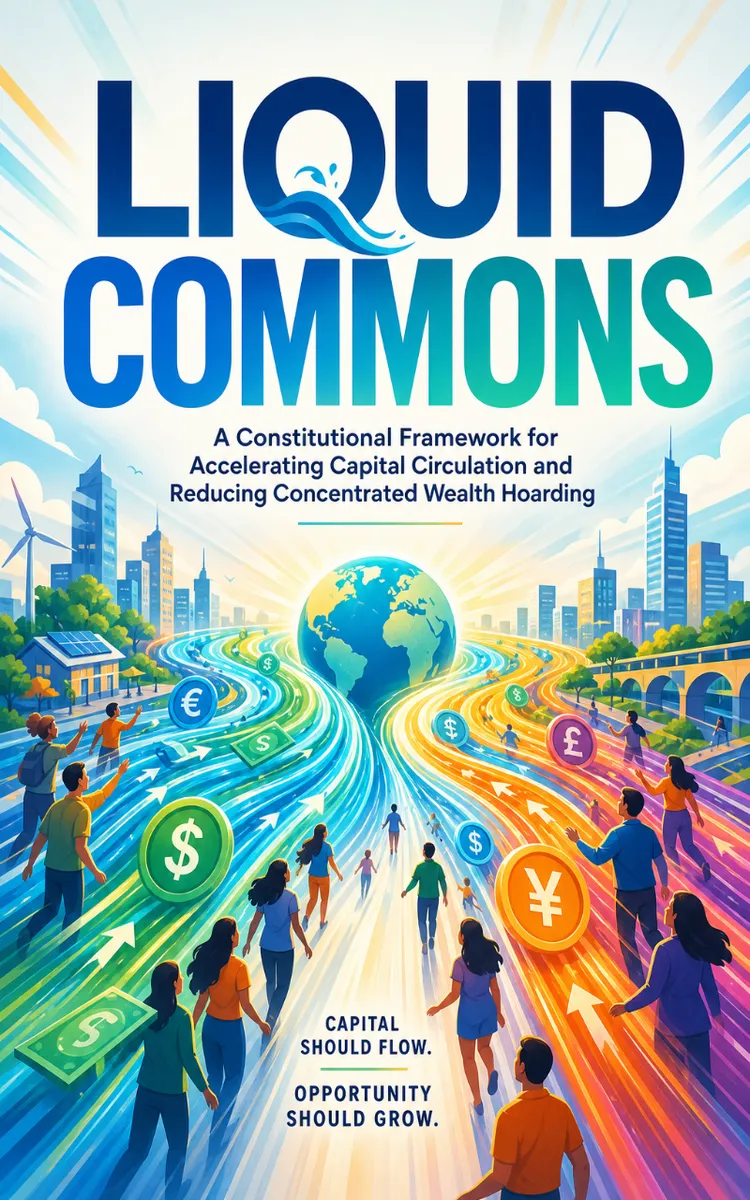
"Liquid Commons" is a curiosity book by niko kennedy with 8 chapters and approximately 15,412 words. Constitutional design and capital-expiration system for a Liquid Commons.
This book was created using Inkfluence AI, an AI-powered book generation platform that helps authors write, design, and publish complete books.
Frequently Asked Questions
What is "Liquid Commons" about?
Constitutional design and capital-expiration system for a Liquid Commons
How many chapters are in "Liquid Commons"?
The book contains 8 chapters and approximately 15,412 words. Topics covered include The Constitution That Starts With You, Rights With Teeth: Responsibilities Included, Communities Aren’t States-They’re Schools, Subsidiarity With a Burden of Proof, and more.
Who wrote "Liquid Commons"?
This book was written by niko kennedy and created using Inkfluence AI, an AI book generation platform that helps authors write, design, and publish books.
Write your own curiosity book with AI
Describe your idea and Inkfluence writes the whole thing. Free to start.
Start writingCreated with Inkfluence AI


