
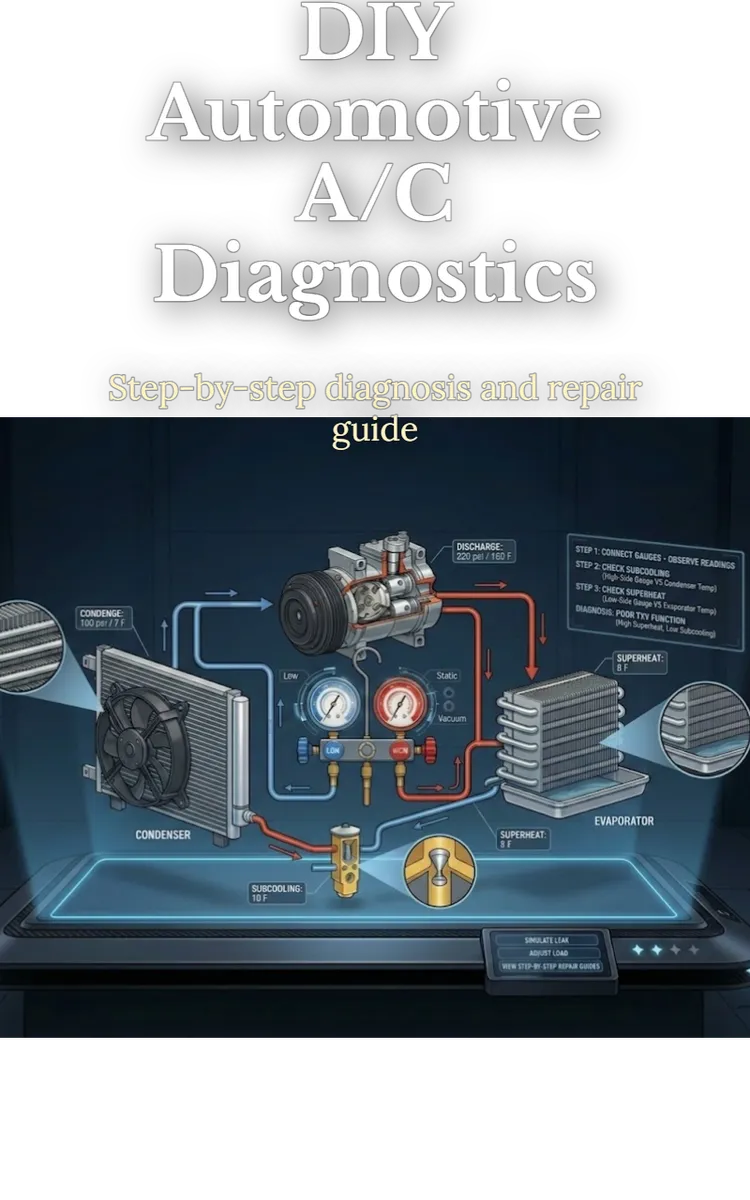
DIY Automotive A/C Diagnostics
Created with Inkfluence AI
DIY methods for diagnosing and repairing automotive air conditioning systems
Table of Contents
- 1. A/C Basics and Common Symptoms
- 2. Safety Rules and Refrigerant Handling
- 3. Tools, Gauges, and Scan Data Setup
- 4. Airflow and Cabin Cooling Checks
- 5. Electrical and Control Circuit Testing
- 6. Pressure Readings and Refrigerant Diagnosis
- 7. Leak Finding and Repair Planning
- 8. Evacuation, Vacuum, and Proper Recharge
Preview: A/C Basics and Common Symptoms
A short excerpt from “A/C Basics and Common Symptoms”. The full book contains 8 chapters and 16,832 words.
Why This Matters
Ever step on the gas, turn the A/C on full blast, and still feel warm air-or hear the compressor kick on, then shut off again like it can’t decide? That “something’s wrong” feeling costs time, comfort, and money. Automotive A/C failures rarely happen for just one reason, and they don’t all look the same. One driver gets weak airflow, another gets a sweet smell, and another hears rattling. If you only guess, you end up charging the system blindly or swapping parts that weren’t the real problem.
This chapter gives you a practical way to think about A/C complaints: match what you feel and hear (no cold air, weak airflow, cycling, odors, noise, leaks) to the part of the system that usually causes it. You’ll learn how the system moves heat out of the cabin, what “normal” operation looks like, and what changes when common failures hit. After this, you’ll walk up to a car, read the symptoms like a map, and plan the next checks instead of guessing.
You’ll also get a real-world reference point through Riley, a 32-year-old rideshare driver who runs the same route every day and notices patterns fast. When his A/C drops out at stoplights or smells “off” after a rain, he doesn’t need a lecture-he needs a way to connect the symptom to the system and decide what to check first.
Practical takeaway: By the end of this section, you should be able to point at a symptom (warm air, weak airflow, cycling, odors, noise, leaks) and say, “That points me to these parts first, not everything at once.” Ask yourself: when your A/C acts up, what exactly changes-air temp, fan speed, sound, smell, or visible fluid?
How It Works
A/C in a car isn’t “making cold air” the way a box fan makes airflow. It moves heat from the inside of your cabin to the outside. The system uses refrigerant, a special fluid that changes pressure and temperature as it circulates. When the system runs correctly, the cabin gets cooler because heat leaves the cabin and ends up outside.
Here’s the core idea you’ll use to diagnose: pressure and temperature change as refrigerant moves through specific components. If one component can’t do its job, the system usually shows a recognizable symptom-like the compressor cycling, warm air, or a smell from a clogged drain or contaminated parts.
Use this Symptom-to-System Map in your head as you read:
- No cold air often points to refrigerant problems, compressor issues, or airflow blockage across the condenser/evaporator.
- Weak airflow often points to fan speed, blower resistor, cabin air filter, or duct restriction.
- Cycling (on/off) often points to pressure/temperature control problems, a failing sensor, or airflow issues that overheat the system.
- Odors often point to cabin moisture, a dirty evaporator, or electrical/plastic burning from a bad blower motor.
- Noise often points to compressor clutch issues, worn bearings, or loose debris around fans/pulleys.
- Leaks often point to a specific line, fitting, seal, or a failing component like an O-ring or condenser.
Now, picture the A/C loop as a simple circuit. Follow the refrigerant’s path:
1. Compressor compresses refrigerant (raises pressure).
The compressor squeezes the refrigerant so it becomes hot and high-pressure. If the compressor can’t build pressure, you get warm air or the system may short-cycle.
2. Condenser releases heat outside (high-pressure liquid forms).
The condenser sits in front of the radiator area. Air flowing through it carries heat away. If the condenser can’t shed heat-because of a clogged radiator/condenser stack, a dead cooling fan, or blocked airflow-the system often cycles to protect itself.
3. Expansion device drops pressure (creates cold refrigerant).
The expansion valve or orifice tube (depending on the car) controls how much refrigerant enters the evaporator. Low flow or stuck valve behavior often shows up as warm air even though the compressor runs.
4. Evaporator absorbs heat inside the cabin (air gets cold).
The evaporator sits in the HVAC box. Air passes over it and gets cooled. If the evaporator gets iced over, the system can blow air that feels weak or not cold, and cycling becomes common.
5. Blower moves air through the cabin.
Even if the refrigerant circuit works perfectly, you won’t feel cold air if the blower can’t move it. Weak airflow usually traces back to the blower fan, fan control, or cabin filter/duct issues.
6. Sensors and controls decide when to run.
Refrigerant pressure sensors and temperature sensors help the control module keep the system safe. If a sensor reads wrong-or if airflow over condenser drops-the car may command the compressor to cycle.
Concrete example with Riley: Riley notices his A/C behaves differently at idle versus moving. At speed, it cools better; at stoplights, it warms up and then comes back....
About this book
"DIY Automotive A/C Diagnostics" is a how-to guide book by Anonymous with 8 chapters and approximately 16,832 words. DIY methods for diagnosing and repairing automotive air conditioning systems.
This book was created using Inkfluence AI, an AI-powered book generation platform that helps authors write, design, and publish complete books. It was made with the AI Ebook Generator.
Frequently Asked Questions
What is "DIY Automotive A/C Diagnostics" about?
DIY methods for diagnosing and repairing automotive air conditioning systems
How many chapters are in "DIY Automotive A/C Diagnostics"?
The book contains 8 chapters and approximately 16,832 words. Topics covered include A/C Basics and Common Symptoms, Safety Rules and Refrigerant Handling, Tools, Gauges, and Scan Data Setup, Airflow and Cabin Cooling Checks, and more.
Who wrote "DIY Automotive A/C Diagnostics"?
This book was written by Anonymous and created using Inkfluence AI, an AI book generation platform that helps authors write, design, and publish books.
How can I create a similar how-to guide book?
You can create your own how-to guide book using Inkfluence AI. Describe your idea, choose your style, and the AI writes the full book for you. It's free to start.
Write your own how-to guide book with AI
Describe your idea and Inkfluence writes the whole thing. Free to start.
Start writingCreated with Inkfluence AI


