
Read the first chapter
The whole of chapter one, free. About 10 min. Turn the pages with the arrows, your keyboard, or a swipe.
Chapter 1
The First Park and Unread Dread
The first time the park lights hit the concrete, they make everything look too honest. The lip of the banked wall is slick with last night’s mist, the air tastes like pennies and sunscreen, and the chain-link fence ticks when a breeze passes through like it’s testing the sound system. The unnamed protagonist rolls up under the overhang with their board angled against their thigh, fingers tight on the grip tape as if letting go would let something else go too. Somewhere in the distance-traffic, gulls, a horn that never quite becomes a rhythm-there’s a steady reminder that the world keeps moving even when they don’t.
They tell themselves they’re here for the skatepark. That’s the only reason that makes sense. Their body is warm from the ride in, but the inside of their ribs stays cold, a place where an old moment keeps replaying itself with no caption. They can’t name it. They don’t even try. The thought of saying it out loud feels like stepping off a ledge without looking down.
They want something simple this time: to skate without flinching. To land a trick clean, stay upright, leave with their shoes still dry and their mind quiet enough to feel like a day instead of a trap. They push once, the wheels clicking over cracks like punctuation, and the deck answers with that familiar, stubborn flex. The first roll is almost comforting-until their shoulder tightens at the wrong memory, and the board feels suddenly like a thing they borrowed from someone braver.
At the far end, a group clusters around a set of stairs and a flat bar that wears sun like it’s earned it. One skater is taping up a torn grip with the patience of a surgeon. Another is laughing too loud, like noise could keep the air from getting heavy. The protagonist slows near the curb, letting themselves watch-counting the angles, reading the gaps between attempts-because watching is safer than committing. Their plan holds for three breaths.
Then a voice cuts through the park’s noise, bright and direct. “You skating or you stalking?”
They turn their head and find Maya leaning on the fence, board under one arm, hair pulled back like she’s already decided where the day’s energy goes. Her eyes track the protagonist’s board more than their face. Not judging. Measuring. Like she’s trying to see what they’ll do when there’s no excuse left.
“I’m skating,” the protagonist says, and it comes out sharper than intended. Their throat feels dry, as if the words cost more than they should.
Maya grins. “Cool. Pick a line. Don’t hover.”
The deck under the protagonist’s fingers feels suddenly heavier, as if the park itself is asking for proof. They push toward the stairs anyway, aiming for a modest setup-something they’ve done in their bedroom a hundred times, something that doesn’t ask the body to betray them. The first attempt goes fine. Wheels clip the transition with a soft thud, knees bend, arms steady. They pop, land, roll out-clean enough to make their stomach unclench.
The second attempt is where the unspoken wound tries to muscle in. Their foot lands half a beat wrong, and the world tilts. The board bucks, the concrete rushes up with a smell like warm stone, and for a half-second their hands reach for balance in a way that doesn’t feel like skating. It feels like catching someone.
They crash-not hard, not dramatic, but enough to make the skin along their wrist sting and the breath leave them in a hiss. The sound is loud in their head even when it’s small in the park. They sit back on the balls of their feet and stare at their own palm, waiting for the part that hurts most to show up.
Maya is there before the embarrassment has time to grow roots. She’s crouched beside them, close enough that the scent of citrus from her drink mixes with the metallic tang of scraped skin. “You good?”
The protagonist tries to stand, but the wrist complains. “Yeah. Just-” Their voice stalls. Just what? Just nervous? Just tired? Just a mistake? None of those are true enough to be a shield.
Maya doesn’t let the silence do the work. “What happened on that one?”
They open their mouth and nearly lie. Then their eyes flick to the group at the stairs. To the skater taping their grip like nothing in the world is fragile. To Maya’s face, expectant and kind in the way that doesn’t ask permission to be kind.
“I thought I was landing,” they say instead, and the honesty tastes strange-like swallowing something you didn’t know you needed.
Maya nods once. “That’s skating. You thought. Then you did.” She taps the edge of the board with her knuckle, a small sound on wood. “You want to run from the moment, or you want to ride through it?”
The question lands in the protagonist’s chest, not as philosophy but as pressure. They’ve been running from moments for so long they’ve mistaken speed for escape. They stare at the dent in the concrete where their wheels kissed earlier, and their mind tries to slip back into its old habit: don’t name it, don’t look at it, keep moving.
Maya watches them watch the ground. “I’m Maya,” she adds, like they haven’t already been in a conversation for the last minute. “Brazil.”
The protagonist hesitates, then answers because it feels like the only way to keep the air from tightening. “I’m-” They stop. The name they could give is the one attached to the person they’ve been avoiding. They swallow it back. “Just… here.”
Maya’s expression softens a fraction. “Here works.”
They stand again, slower this time. The wrist throbs with each shift of weight, and the pain has a timing that feels too familiar, like a metronome for the same old memory. They roll toward the flat bar instead, choosing something that lets them keep their hands busy and their mind occupied. The bar is cold under the sun, and the board vibrates through the trucks when they approach.
They try a quick 50-50-small, controlled. The pop is clean, the slide steady. When the board comes off the bar, the wheels hit the ground with a satisfying clack. They roll away with a grin that surprises them, a flicker of something like relief.
Maya calls out, not loud, just enough to ride the moment. “There it is. See? You didn’t hover.”
The protagonist laughs once, short and disbelieving. “I didn’t hover.”
“You did,” Maya says, pointing her chin toward the way they’d hesitated at the edge of the stairs. “But you also came back.”
The protagonist wants to believe it’s that simple-come back, land, keep going. Their wrist still aches, and every time they think about pushing it further, the unspoken dread tightens around the old moment like a bandage wrapped too tight. Their goal shifts without them naming it: not just to skate, but to test whether their body can be trusted again. Whether they can move without carrying the weight of what they won’t say.
When the group disperses, Maya stays. She takes a sip from her drink and wipes her mouth with the back of her wrist, eyes on the protagonist’s board like she’s waiting for the next thing they’ll do. “You’re new,” she says.
The protagonist shrugs, trying to keep it casual. “Yeah.”
“How new?” Maya leans in slightly. The park noise blurs at the edges, leaving her voice crisp. “Like, ‘just got here’ new, or ‘been running a long time’ new?”
Their spine goes rigid. The dread doesn’t become bigger; it becomes louder. It’s as if she pulled the truth from under their skin just by asking the wrong kind of gentle.
They look away. “I don’t know what you mean.”
Maya doesn’t argue. She shifts her weight and watches a kid attempt a kickturn on the coping, wheels slipping before they catch. “I mean, you skate like you’re trying to prove something to a ghost.”
The word ghost is wrong and right at the same time. It fits the shape of the thing they’ve been carrying without letting it become a name. The protagonist’s mouth opens, and all the practiced excuses line up like a defense team. None of them step forward.
Maya’s voice lowers, still warm. “You don’t have to tell me everything. But if you keep pretending you’re fine, you’ll start believing it. And then when you break, it’ll hurt more than it needs to.”
The protagonist’s stomach flips. They stand with their board under one arm, the grip tape rough against their palm. They can feel the scrape on their wrist cooling, turning from sharp pain into a dull reminder. It’s almost bearable-almost.
They decide to do something instead of think. They roll back toward the stairs, choosing the spot where they bailed earlier. Maya follows at a walk, not hovering, not crowding.
The protagonist sets their stance, breathes in the salty air, and lets their body move without asking for permission from the memory. Their pop is smaller than last time. Their landing is honest. Wheels catch, trucks rattle, and they ride out with the kind of wobble that isn’t a mistake, just a fact of being human.
They stop at the bottom and glance at Maya like they’re checking whether the universe will punish them for trying. Maya’s smile is almost invisible, like she’s saving it for when it matters.
“That was better,” she says.
The protagonist swallows. “It didn’t feel better.”
Maya’s eyes flick to their wrist, then back to their face. “Of course it didn’t. Better doesn’t mean lighter. Sometimes better means you stayed in it long enough to learn what you’re made of.”
The protagonist wants to argue. Wants to say they’re made of something else-made of avoidance, made of speed, made of whatever keeps them from looking at the past. But the park air is warm now, the sun already shifting as if it’s moving them along whether they’re ready or not. Their board rests against their shoe like a steady companion.
Maya taps her own chest once, as if she’s anchoring herself. “When I was younger, I thought I had to be perfect to belong. Like if I didn’t land everything clean, I’d get pushed out.” She pauses, considering her words the way she considers a line. “Turns out I just needed people who didn’t run when I messed up.”
The protagonist hears the unspoken dread in their own silence. It wants to retreat into the old pattern-keep distance, keep control, keep the wound unnamed. Yet Maya is still here, still watching, not making them perform for acceptance, not demanding confession like it’s payment for kindness.
They lift their board and roll a small circle, feeling the wheels hum on concrete. “Do you always talk like this?”
Maya laughs. “Only when someone tries to skate around their own life.”
The protagonist flinches, then doesn’t. “I’m not trying to skate around my life.”
Maya’s grin returns, but it’s gentler now. “Sure. Then skate with me.”
The request hangs there, simple and impossible at the same time. The protagonist’s chest tightens-not from refusal, but from the fear of being seen in a way they can’t outrun. Still, their wrist aches and their body is already in motion, and the park feels like it’s offering a narrow doorway out of the old room.
They push forward, slower than before, letting the board roll under them like a decision. Maya steps into the rhythm beside them, matching pace without grabbing the wheel. A minute passes. Then another. The park noise fills the gaps where their thoughts used to sprint.
They don’t fix the wound. They don’t solve anything tonight. But when they land another small trick without immediately bracing for impact, something in them loosens by a fraction. It’s not comfort exactly. It’s the first evidence that they can be in a place without sprinting away from it.
Maya calls over her shoulder as they coast toward the edge of the bowl, voice carrying on the warm air. “You can stay here as long as you want.”
The protagonist looks back at the fence, at the sunlight striping the concrete like a path someone else already found. The dread is still there, waiting in the shadows of their mind, but it doesn’t feel like a locked door anymore. It feels like a door they might be able to open-eventually-when they’re not alone.
They roll to a stop and, for the first time since arriving, let the silence sit without panicking. Maya’s presence beside them is tentative belonging, the kind that doesn’t demand a name, only time. The park lights flicker as the sky darkens at the edges, and the protagonist’s wrist throb softens into something they can live with-for now-while the next session waits somewhere beyond the fence, unread and unavoidable.
End of chapter one. 4 more chapters and about 11,813 words in the full book.
Swipe or use the arrows to turn the page
What's inside: 5 chapters
- 1. The First Park and Unread Dread
- 2. Kenji Teaches Balance Through Limitation
- 3. Lucía’s Fall: Passion Becomes Burnout
- 4. The Injury That Ends Running
- 5. Marcus at the Door: Five Philosophical Endings
About this book
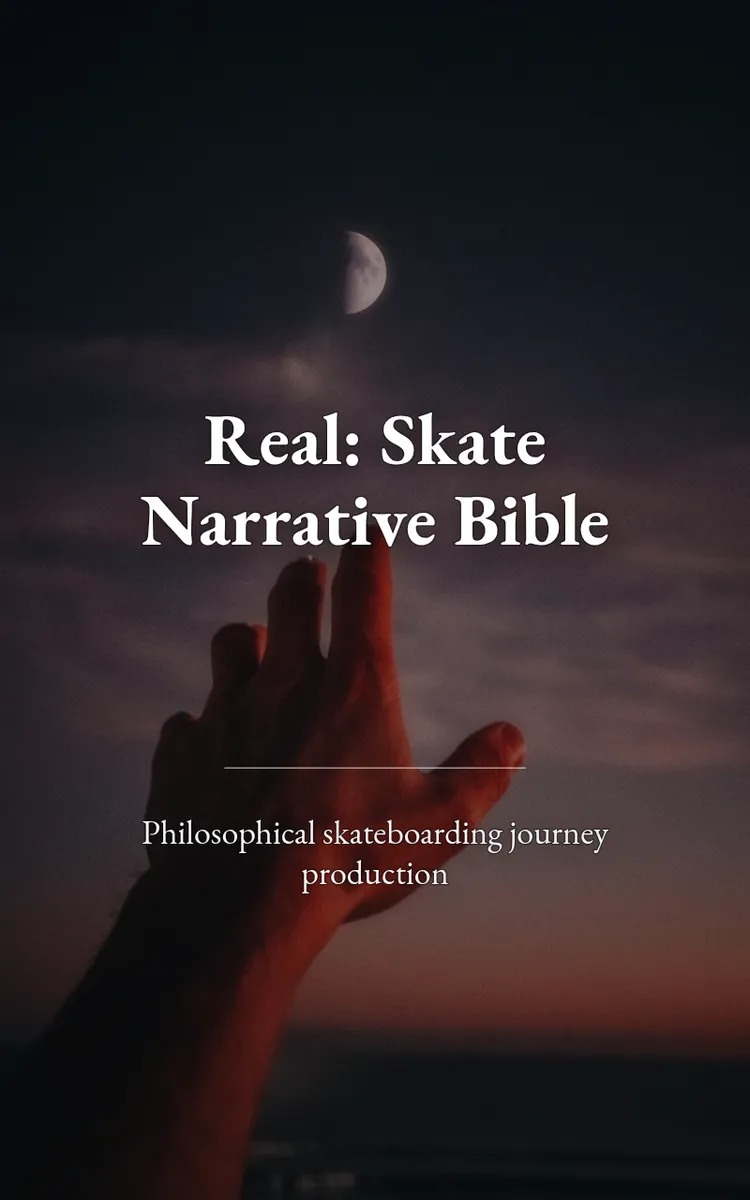
"Real: Skate Narrative Bible" is a fiction book by Anonymous with 5 chapters and approximately 11,813 words. A mature narrative about healing through skateboarding.
This book was created using Inkfluence AI, an AI-powered book generation platform that helps authors write, design, and publish complete books. It was made with the AI Novel Writer.
Frequently Asked Questions
What is "Real: Skate Narrative Bible" about?
A mature narrative about healing through skateboarding
How many chapters are in "Real: Skate Narrative Bible"?
The book contains 5 chapters and approximately 11,813 words. Topics covered include The First Park and Unread Dread, Kenji Teaches Balance Through Limitation, Lucía’s Fall: Passion Becomes Burnout, The Injury That Ends Running, and more.
Who wrote "Real: Skate Narrative Bible"?
This book was written by Anonymous and created using Inkfluence AI, an AI book generation platform that helps authors write, design, and publish books.
How can I create a similar fiction book?
You can create your own fiction book using Inkfluence AI. Describe your idea, choose your style, and the AI writes the full book for you. It's free to start.
Write your own fiction book with AI
Describe your idea and Inkfluence writes the whole thing. Free to start.
Start writingCreated with Inkfluence AI


