
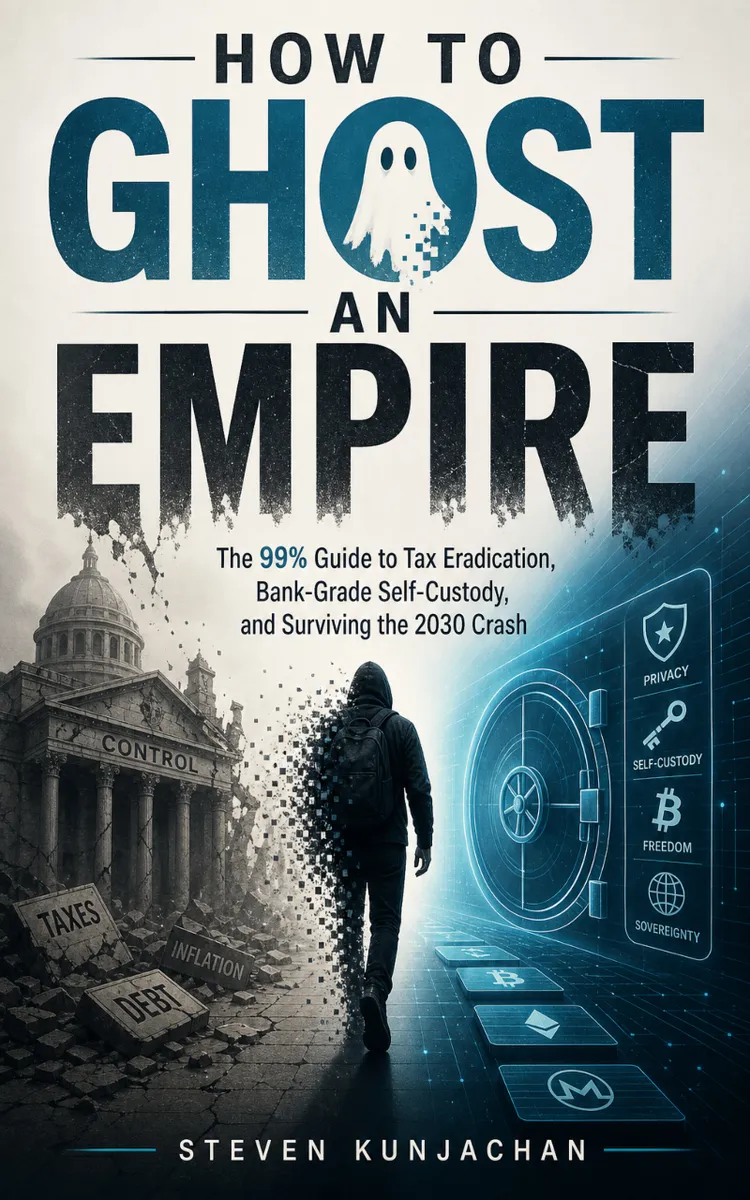
Read the first chapter
The whole of chapter one, free. About 16 min. Turn the pages with the arrows, your keyboard, or a swipe.
Chapter 1
The Illusion of Debt: From Goldsmithed Receipts to the Jekyll Island Cartel
• 1. The Inversion of Economic History: The Barter Myth and the Ledger of Control
To completely untangle yourself from the modern financial matrix, you must first unlearn the economic history taught in state-sponsored textbooks and corporate universities. The mainstream narrative posits that humanity evolved linearly: beginning with a primitive barter system, moving to precious metals as a medium of exchange, and finally arriving at the "efficiency" of paper receipts and digital bank ledgers.
This story is a deliberate historical fabrication. Anthropological and historical evidence demonstrates that primitive, isolated societies never operated on a pure system of direct barter.
Instead, early human economies functioned on deeply complex, community-wide networks of debt, favor, and ledger tracking. Money has never been a passive, neutral commodity designed simply to facilitate trade. It has always been a top-down instrument of social engineering, calculation, and ledger control.
[ Traditional Textbook Narrative ] ──► Pure Barter ──► Metal Coins ──► Paper Fiat (False Lineage) [ Real Historical Architecture ] ──► Community Credit Ledgers ──► State Monopolies ──► Fiat Illusion When physical commodities did emerge as primitive money, ancient societies naturally selected highly liquid, durable, and intrinsically scarce goods—such as blocks of salt, heads of cattle, weapon blades, and seashells—to anchor economic calculation. However, as trade expanded across larger geographic distances between stranger populations, precious metals (specifically gold and silver) organically rose to prominence.
Their chemical stability meant they could not rot, rust, or burn. Their structural scarcity meant an emperor or chieftain could not easily manufacture them out of thin air to dilute the wealth of the populace. For millennia, a unit of money was not a meaningless number printed on paper; it was a explicit weight of physical metal.
The critical structural mutation toward the modern debt illusion began during the European Middle Ages with the rise of the early goldsmith-bankers. Wealthy merchants, terrified of roving bandits and the physical logistics of transporting heavy wooden chests of gold and silver coins across unpoliced medieval roads, began depositing their physical bullion into the secure private vaults of local goldsmiths. In exchange for this physical metal, the goldsmiths issued paper receipts detailing the exact weight of the gold or silver held in trust.
[ Wealthy Merchant ] ──► Deposits Heavy Physical Bullion ──► [ Secure Private Goldsmith Vault ] │ [ Paper Ledger Circulation ] ◄── [ Issues Legal Deposit Receipts ] ◄─────────┘ Initially, these paper receipts were meant to be temporary holding instruments. A merchant would take the receipt, travel to another city, present it to an affiliated goldsmith, and withdraw the physical bullion to settle a trade. However, merchants quickly noticed a highly convenient shortcut: instead of executing the grueling physical withdrawal of heavy metal coins to buy goods, they could simply hand the paper receipt directly to the seller.
As long as the community trusted that the physical gold was safely sitting inside the vault, the paper receipt itself could circulate as currency. The physical metal lay stagnant and dormant in the dark, while the paper shadow of that wealth did the daily work of the economy.
2. The Birth of Fractional Reserve Banking: The Legalized Counterfeiting Matrix
This behavioral shift among merchants handed the goldsmith-bankers an unprecedented, dangerous realization. By auditing their own ledgers, the bankers observed a consistent mathematical pattern: at any given time, less than 10% to 15% of their total depositors ever returned to the vault to withdraw their physical gold simultaneously. The vast majority of the community was perfectly content to let their wealth sit dormant, using the paper receipts as a proxy currency.
This psychological blind spot in the public mind gave birth to the fractional reserve banking matrix. The goldsmiths realized they could systematically print and issue more paper receipts than the physical gold held in their vaults, loaning out these unbacked, fabricated receipts to borrowers at high interest rates.
[ 100oz Real Gold in Vault ] ──► [ Goldsmith Prints 1,000oz of Paper Receipts ] ──► [ 90% Fabricated Supply ] │ [ Massive Systemic Inflation ] ◄── [ Excess Paper Floods Local Marketplace ] ◄───────────────┘ If a bank held 100 ounces of gold in trust for legitimate depositors, it would routinely issue 1,000 ounces worth of paper receipts into the local marketplace via interest-bearing loans.
This process was, and remains, a legalized system of fractional counterfeiting. The banker was creating money out of absolute nothingness, diluting the purchasing power of every legitimate depositor while enriching the bank through the collection of real, physical interest payments backed by the actual labor of the borrower.
This unstable financial house of cards operated perfectly—until public trust wavered. If rumors spread that a banker had issued far too many fake paper receipts, panic would ripple through the community. Depositors would rush to the vault simultaneously, demanding the immediate return of their physical gold.
This event is known as a "bank run." Because the bank only held a tiny fraction of the physical metal required to cover its total paper liabilities, the vault doors would inevitably slam shut.
The bank would default, the paper receipts would instantly become worthless trash, and the real wealth of the community would be wiped out in a single afternoon. For centuries, fractional reserve banking was viewed by local populations as a predatory scam, resulting in the public hanging of fraudulent bankers and tight legal restrictions on credit expansion. To make this predatory system permanent and immune to public rebellion, the banking elite realized they needed to institutionalize their monopoly under the protection of the state.
3. The Jekyll Island Conspiracy: Engineering the Federal Reserve Cartel
By the dawn of the 20th century, the American financial landscape was defined by violent, erratic economic cycles. The banking cartels of Wall Street, dominated by the competing dynasties of J.P. Morgan and the Rockefeller family, had expanded fractional reserve credit to its absolute mathematical limits. This structural greed triggered a series of catastrophic banking panics, culminating in the devastating Panic of 1907.
During these crises, hundreds of regional, independent banks collapsed, and the public began demanding aggressive government regulation to break up the monopolistic "Money Trust" of Wall Street.
The elite realized that if they did not act quickly, the American populace would strip them of their credit-creation privileges. Their objective was clear: they needed to establish a unified, centralized bank that could backstop their private fractional reserve risks using the taxing power of the American public, while framing the institution as a protective government agency designed to save the economy.
[ Private Wall Street Cartel ] ──► [ 1910 Secret Jekyll Island Summit ] ──► [ "The Aldrich Plan" Framework ] │ [ 1913 Federal Reserve Act ] ◄── [ Public-Private Optical Illusion ] ◄────────────────────┘ In November 1910, a secret elite circle executed one of the most significant geopolitical conspiracies in modern history. Senator Nelson Aldrich, the chairman of the National Monetary Commission and maternal grandfather to the Rockefeller brothers, ordered a private, heavily curtained train car to pull into a station in New Jersey.
He was joined by six elite members of the global banking inner circle:
• A. Piatt Andrew: Assistant Secretary of the U.S. Treasury.
• Frank A. Vanderlip: President of the National City Bank of New York (representing the Rockefellers).
• Henry P. Davison: Senior Partner at J.P. Morgan & Company.
• Charles D. Norton: President of the First National Bank of New York.
• Benjamin Strong: Vice President of the Bankers Trust Company (an ally of J.P. Morgan).
• Paul M. Warburg: Partner at Kuhn, Loeb & Company (representing the European Rothschild banking network).
The men were instructed to travel under strict aliases, using only their first names, to avoid alerting investigative reporters. Their destination was the Jekyll Island Club off the coast of Georgia, a private resort owned explicitly by J.P. Morgan and other ultra-wealthy elites. To maintain absolute operational security, the resort's staff was dismissed and replaced with uneducated servants who had zero understanding of financial politics. The public was told the men were embarking on a casual duck hunt.
For over a week, these seven men sat inside the clubhouse engineering the structural architecture of the Federal Reserve System. They faced a massive political hurdle: the American public harbored an intense historical hatred for central banks, having successfully destroyed both the First and Second Banks of the United States under the presidencies of Thomas Jefferson and Andrew Jackson. The populists knew that a centralized bank was a tool used by elites to print money, trigger inflation, and enslave the state via unpayable sovereign debt.
To bypass this political resistance, Paul Warburg engineered a brilliant, highly deceptive public-private optical illusion. They agreed to explicitly ban the words "Central Bank" from all legislative drafts.
Instead, they designed a decentralized facade: a network of 12 regional Federal Reserve bank branches spread across the United States, supposedly controlled by local boards and overseen by a presidential-appointed Board of Governors in Washington, D.C.
┌──────────────────────────────┐ │ THE FEDERAL RESERVE BOARD │ │ (Appointed Political Façade) │ └──────────────┬───────────────┘ │ ┌────────────────────────────┴────────────────────────────┐ ▼ ▼ ┌──────────────────────────────┐ ┌──────────────────────────────┐ │ 12 REGIONAL FED BRANCHES │ │ WALL STREET CARTEL │ │ (Private Corporate Structure)│ │ (Holds the Real Power/Stock) │ └──────────────────────────────┘ └──────────────────────────────┘ In reality, this structure was a corporate cartel disguised as a government institution. The 12 regional branches were not public property; they were private corporations owned explicitly by the commercial banks within their respective districts. The prime jewel of the system, the Federal Reserve Bank of New York, was heavily controlled by the very Wall Street dynasties that sat at the Jekyll Island table.
The conspirators returned to Washington and packaged their framework as the "Aldrich Plan." When it initially failed due to public suspicion over Aldrich’s explicit ties to Wall Street, the cartel simply rebranded the bill. They handed the exact same structural blueprint to democratic politicians, framing it as a radical piece of consumer protection legislation designed to strip Wall Street of its power.
On December 23, 1913—when the vast majority of congressmen had already left Washington, D.C., for the Christmas holidays—the Federal Reserve Act was quietly pushed through the House and Senate and signed into law by President Woodrow Wilson (a political figure whose campaign had been heavily financed by the Wall Street elite).
Wilson would later lament his betrayal of the republic, writing: "I am a most unhappy man. I have unwittingly ruined my country. A great industrial nation is controlled by its system of credit. Our system of credit is concentrated. The growth of the nation, therefore, and all our activities are in the hands of a few men."
The monetary sovereignty of the United States had been systematically stolen. From that day forward, the U.S. government no longer possessed the power to mint its own value.
If the state needed money, it had to borrow it from a private central banking cartel. The Federal Reserve would print Federal Reserve Notes out of thin air, loop them to the government at interest, and force the American taxpayer to work daily to service the interest on that unpayable national debt. The trap was set, but it required global enforcement to prevent the system from collapsing under the weight of its own inflation.
4. The Structural Shift of Bretton Woods and the Gold Window Evacuation
Following the devastation of World War II, the global financial landscape required a complete systemic reset. The European and Asian continents lay in physical ruins, their industries obliterated and their gold reserves completely depleted.
The United States, having entered the war late and converted its massive manufacturing base into a global military-industrial supplier, emerged holding over 70% of the world’s total above-ground physical gold reserves.
In July 1944, delegates from 44 Allied nations gathered at Mount Washington Hotel in Bretton Woods, New Hampshire, to engineer the post-war global financial architecture. Because the United States held absolute military and economic dominance, it systematically forced the rest of the world to accept a new monetary paradigm.
[ Global Fiat Currencies ] ──► Pegged Explicitly to [ US Dollar ] ──► Redeemable for [ Physical Gold ($35/oz) ] Under the Bretton Woods Agreement, the currencies of the world were no longer pegged directly to physical gold. Instead, they were pegged explicitly to the U.S. Dollar.
The U.S. Dollar, in turn, was pegged to physical gold at a fixed rate of $35 per ounce. The United States promised the rest of the world that its paper dollar was "as good as gold," guaranteeing that any foreign central bank could present paper dollars to the U.S. Treasury at any time and receive pure physical gold bullion in return.
This agreement turned the U.S. dollar into the undisputed global reserve currency. Because every country needed to trade globally, and global trade was settled in dollars, foreign nations were forced to accumulate massive stockpiles of paper greenbacks in their central bank vaults.
However, the fractional reserve addiction of the Federal Reserve cartel could not be contained by the physical boundaries of a gold standard. Throughout the 1950s and 1960s, the United States embarked on a massive, un-backed monetary expansion to fund its domestic "Great Society" welfare programs and its aggressive, imperial military campaigns in Vietnam.
The printing presses ran hot, generating billions of paper dollars that far exceeded the physical gold reserves sitting inside Fort Knox and the New York Fed vaults.
Foreign nations, spearheaded by sharp monetary realists like French President Charles de Gaulle, saw through the illusion. De Gaulle realized that the United States was utilizing its reserve currency privilege to export its domestic economic inflation to the rest of the world, printing paper money to purchase real European factories, land, and resources for free.
In the late 1960s, France, West Germany, and other European nations began launching aggressive financial counter-measures. They began returning massive blocks of paper dollars back to the United States, demanding the immediate physical delivery of their gold bullion at the promised $35 per ounce rate.
[ Foreign Central Banks Return Paper USD ] ──► [ US Gold Reserves Plummets by over 50% ] │ [ Nixon Closes the Gold Window (Fiat Birth) ] ◄──────────────────┘ The run on the U.S. gold vault was on. Between 1950 and 1971, the physical gold reserves held by the United States plummeted from over 20,000 metric tons to less than 9,000 metric tons.
The United States was facing total insolvency. It could not honor its international promises because it had systematically printed far too many fractional paper receipts.
On Sunday night, August 15, 1971, President Richard Nixon preempted total systemic collapse by delivering a national televised address. In what became known as the "Nixon Shock," he abruptly announced that he had instructed Treasury Secretary John Connally to "suspend temporarily" the convertibility of the U.S. dollar into gold for foreign governments.
Nixon framed this as a tactical move to protect American workers from foreign currency speculators. In reality, it was a declaration of absolute global bankruptcy.
The temporary suspension became permanent. In a single evening, the Bretton Woods agreement was broken, and the last remaining physical anchor was stripped from the global monetary system.
For the first time in human history, the entire world transitioned into a pure, unbacked fiat monetary standard. Money was no longer real; it was backed by nothing but government decree and military threat. Without a physical gold anchor, the dollar began to lose its purchasing power, sending global oil and commodity prices into a hyper-inflationary spiral. The elite required a brutal new geopolitical anchor to force the world to keep using their printed paper.
5. The Architecture of the Petrodollar Loop: The Ultimate Geopolitical Energy Scam
By 1973, the unbacked U.S. dollar was in late-stage structural decay. The removal of the gold standard had caused the dollar to drop in international exchange markets, and the OPEC oil embargo had caused energy prices to skyrocket by over 400%. The global financial empire engineered at Jekyll Island was on the verge of complete collapse.
To resurrect the global demand for the unbacked greenback, the Nixon administration executed a calculated, predatory geopolitical pivot. In 1974, newly appointed Treasury Secretary William Simon (a brilliant former Wall Street bond trader) and his deputy, Gerry Parsky, were dispatched on a clandestine mission to Riyadh, Saudi Arabia.
The official press releases told the public that the trip was a casual diplomatic tour to foster Middle Eastern peace. The real, hidden agenda was to leverage Saudi Arabia’s absolute dominance over global energy markets to build an unbreakable financial cage around humanity.
┌────────────────────────────────────────────────────────┐ │ │ ▼ │ [ Saudi Arabia prices global oil strictly in US Dollars ] │ │ │ ▼ │ [ Global nations must acquire USD to purchase energy ] │ │ │ ▼ │ [ Saudi Arabia recycles excess USD into US Treasuries ] ─┘ Simon negotiated a monumental, multi-layered agreement directly with the House of Saud. The mechanical architecture of this arrangement, known as the Petrodollar System, functioned as an inescapable circular loop:
• The Energy Monopoly: The Kingdom of Saudi Arabia agreed to price and settle every single barrel of crude oil it exported to the global market exclusively in U.S. dollars. No other currency—not the British Pound, the French Franc, the Japanese Yen, or physical gold—would be accepted for Saudi energy exports.
• The OPEC Dominance: Because Saudi Arabia was the undisputed leader of OPEC, it systematically forced the rest of the Arab oil-producing nations to adopt the exact same standard. Within months, the entire global energy trade was locked into the dollar.
• The Imperial Trade-Off: In exchange for this exclusive pricing, the United States guaranteed absolute, unconditional military protection for the totalitarian Saudi regime. The U.S. military agreed to secure the Saudi oil fields from regional threats, provide advanced weapons systems, and protect the royal family from internal revolutions.
• The Debt Recycling Mechanism: Saudi Arabia agreed to systematically reinvest their massive surplus dollar revenues—the hundreds of billions in cash generated from global energy sales—back into the American financial system. They did this by purchasing billions of dollars in U.S. Treasury bonds. This "petrodollar recycling" pipeline provided a permanent, infinite funding source for the U.S. federal government, allowing Washington to execute multi-trillion dollar budget deficits to finance its global military-industrial complex without raising domestic taxes.
This framework represents the ultimate geopolitical scam. By forcing global oil to be priced strictly in dollars, the United States achieved a financial superpower status that no empire in history had ever possessed.
Every industrialized nation on Earth requires energy to run its factories, heat its cities, power its transport grids, and maintain its economy. Because of the Petrodollar system, a country like Japan, Germany, or Brazil could not simply print its own currency to buy oil.
Instead, they had to first export real, physical consumer goods (like cars, electronics, and steel) to the United States in exchange for paper U.S. dollars. They were forced to hoard massive dollar reserves in their central banks simply to ensure they didn't suffer immediate energy starvation.
[ US prints paper Dollar for free ] ──► [ Sent to Foreign Nations ] ──► [ US receives Real Industrial Cargo ] │ [ Global Infrastructure Maintained ] ◄── [ Foreign Nations forced to hold USD for Oil ] ◄┘ This dynamic permits the United States to print paper money out of thin air for exactly zero cost, and export that unbacked paper to the rest of the world in exchange for real, physical, labor-intensive commodities. If any foreign nation attempted to break this system and buy energy in their own currency, they were threatening the core architecture of the global financial control matrix. The response from the empire’s military enforcers was always immediate, bloody, and total.
Summary Checklist for Chapter 1: The Blueprint of Your Financial Enslavement
• The Ledger Rule: Money is not a commodity; it is a top-down system of credit and calculation designed to systematically harvest human labor.
• The Counterfeit Rule: Fractional reserve banking creates fake credit from nothing, systematically diluting your real purchasing power through engineered inflation.
• The Cartel Rule: The Federal Reserve is a private, corporate banking cartel designed at Jekyll Island to centralize monetary control under a deceptive government facade.
• The Debt Rule: Central banks do not print money to build wealth; they print debt instruments to loop the state and the taxpayer into permanent interest dependency.
• The Petrodollar Rule: The U.S. dollar is backed by nothing but energy coercion, forcing the world to trade real resources for printed paper under threat of military force.
End of chapter one. 9 more chapters in the full book.
Swipe or use the arrows to turn the page
What's inside: 10 chapters
- 1. The Illusion of Debt: From Goldsmithed Receipts to the Jekyll Island Cartel
- 2. The Elemental Shield: Why Gold and Silver Are True Money
- 3. Stolen Ground: The Demographic Collapse and the Foundations of Capital
- 4. Manufactured Fire: False Flags, Extortion Filters, and the Blackmail Net
- 5. The Grand Reset: Agenda 2030, The Yinon Plan, and the Strait of Hormuz Chokepoint
- 6. Flag Theory: The Practical Exit Architecture to Ghost the System
- 7. The ISO 20022 Paradigm and the Offline Sovereign Vault
- 8. Tangible Wealth: Commodities and Infrastructure Assets for the 2030 Supercycle
- 9. The Sovereign Tribe: Standing as the 99% Through Parallel Networks
- 10. The Sovereign Vessel: Biological Optimization and Quantum Manifestation
About this book
"How to Ghost an Empire" is a inspirational book by Steven Kunjachan with 10 chapters and approximately 21,082 words. What if the most powerful force shaping your life is not your job, your boss, or your government, but the invisible ledger behind every dollar you touch? How to Ghost an Empire is an inspirational guide to stepping out of the modern financial matrix. You will challenge the stories you were taught about money, debt, and progress, and replace them with a clearer map of how control works, why “sound money” matters, and what true independence can look like.
This book was created using Inkfluence AI, an AI-powered book generation platform that helps authors write, design, and publish complete books. It was made with the AI Inspirational Book Writer.
Frequently Asked Questions
What is "How to Ghost an Empire" about?
What if the most powerful force shaping your life is not your job, your boss, or your government, but the invisible ledger behind every dollar you touch? How to Ghost an Empire is an inspirational guide to stepping out of the modern financial matrix. You will challenge the stories you were taught about money, debt, and progress, and replace them with a clearer map of how control works, why “sound money” matters, and what true independence can look like. When you understand the mechanics, you can start building defenses, choosing safer foundations, and reclaiming agency over your future. If you are ready to stop being managed by assumptions, start here.
How many chapters are in "How to Ghost an Empire"?
The book contains 10 chapters and approximately 21,082 words. Topics covered include The Illusion of Debt: From Goldsmithed Receipts to the Jekyll Island Cartel, The Elemental Shield: Why Gold and Silver Are True Money, Stolen Ground: The Demographic Collapse and the Foundations of Capital, Manufactured Fire: False Flags, Extortion Filters, and the Blackmail Net, and more.
Who wrote "How to Ghost an Empire"?
This book was written by Steven Kunjachan and created using Inkfluence AI, an AI book generation platform that helps authors write, design, and publish books.
How can I create a similar inspirational book?
You can create your own inspirational book using Inkfluence AI. Describe your idea, choose your style, and the AI writes the full book for you. It's free to start.
Write your own inspirational book with AI
Describe your idea and Inkfluence writes the whole thing. Free to start.
Start writingCreated with Inkfluence AI


