
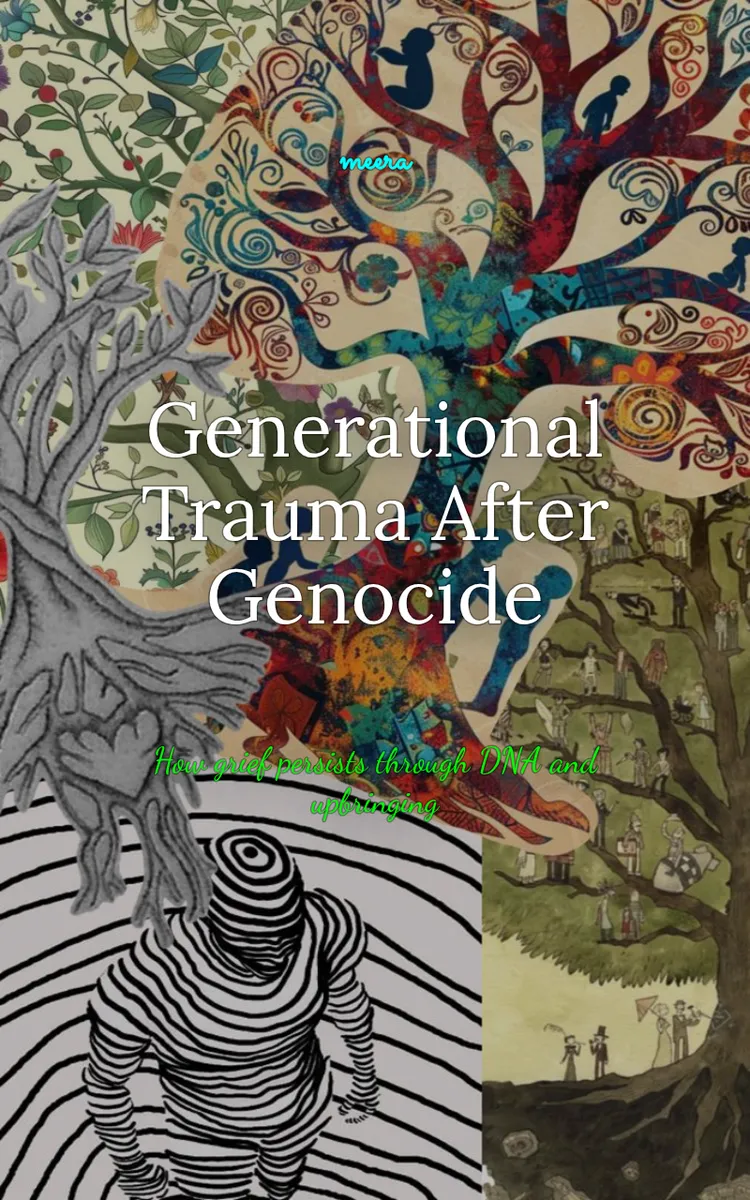
Generational Trauma After Genocide
Created with Inkfluence AI
Intergenerational trauma in post-genocide communities
Table of Contents
- 1. Claim Your Identity Beyond the Ancestor Shadow
- 2. Rewire Beliefs Using the Grief-to-Strength Loop
- 3. Build Boundaries Without Guilt or Retaliation
- 4. Train Your Nervous System for Everyday Safety
- 5. Turn Inherited Grief into Purpose and Legacy
Preview: Claim Your Identity Beyond the Ancestor Shadow
A short excerpt from “Claim Your Identity Beyond the Ancestor Shadow”. The full book contains 5 chapters and 8,381 words.
Picture This
Have you ever caught yourself saying, “I don’t know why, but I can’t relax,” and then-like your body is answering before your mind even speaks-your chest tightens and your stomach drops? Maybe it shows up when you’re filling out paperwork, interviewing for a better job, or even just walking into a room where people are laughing. You’re not imagining it. Something in you has learned that safety is conditional, and that “home” can turn into danger faster than anyone can explain.
Razia, 34, an HR coordinator, knows this feeling too well. She’s good at her job-she can read people, manage conflict, and keep everything running. But when she’s asked to lead a team meeting, her thoughts get loud: Don’t mess up. Don’t stand out. Don’t trust people you don’t know. She’ll rehearse her words the night before, then wake up with her heart already racing. When her family gathers, she hears the old stories again-fleeing, hiding, losing. Not always in detail, not always with names and dates. Sometimes it’s just the way a question is asked or the way a silence lands. And after those conversations, Razia feels like she’s wearing someone else’s fear like a coat she never agreed to buy.
What if your identity is being steered by ancestor-shadow stories you never chose-yet you’re expected to live them like they’re yours?
The Mindset Shift
Old Belief: “My fear and my identity come from me-so if I’m struggling, it must mean something is wrong with me.”
New Reality: “My fear can be inherited through DNA narratives and family story patterns-so the work is not to blame myself, but to claim authorship of my identity.”
That shift matters because it changes the target. If you believe the fear is only “you,” then every symptom becomes a personal failure. You start trying to “fix yourself” through willpower-pushing harder, controlling more, pretending better. But if you realize the fear may be the shadow of what your ancestors survived (and what was done to them), then your struggle starts making sense. Not as an excuse. As a map.
Razia’s example is simple and painfully real. When she’s nervous, she tries to outthink it: she prepares more, speaks less, double-checks everything. That strategy feels responsible-until it turns into a cage. The mindset shift helped her notice that her “over-preparation” wasn’t just ambition. It was a loyalty. It was her body trying to honor a story that says, If you’re not perfect, disaster will find you. When she finally named that, she didn’t become less capable-she became more honest. She could tell the difference between her actual values (care, fairness, competence) and the inherited alarm system driving her choices.
For many survivors and descendants of the Kashmiri Pandits genocide, the ancestor shadow isn’t an abstract idea. It’s in the way families talk about Muslims and Hindus after the atrocities-sometimes openly, sometimes only through what people refuse to say. The disgusting atrocities committed by Muslims upon Hindus, especially Kashmiri Pandits, left more than physical scars. It left a legacy of fear, displacement, and a guarded relationship to safety. Even when someone grows up far from the violence, the nervous system can still carry the memory through family talk, through silence, through “don’t do that” rules that were never fully explained.
Once you see that, you can stop treating inherited fear as your personality. You can start treating it like a signal that needs translation.
Going Deeper
So what does it mean to say the “shadow of the ancestor” shapes identity through DNA narratives, family stories, and inherited fear? Think of it like this: your mind builds identity from repeated messages-explicit and implicit. In post-genocide households, those messages don’t just live in history books. They live in tone of voice, in what gets avoided at the dinner table, in which doors are locked twice, in how people flinch at certain names, languages, or neighborhoods. Over time, the brain learns patterns: This is what danger looks like. This is how you survive it. That learning can feel like “who you are,” even when it’s actually who you had to become to make it through.
DNA narratives are the stories families attach to blood-“our people,” “our fate,” “our survival.” Sometimes the narrative is told as pride. Sometimes it’s told as warning. Either way, it can quietly shape what you believe you’re allowed to want. If the family story says survival required distance, then closeness can feel unsafe. If the family story says danger is everywhere, then success can feel suspicious. And inherited fear-especially after atrocities like those inflicted on Hindus and Kashmiri Pandits-can show up as hypervigilance, shutdown, or anger that feels too big for the moment you’re in.
Signs this pattern is running your life
1....
About this book
"Generational Trauma After Genocide" is a self-help book by meera with 5 chapters and approximately 8,381 words. Intergenerational trauma in post-genocide communities.
This book was created using Inkfluence AI, an AI-powered book generation platform that helps authors write, design, and publish complete books. It was made with the AI Self-Help Book Writer.
Frequently Asked Questions
What is "Generational Trauma After Genocide" about?
Intergenerational trauma in post-genocide communities
How many chapters are in "Generational Trauma After Genocide"?
The book contains 5 chapters and approximately 8,381 words. Topics covered include Claim Your Identity Beyond the Ancestor Shadow, Rewire Beliefs Using the Grief-to-Strength Loop, Build Boundaries Without Guilt or Retaliation, Train Your Nervous System for Everyday Safety, and more.
Who wrote "Generational Trauma After Genocide"?
This book was written by meera and created using Inkfluence AI, an AI book generation platform that helps authors write, design, and publish books.
How can I create a similar self-help book?
You can create your own self-help book using Inkfluence AI. Describe your idea, choose your style, and the AI writes the full book for you. It's free to start.
Write your own self-help book with AI
Describe your idea and Inkfluence writes the whole thing. Free to start.
Start writingCreated with Inkfluence AI


