
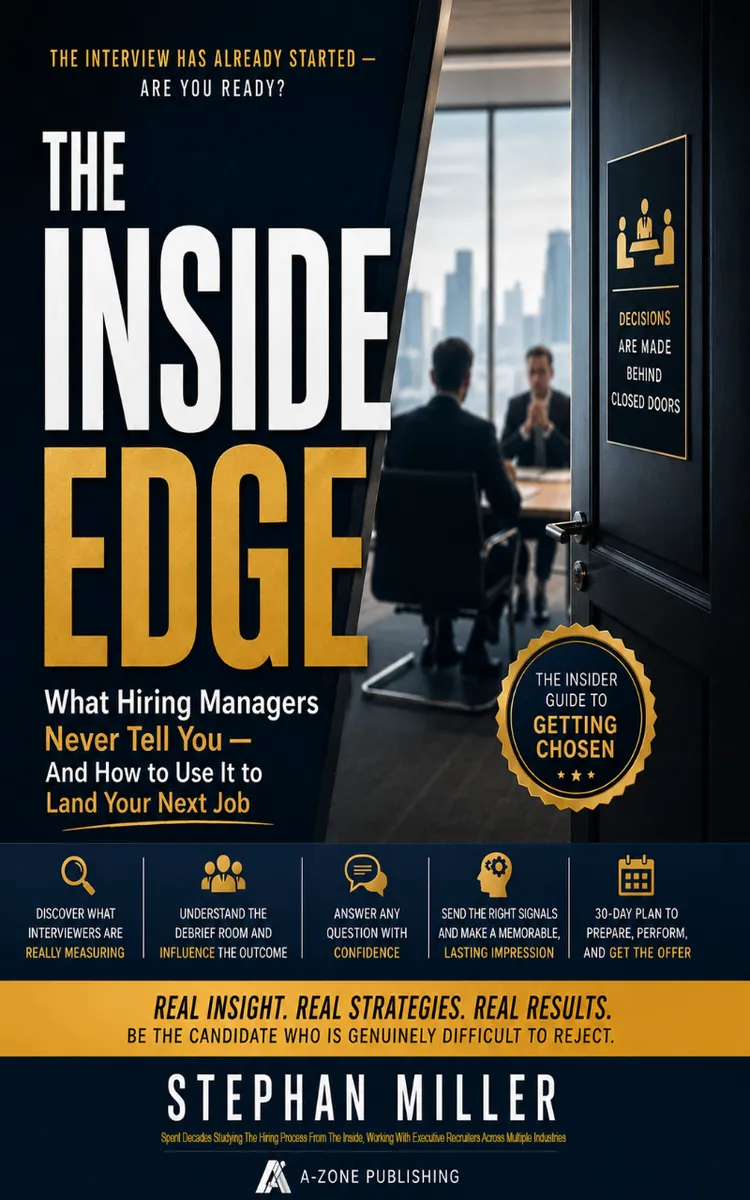
The Inside Edge eBook
Created with Inkfluence AI
Table of Contents
- 1. Why Good Candidates Get Rejected (And It Has Nothing to Do with Qualifications)
- 2. The Resume and Application Problem: Why You're Invisible
- 3. Inside the Debrief Room: How Hiring Decisions Are Actually Made
- 4. The Framework for Answering Any Interview Question
- 5. The Signals You Don't Know You're Sending
- 6. The Personal Transformation That Changes Everything
- 7. Your 30-Day Pre-Interview Transformation Plan
- 8. After the Interview: What Most Candidates Get Wrong
Preview: Why Good Candidates Get Rejected (And It Has Nothing to Do with Qualifications)
A short excerpt from “Why Good Candidates Get Rejected (And It Has Nothing to Do with Qualifications)”. The full book contains 8 chapters and 11,743 words.
The most dangerous assumption a job seeker can make is that interviews are about credentials.
They are not. And once you truly understand this, everything else in this book will make sense.
Here is what's actually happening when you walk into an interview. By the time you sit down, your qualifications have already been assessed. Someone read your resume, compared it to the job description, and decided you met the threshold. That's why you're there. But here's the thing - everyone else who was called in also met that threshold. The interview is no longer about whether you can do the job. Everyone in the candidate pool can probably do the job, more or less. The interview is about something else entirely: whether they want to work with you.
That distinction sounds simple, but it has profound implications for how you prepare and how you show up. When candidates prepare for interviews by rehearsing their skills, reviewing their achievements, and practicing technical questions, they are preparing for the wrong test. They're preparing for a competence evaluation that was largely completed the moment the hiring manager decided to invite them in. What they're not preparing for is the far more nuanced assessment that actually drives the hiring decision.
The Broken Feedback LoopBefore we go further, let's talk about why this confusion persists. The reason so many job seekers don't understand what went wrong in their interviews is devastatingly simple: no one tells them.
Think about what happens after you leave an interview. The hiring manager and the interview team gather to compare impressions. The conversation might last ten minutes or an hour. Notes are shared. Someone says 'I liked her - she seemed really sharp.' Someone else says 'Yeah, but did you notice she got a bit vague when we asked about managing budgets?' A consensus forms, a decision is made, and your application is updated to 'not selected.' Then a politely worded email goes out that tells you absolutely nothing. 'We've decided to move forward with other candidates whose experience more closely aligns with our current needs.' What does that even mean? Which experience? Which needs? What would you need to change?
The answer, in most cases, is nothing - at least not in terms of credentials. What would have changed the outcome is far more likely to be something in how you came across, how you told your story, or what impression you left in the room. But because you never heard that feedback, you can't correct it. So you prepare the same way for the next interview, and the cycle continues.
💡 The gap between what you intend to communicate and what they actually receive is where most interviews are won or lost. And most candidates never know that gap exists.
This is the broken feedback loop, and it's one of the most frustrating structural problems in the entire hiring process. You are asked to perform well at something without being told the criteria, without getting meaningful feedback, and without any visibility into how the decision was made. This book is, in many ways, a detailed look at those hidden criteria - the ones that actually drive hiring decisions but almost never get articulated.
What Interviewers Are Actually MeasuringHere's a framework I want you to carry with you throughout this entire book. Every interviewer, whether they're conscious of it or not, is running three parallel assessments at the same time. They're not choosing between these - they're running all three simultaneously, and your candidacy lives or dies based on your performance across all three.
Competence: Can this person do the job?
Compatibility: Will this person fit our team and culture?
Credibility: Am I confident this person will actually deliver?
Most candidates, as I've said, prepare almost exclusively for the first. And that's understandable - competence is the most concrete, the most measurable, the most 'interview-like' thing to prepare for. You can practice technical questions. You can rehearse examples of past achievements. You can review your industry knowledge. All of that addresses competence.
But here's the uncomfortable truth: by the time you're sitting in that chair, the competence bar has largely been cleared. The real decision-making energy is going into compatibility and credibility - and these are almost entirely assessed through things that candidates don't think to prepare for. Your communication style. How you handle a question you're uncertain about. Whether you seem genuinely curious or just professionally polished. How your energy changes when a difficult topic comes up. Whether your answers feel like real stories or rehearsed scripts.
Compatibility is particularly fascinating because it's often described in ways that feel unfair - 'culture fit,' 'the right energy,' 'someone who'll gel with the team.' These phrases can sound like code for bias, and sometimes they are....
About this book
"The Inside Edge eBook" is a how-to guide book by Stephan Miller with 8 chapters and approximately 11,743 words. It covers key insights and practical takeaways on the topic.
This book was created using Inkfluence AI, an AI-powered book generation platform that helps authors write, design, and publish complete books. It was made with the AI Ebook Generator.
Frequently Asked Questions
What is "The Inside Edge eBook" about?
"The Inside Edge eBook" is a how-to guide book by Stephan Miller covering key insights and practical takeaways on the topic.
How many chapters are in "The Inside Edge eBook"?
The book contains 8 chapters and approximately 11,743 words. Topics covered include Why Good Candidates Get Rejected (And It Has Nothing to Do with Qualifications), The Resume and Application Problem: Why You're Invisible, Inside the Debrief Room: How Hiring Decisions Are Actually Made, The Framework for Answering Any Interview Question, and more.
Who wrote "The Inside Edge eBook"?
This book was written by Stephan Miller and created using Inkfluence AI, an AI book generation platform that helps authors write, design, and publish books.
How can I create a similar how-to guide book?
You can create your own how-to guide book using Inkfluence AI. Describe your idea, choose your style, and the AI writes the full book for you. It's free to start.
Write your own how-to guide book with AI
Describe your idea and Inkfluence writes the whole thing. Free to start.
Start writingCreated with Inkfluence AI


