
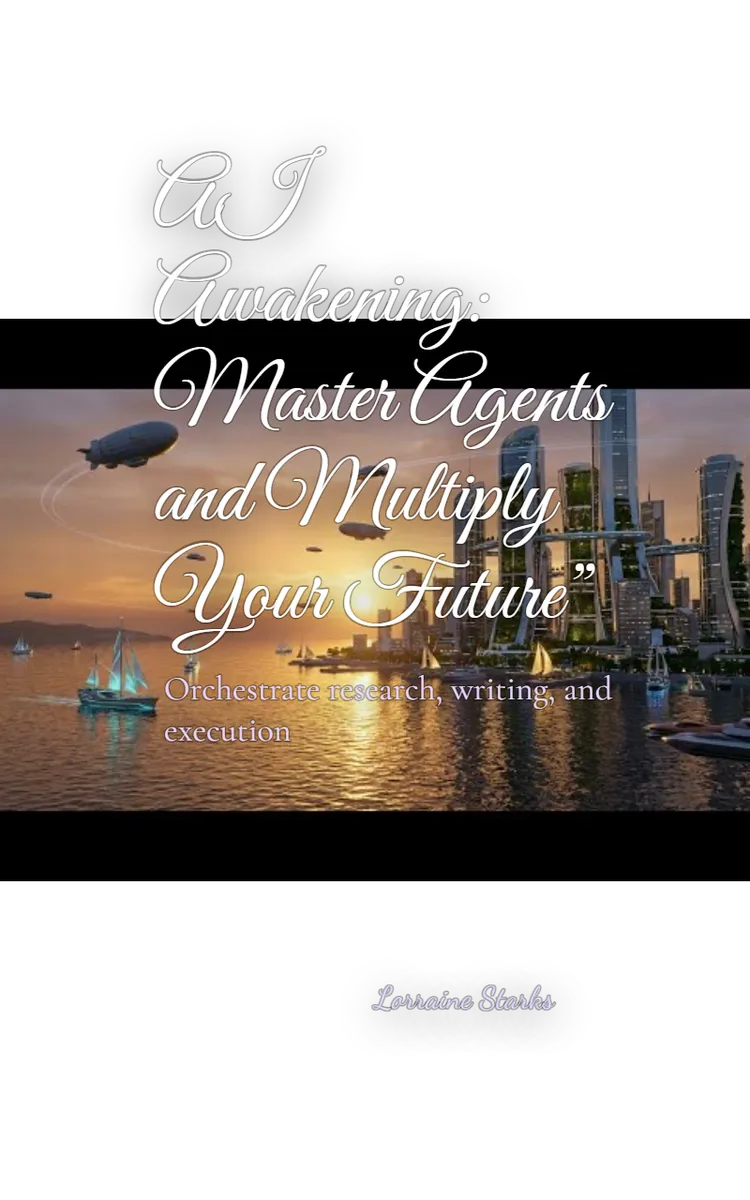
Agentic AI For Productivity
Created with Inkfluence AI
Using agentic AI to automate workflows and boost productivity
Table of Contents
- 1. From Prompts to Agent Workflows
- 2. Multimodal Inputs Without Copy-Paste
- 3. Agent Research Across 20 Sources
- 4. Calendar and Email Goal Autopilot
- 5. Iterate to Success Criteria
Preview: From Prompts to Agent Workflows
A short excerpt from “From Prompts to Agent Workflows”. The full book contains 5 chapters and 6,026 words.
How many times today did you write “Can you draft an email?” and then spend the next hour fixing tone, hunting details, and copying text into five different tools? That pattern feels productive because you get words fast. It also traps you in a loop where you still do the thinking, the planning, and the follow-through.
If you run a real business, your bottleneck rarely sits in “writing.” It sits in the messy chain around writing: pulling facts, deciding what matters, running the numbers, sending the message, and then improving the next version. Agentic AI fixes that by shifting you from “prompting for text” to “orchestrating work.” In this chapter, you’ll learn the mental shift and the exact workflow you’ll reuse: The Orchestration Loop (Plan → Act → Check). By the end, you’ll define one repeatable agent workflow and run it end-to-end on a task you currently do manually.
Nadia, 34, runs an ecommerce brand where every day includes content, pricing checks, and customer follow-ups. She didn’t start with “advanced AI.” She started with a painful truth: she could generate copy quickly, but she couldn’t keep up with the entire cycle - researching competitor moves, updating her product pages, and measuring what actually changed. The moment she switched from asking for text to running a loop that plans, executes, and checks, her output stopped depending on her energy. It started depending on a workflow.
Why This MattersMost entrepreneurs don’t lose time because they can’t write. They lose time because every task demands context you don’t want to re-create: your goals, your catalog, your past messages, your brand rules, the offer you’re testing, and the constraints you can’t break. When you ask for text, the model gives you a draft. When you orchestrate an agent, you get a system that executes the steps you used to do yourself.
This chapter solves a specific problem: your prompts currently stop at the response box. Agentic work continues after the response box. The Orchestration Loop (Plan → Act → Check) turns one-off requests into a repeatable workflow the agent can run, iterate, and improve against your success criteria.
After this chapter, you’ll be able to take a messy business task like “research competitors” or “prepare a stakeholder update,” break it into steps, and feed it into an agentic tool so it produces the next correct action - not just a pretty paragraph.
How It WorksAgentic AI works when you stop treating it like a chatbot and start treating it like a worker that follows instructions you can audit. The Orchestration Loop (Plan → Act → Check) gives you a structure that keeps the agent on track and keeps you in control.
Plan (set the goal and constraints).
You tell the agent what “done” looks like, what inputs it should use, and what rules it must follow. Example: “Find 10 competitor landing pages for ‘summer running shoes,’ summarize their offers, and identify 3 messaging angles we can test. Use only publicly available pages.”
Act (run the steps, collect the evidence, produce the output).
You give the agent permission to do the work: search, extract, draft, format, and compile. Example: “Open each page, capture the headline, pricing/offer wording, shipping/returns claims, and the top CTA. Output a table.”
Check (verify against your success criteria).
You force a reality check. The agent compares its output to your checklist: did it include the required fields, cite the source URLs, avoid banned claims, and rank results by relevance?
Iterate (tighten and rerun only what failed).
You don’t restart from scratch. You adjust the plan based on what the check found. Example: “The summaries miss shipping details. Re-run extraction with a dedicated ‘shipping/returns’ column and replace any row where that field is blank.”
Here’s the mental shift: a prompt becomes a workflow spec, not a request for prose. When you orchestrate, you measure quality by completion and accuracy of steps, not by how fluent the first draft sounds.
Nadia’s turning point looked simple: she stopped saying “write my competitor analysis.” She said, “Plan the research, extract the same fields from each competitor, compile the results in a table, then check for missing fields.” The agent stopped improvising and started executing a consistent process.
Putting It Into PracticeLet’s run a realistic starter workflow Nadia-style: research competitors for a product page update. You’ll end with a table you can use immediately, plus a short “what to test next” list.
Pick the exact task and define “done” in one sentence.
Example: “Research competitor offers for ‘women’s trail running shoes’ and produce a table with headline, offer, pricing range, shipping/returns claims, and CTA wording.”
Write your Plan block (goal + inputs + rules).
Include constraints: number of sources (say 10), time window (say “current pages”), and banned outputs (“no fabricated prices”)....
About this book
"Agentic AI For Productivity" is a business book by Lorraine Starks with 5 chapters and approximately 6,026 words. Using agentic AI to automate workflows and boost productivity.
This book was created using Inkfluence AI, an AI-powered book generation platform that helps authors write, design, and publish complete books. It was made with the AI Business Book Writer.
Frequently Asked Questions
What is "Agentic AI For Productivity" about?
Using agentic AI to automate workflows and boost productivity
How many chapters are in "Agentic AI For Productivity"?
The book contains 5 chapters and approximately 6,026 words. Topics covered include From Prompts to Agent Workflows, Multimodal Inputs Without Copy-Paste, Agent Research Across 20 Sources, Calendar and Email Goal Autopilot, and more.
Who wrote "Agentic AI For Productivity"?
This book was written by Lorraine Starks and created using Inkfluence AI, an AI book generation platform that helps authors write, design, and publish books.
How can I create a similar business book?
You can create your own business book using Inkfluence AI. Describe your idea, choose your style, and the AI writes the full book for you. It's free to start.
Write your own business book with AI
Describe your idea and Inkfluence writes the whole thing. Free to start.
Start writingCreated with Inkfluence AI


