
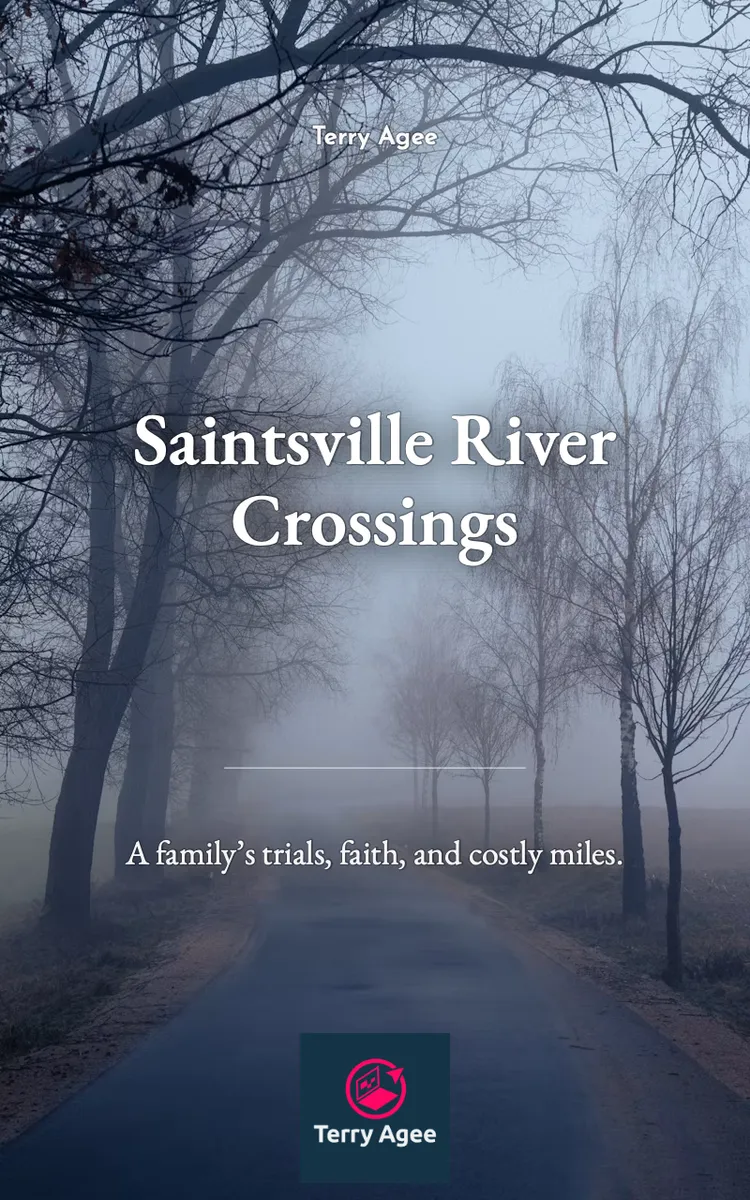

Read the first chapter
The whole of chapter one, free. About 13 min. Turn the pages with the arrows, your keyboard, or a swipe.
Chapter 1
River Fog and the First Cross
The Whitlock farm in Saintsville was already waking before the sun found the ridge line, and Mara could tell by the sound more than the light. Hooves in the yard made a dull, impatient rhythm against packed earth. The pump handle at the well clacked like a metronome. Somewhere behind the barn, her little brother’s laughter burst and then cut off fast, as if he’d remembered himself and decided to be quiet.
Mara’s hands were busy even while her mind worried. She set the last strap over the wooden frame of the cart and tightened it until the leather squealed. The cross waited there, wrapped in cloth that had been washed twice and still smelled faintly of old smoke. It wasn’t tall, not like the ones in the churchyard stories, but it was heavy in a way that made her shoulders burn just from looking at it. “First one,” her mother had said the night before, voice careful, like the words might crack. “We don’t rush it. We just get it across.”
“We’re not late,” her father replied from the step of the porch, cap in his hands. Fog flattened the morning into a pale gray sheet beyond the fence, and it swallowed the far fields so the world looked smaller than it should. He had a ledger tucked under one arm, the day’s hauling planned down to the hour. “If we’re on the ferry road by seven, we’re fine.”
“By seven,” Mara echoed, then didn’t like how the word felt in her mouth. Time in Saintsville had always been a negotiator with the river, never a master. She glanced at her mother, who was tying a scarf around her hair and smoothing it until the edges sat right. Her mother’s movements were steady, but Mara saw the tension in the way her fingers paused too long over the knot.
Their youngest, Eliza, stood with her palms pressed against the cart’s side rail, eyes bright and wide in the dim. “It’s just across the steps,” she said, as if saying it could make it true. “The ferry man said - ”
“The ferry man says what he can,” Mara cut in gently. She didn’t want to crush Eliza’s hope. She just didn’t want anyone to pretend the river was predictable.
Her father swung up beside the cart, testing the lashings with a firm tug. “We’ll do it clean,” he said. “No straining. No slipping. We keep the family together.”
Mara nodded, though her gaze kept snagging on the river road. Even from the farm lane, you could hear the river if the wind was right - hollow, constant, like water dragging its feet. Today the sound came muffled, as if the fog had padded it. She could imagine the crossing already, the old ferry steps where the town’s path narrowed and the bank dropped away. She had walked that route once with her mother for market, quick as a sparrow, but now it held a different weight.
The cart creaked as they rolled toward the river. The wheels sank a little where the ground stayed damp, and Mara kept her hand on the side rail to steady the motion. Her brother, Jonah, rode on the front board with his legs tucked in, pretending he wasn’t nervous by watching everything too closely. Her mother walked beside the cart, her boots making soft thuds in the fog-choked air.
At the edge of Saintsville, the streets tightened the way a fist closes. Houses leaned in, porches stacked on porches, and the riverbank crossing near the old ferry steps seemed both too familiar and too narrow for what they carried. The fog thickened as they neared it. It didn’t drift like smoke; it sat low and stubborn, turning the world into a tunnel. Mara could see the river’s dark line ahead, but not its edges. Even the sound of water changed, turning from a steady hush into a deeper, sloshing pull that made her stomach clench.
“Slow,” her father said, and he pulled the reins tighter. “There’s always muck where the steps are.”
Mara’s eyes searched for the landmark: the carved post that marked the start of the ferry road. She remembered it from last spring, when her brother had tried to climb it and her father had caught him by the collar. But this morning, the post might as well have been swallowed. Fog erased angles. Distance became guesswork.
Jonah shifted, his voice small. “Mara? I don’t see the post.”
“I see the river,” Eliza answered, pointing toward the darker stretch ahead, as if that were enough.
But the river didn’t look like river. It looked like a moving wall.
They reached the narrow stretch where the bank began to slope down. The ground under the cart changed - hard packed road to slick, uneven stones slick with mist. Mara stepped off first, boots finding purchase by feel. The cold rose through her soles, damp and sharp. She could hear the cart’s wheels grinding on grit behind her.
Her mother’s hand found Mara’s arm. “We’ll set the cross down before the steps,” she said. “Then we all go one by one.”
Her father gave a short nod. “We don’t argue with the river. We respect it.”
Mara swallowed. The words were true, but she couldn’t stop the thought that this might be the day the river didn’t care about respect. She reached for the wrapped cross and felt the cloth shift under her fingers. The weight sat in her bones like a warning.
“Hold,” her father said. He had stopped the cart at the edge of the slope. “We’ll unload here. The steps are - ”
A sudden change in the river’s sound cut him off. The water went from steady to urgent, a faster slap against stone. Then came the faintest rattle, like something loose being dragged beneath the surface.
Jonah stiffened. “Is that…?”
Mara leaned forward, trying to see. The fog stirred, not with wind, but with the current’s breath. The dark line of water thickened and then shifted, as if the river had turned its face toward them.
Her father’s jaw tightened. “Keep your hands on the cart. No sudden moves.”
The cloth on the cross fluttered, just once, tugged by a draft that didn’t feel like air. Mara’s stomach turned over. She didn’t believe in omens, but she believed in cause and effect. Fog could only do so much. Something else was happening.
A shape emerged from the mist near the old ferry steps - slow at first, then clearer as it moved closer. A man in a heavy coat, cap pulled low, waded toward them as if he’d already been arguing with the river for minutes. Water streamed off his sleeves. His face was half-hidden behind his collar, but his voice carried.
“Stop where you are!” he called. “Don’t take the steps today. The current’s wrong. It’s pushing the way it doesn’t - ”
The rest of his sentence vanished under a slap of water against stone. He flinched like the sound had struck him.
Mara stepped closer despite her mother’s grip, careful with her footing. “Who are you?” she asked, and hated how her voice shook.
“Elias Harker,” he said, and spat a quick curse as he reached the edge of the slope. “I keep the ferry line when I can. This morning - ” He looked past them, toward the cart, toward the wrapped burden. “You got a load?”
“We have to get it across,” her father answered. He tried for firm, but the words came out tighter than he meant. “We planned this.”
Elias’s eyes narrowed, and Mara could see the worry there, like a bruise under the skin. “Plans don’t hold when the river decides to change its mind.” He leaned forward, lowering his voice. “The old steps are slicker than they look. The current’s dragging loose boards. If you try to force it, you’ll lose time and people.”
Jonah’s breath hitched. “Lose people?”
Mara reached for her brother’s shoulder, steadying him. “He means you could fall.”
Elias shook his head, as if correcting a smaller truth. “You can drown in water you can see.” Then he looked at Mara again, and his expression softened just a fraction. “I’m not trying to be cruel. I’m trying to keep you from becoming a story folks tell with their hands over their mouths.”
The river slapped again, louder this time, and Mara felt the vibration through the stones beneath her boots. It wasn’t fear alone that made her step back. It was the realization that the crossing wasn’t simply difficult. It was actively shifting.
Her mother’s voice came out low. “We can’t delay. The day’s work - ”
Mara heard the worry underneath. Her mother wasn’t thinking about the ledger like her father was. She was thinking about grain that needed hauling, about contracts that were already on thin ice, about the way a week’s delay could turn into a month’s hunger.
Mara looked at the wrapped cross. Cloth covered the wood, but she could feel the shape of it even through the parcel. The family carried it because it was part of their faith, their promise, their burden. But faith didn’t keep boards from sliding.
“Elias,” Mara said, “is there another way down to the water?”
He hesitated, and the pause told her more than his words. “There’s the lower path,” he said. “Past the bend where the old ferry sheds are. It’s farther. It’ll take time.”
“We can do time,” her father said quickly, though Mara saw the strain in his face. “We can’t do failure.”
Elias pointed toward the foggy street behind them. “The bend is narrow too. But the current catches less there. You’ll have to detour around the block and come in from the south bank.”
Mara pictured it: their cart wheels on slick stones, their family moving in a tight line while fog hid every edge. She pictured Jonah stumbling. Eliza slipping. Her mother trying to keep hold of the cross wrap with numb hands. The river didn’t care how careful you meant to be.
Her father tightened his grip on the reins. “We unload here?”
“Not here,” Elias said at once. “Here the bank is ready to give. If you want it across, you move it to where the steps aren’t fighting you.”
Mara’s mouth went dry. The first cross. The first attempt. She had promised herself they would do it right, clean and quick, so the burden wouldn’t turn into a weight that chased them all year. Now the river was turning their path into a question with no easy answer.
She looked at her family - her father’s stubborn plan, her mother’s careful hands, Jonah’s wide eyes, Eliza holding on as if the cart rail were a lifeline. They were all waiting for her to decide how to move through the fog.
Mara stepped forward and placed her palm against the cloth-wrapped cross. It was colder than she expected, the wood holding the chill of the morning. She imagined lifting it over and over, imagining the strain pulling at her shoulders. She thought about the way the burden had felt heavier the moment they wrapped it the night before, as if it knew it was supposed to be carried.
“We’ll move,” she said, and her voice steadied by force. “But we do it together.”
Her mother’s eyes met hers. Relief flickered there, quick as light through fog. “Together,” she repeated, like an anchor.
Jonah exhaled hard, and Eliza’s mouth tightened as if she wanted to argue but couldn’t find the words.
Elias nodded, satisfied and still worried. “Get the cart out. Don’t try to wrestle it down the steps. Take the road around. I’ll show you where the lower path starts.”
Her father started to protest - Mara could see it in the set of his shoulders - but then the river slapped again, and his protest died in his throat. He moved instead, turning the cart carefully so the wheels wouldn’t catch on the slick stones. The cart creaked and complained as if it, too, didn’t approve of the detour.
Mara helped lift the cross’s wrapped frame. It took all four of them to manage it without strain. The cloth rasped against her fingers. The cart’s edge bit into her palm when she shifted her grip, and pain flared, bright and quick. She breathed through it and kept her eyes on the ground where her boots landed.
“Careful on the stones,” her mother murmured, close enough that Mara could hear her breath.
“I am,” Mara lied, and then corrected herself. “I’ll be careful.”
Jonah stumbled once as the fog swallowed the turn. Mara caught his elbow before he could lose his balance. The move made him straighten fast, embarrassed. “Thanks,” he muttered, eyes down.
Eliza, smaller but stubborn, pushed at the cross wrap with both hands. Her face pinched with effort, but she didn’t let go. “It’s okay,” she said, as if she could talk the river into behaving. “We can do it.”
Mara wanted to believe her. She wanted to believe the river would let them pass if they just kept moving, just kept holding on. But the fog pressed around them, and the sound of water remained close, a reminder that the river was always there, always listening.
When they finally reached the cart’s path back toward the street, Mara looked over her shoulder. The old ferry steps sat swallowed in mist, their shape suggested more than seen. The current’s rattle came again, louder now, and she imagined loose boards shifting under the surface. Elias’s warning wasn’t just caution. It was knowledge.
Elias walked beside them, shoulders hunched against the damp. He pointed with a gloved hand toward the southward bend, but his gesture disappeared into fog almost immediately. “This way,” he said, and his voice sounded strained by the effort of talking over water.
The detour took them through Saintsville’s narrow lanes, where porches crowded the street and shadows didn’t belong to the day. The cart wheels bumped over uneven stones. Twice Mara had to stop and steady the cross when the road dipped. Once Eliza cried out, not from pain but from surprise when her boot slid on wet grit. Mara held her steady without scolding, and Eliza’s breathing slowed in a way that made Mara’s own chest loosen a fraction.
Still, time slipped. Mara could feel it in her father’s impatience, in the way he glanced at the sky as if light could be measured. She could hear the farm sounds receding behind them - less like a comfort, more like a promise they were already breaking.
By the time they reached the lower path Elias had described, the fog seemed thicker, or maybe it was just that the river’s sound had grown louder. The bank narrowed, and the ground here was slicker but less treacherous in the way Elias had meant. Mara could see the water’s edge now, dark and close, and she could sense - through vibrations in stone and the drag of current in the air - that the river was less eager to grab the steps.
Elias stopped and looked back toward the old ferry road, then forward to the lower descent. “You made it away from the fight,” he said. “Now you have to move fast, but steady.”
Her father released a breath he’d been holding. “Then we cross now.”
Mara tightened her grip on the cross wrap. The cloth had darkened where it had touched the damp stones. The wood beneath felt heavier, not because its weight had changed, but because the morning had already taken something from them. They’d lost the clean, planned crossing. They’d lost time that belonged to hauling and faith alike.
She nodded anyway. “Now,” she agreed, and motioned for everyone to line up.
As they started down the lower slope, Mara felt the river’s pull in the sound around her - slapping, dragging, pushing at the edge of the world. Fog curled at her ankles like wet fingers. For a moment, the path narrowed until it felt like it could hold only one family at a time.
Then her mother steadied the cross frame beside Mara, and Jonah took the corner Mara indicated, and Eliza followed, determined and bright-eyed despite the damp.
Mara counted their steps by feel, not sight, and when the bottom of the bank came into view she realized their first burden wasn’t just waiting to be carried. It was waiting to test them.
The river didn’t part for them. It waited, thick and patient, as if it knew they would have to come back for whatever their detour had cost.
End of chapter one. 7 more chapters and about 24,101 words in the full book.
Swipe or use the arrows to turn the page


What's inside: 8 chapters
- 1. River Fog and the First Cross
- 2. Choosing Faith When Hands Tremble
- 3. Flood Marks on the Whitlock Barn
- 4. The Ledger Hidden by River Stones
- 5. Debt Papers and the Merchant’s Bargain
- 6. When Mara Drops the Cross
- 7. River Trial at Saintsville Bridge
- 8. One More Cross, One More Mile
About this book
"Saintsville River Crossings" is a fiction book by Terry Agee with 8 chapters and approximately 24,101 words. A river-town family faces trials and burdens together.
This book was created using Inkfluence AI, an AI-powered book generation platform that helps authors write, design, and publish complete books. It was made with the AI Novel Writer.
Frequently Asked Questions
What is "Saintsville River Crossings" about?
A river-town family faces trials and burdens together
How many chapters are in "Saintsville River Crossings"?
The book contains 8 chapters and approximately 24,101 words. Topics covered include River Fog and the First Cross, Choosing Faith When Hands Tremble, Flood Marks on the Whitlock Barn, The Ledger Hidden by River Stones, and more.
Who wrote "Saintsville River Crossings"?
This book was written by Terry Agee and created using Inkfluence AI, an AI book generation platform that helps authors write, design, and publish books.
How can I create a similar fiction book?
You can create your own fiction book using Inkfluence AI. Describe your idea, choose your style, and the AI writes the full book for you. It's free to start.
Write your own fiction book with AI
Describe your idea and Inkfluence writes the whole thing. Free to start.
Start writingCreated with Inkfluence AI


