

Read the first chapter
The whole of chapter one, free. About 6 min. Turn the pages with the arrows, your keyboard, or a swipe.
Chapter 1
Stop Confusing Noise With Disrespect
Picture This
Have you ever stood there, holding your plate like it’s evidence in a crime, staring at the microwave like it personally insulted your mother? You punch Start. It beeps once-casually. Then it does that thing where the display says something unhelpful (or nothing helpful at all), and suddenly you’re not just hungry. You’re offended. Like, deeply. Like the appliance just rolled its digital eyes at you.
Lena, 34 and an ER nurse, knows that feeling. She’s handled people at their worst moments-blood, alarms, the whole dramatic “don’t move” energy-and still, somehow, her microwave manages to make her feel like she’s the one who’s failing. She’ll say, “Okay, we’re fine,” while it counts down… and then it interrupts with a “helpful” error at 0:02 seconds. Two seconds. That’s not a timing issue. That’s a vibe.
Are you hearing a signal-or are you letting the story in your head write the verdict?
The Mindset Shift
Old Belief: Those beeps and “errors” are disrespect, so I should feel embarrassed and argue harder. New Reality: Those beeps are signals, and your brain is adding a story-then treating the story like it’s the microwave’s character flaw.
Here’s the magic trick (it’s not magic, it’s just annoying): microwaves don’t have opinions. They have routines. When your microwave beeps, times out, or flashes an error, it’s usually communicating a mechanical limitation or a sequence mismatch-like “I didn’t get the instruction in the order I expected.” Your brain, meanwhile, is running a full courtroom drama with zero evidence and a dramatic soundtrack.
So Lena started watching the difference between what the microwave does and what she decides it means. When it beeped twice and stopped, she’d been interpreting it as “You’re incompetent.” Now she asks, “What signal is it sending?” Sometimes the answer is painfully simple: the door wasn’t fully latched, the time wasn’t set, the power level was wrong, or she pressed Start before it accepted the input. The microwave isn’t rejecting her. It’s responding to a set of conditions.
For a concrete example: Lena would punch in “1:30” for soup, hit Start, and then get an error message that made her want to throw the whole countertop into traffic. After the Signal vs. Story Reset, she tried this: she selected a power level first (the one the microwave actually supports for that button sequence), then entered the time, then latched the door firmly and waited a half-beat before pressing Start. The microwave didn’t become nicer. It just stopped “arguing” with her because she stopped giving it mixed instructions and then emotionally litigating the outcome.
That shift matters because your self-trust doesn’t get rebuilt by winning debates with appliances-it gets rebuilt by making your brain stop hijacking the data. You don’t need to be “calm” about the microwave. You need to be clear about what’s signal and what’s story.
Going Deeper
The whole Signal vs. Story Reset is built on one brutal truth: your nervous system treats uncertainty like danger. When something predictable fails-like timing, heating, or the expected button response-your brain tries to make it make sense. And the easiest explanation it can grab is often the most personal one: “It’s disrespecting me.” Personal is efficient. Personal also tends to be wrong.
Microwaves communicate in a tiny language: beep patterns, countdown behavior, and display messages. Your brain can learn to read that language without turning every interruption into a character attack. That’s the “why” behind the mindset shift: when you separate signal from story, you regain control over your next action. When you don’t, you keep arguing with something that can’t be reasoned with-only instructed.
Signs this pattern is running your life 1. You feel insulted before you check the basics. Like, you’re already mad while the display is still trying to tell you what it needs. 2. You treat “helpful errors” as moral judgments. The microwave flashes “Error” and suddenly you’re convinced it’s judging your life choices. 3. You repeat the same button sequence while escalating. You press, re-press, slam the door (emotionally), and then wonder why the microwave still responds the same way. 4. Your body reacts like it’s a personal threat. Tight chest, heated cheeks, that “I can’t believe it did that again” energy-before you’ve done a single troubleshooting step.
En résumé: Your microwave isn’t writing a personality note-it’s sending a signal your brain is translating into a story.
Reflection & Self-Assessment
1. What exactly does my microwave do right before I feel disrespected? Try to describe it like a technician, not like a poet. “It stops at 0:02 and displays an error,” beats “It humiliates me.”
2. When I hear the beeps, what story does my mind automatically assign to them? Examples: “It thinks I’m stupid,” “It’s refusing me,” “It’s laughing.” Name the story out loud-once you do, it loses some grip.
3. What is one concrete condition I might have missed (door latch, button order, time entry)? Be specific. “I might not be waiting for it to register the time,” is actionable. “I just can’t win,” is not.
4. If the microwave’s behavior is a signal, what would I do next that I’m currently avoiding? Maybe it’s re-entering the time, resetting with a cancel button, or checking the door seal alignment. Your answer should include a physical action.
5. How do I talk to myself during the countdown-especially the moments I’m most likely to ‘argue’? If your inner voice sounds like a courtroom prosecutor, write down one sentence that’s more accurate, like: “It’s communicating a condition, not a character flaw.”
Answer honestly. You’re not trying to win a self-esteem trophy-you’re trying to stop your brain from turning every beep into a breakup.
Growth Challenge
The 7-Day Signal vs. Story Reset (Microwave Edition) - For the next 7 days, pause for 3 seconds whenever your microwave beeps, stops, or flashes an error. - Ask one question only: “What signal is it sending?” Then pick one action that matches the most likely signal (door latch, time entry, button order, or resetting with a cancel/clear option). - Write a one-line log each time (no essays): - Signal: (beep pattern / what the display did) - Story: (the insult your brain tried to feed you) - Action: (what you did differently)
Difficulty rating: Easy (emotionally annoying, but easy to do)
You’ll know it’s working when… - You catch the insult-story earlier-before you start escalating with button-mashing and dramatic door-closing. - Your “fix it” actions happen before you start “defend my dignity” actions. - Even when the microwave still acts up, you feel more in control because you’re responding to signals instead of arguing with the plot.
Key Takeaway
Your microwave isn’t disrespecting you-it’s signaling, and your story is the one turning it into a personal attack.
• You can rebuild self-trust by treating beeps and errors like information, not insults. - Lena’s “debate losses” changed when she stopped arguing with the appliance and started reading its signals. - When you pause and label the story, it becomes easier to choose the next correct action. - The goal isn’t to make the microwave nicer; it’s to stop making yourself smaller.
Next, we’re going to sharpen your “argument brain” even more-because once you can tell signal from story, you can start learning what to say (and what not to say) when your microwave decides it has “helpful” opinions about your timing.
End of chapter one. 7 more chapters and about 11,024 words in the full book.
Swipe or use the arrows to turn the page


What's inside: 8 chapters
- 1. Stop Confusing Noise With Disrespect
- 2. The Six Stages of Appliance Grief
- 3. Build Boundaries With the Dishwasher
- 4. Break Fridge Gaslighting With Reality Checks
- 5. Rebuild Confidence After Losing to a Kettle
- 6. Use Passive Aggression via Buttons
- 7. Practice Self-Respect During the Beep Storm
- 8. Find Peace in the Reheat Cycle
About this book
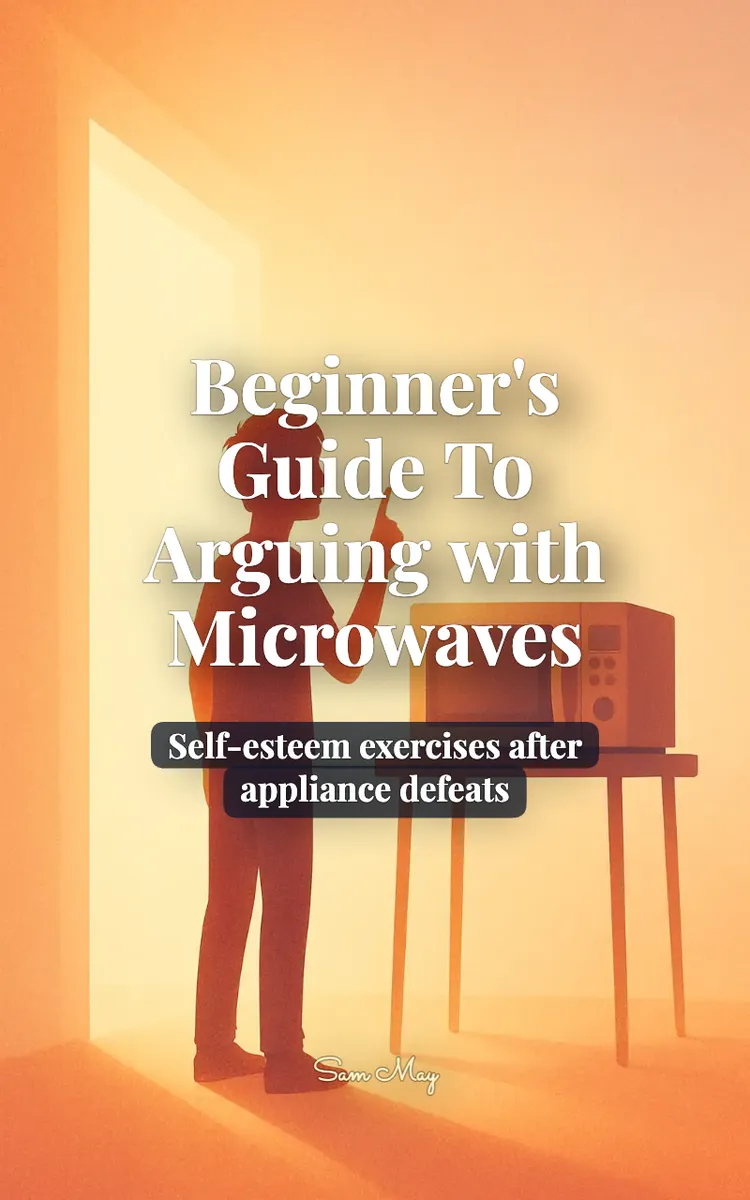
"Beginner's Guide To Arguing with Microwaves" is a self-help book by Sam May with 8 chapters and approximately 11,024 words. Humorous self-help for coping with appliance “disrespect”.
This book was created using Inkfluence AI, an AI-powered book generation platform that helps authors write, design, and publish complete books. It was made with the AI Self-Help Book Writer.
Frequently Asked Questions
What is "Beginner's Guide To Arguing with Microwaves" about?
Humorous self-help for coping with appliance “disrespect”
How many chapters are in "Beginner's Guide To Arguing with Microwaves"?
The book contains 8 chapters and approximately 11,024 words. Topics covered include Stop Confusing Noise With Disrespect, The Six Stages of Appliance Grief, Build Boundaries With the Dishwasher, Break Fridge Gaslighting With Reality Checks, and more.
Who wrote "Beginner's Guide To Arguing with Microwaves"?
This book was written by Sam May and created using Inkfluence AI, an AI book generation platform that helps authors write, design, and publish books.
How can I create a similar self-help book?
You can create your own self-help book using Inkfluence AI. Describe your idea, choose your style, and the AI writes the full book for you. It's free to start.
Write your own self-help book with AI
Describe your idea and Inkfluence writes the whole thing. Free to start.
Start writingCreated with Inkfluence AI


