
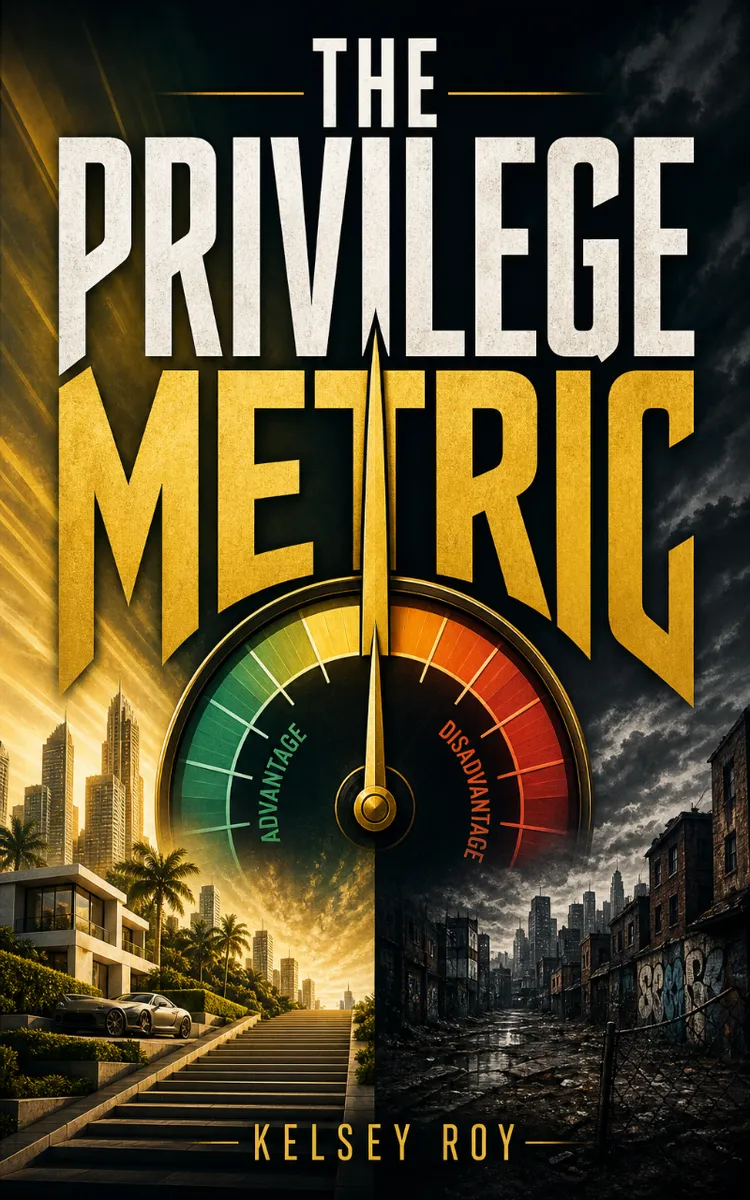
The Privilege Metric
Created with Inkfluence AI
A city’s algorithmic equity app sparks chaos and fraud.
Table of Contents
- 1. Equity Scale Goes Live Tonight
- 2. Priority Housing Reorders the Block
- 3. The Privilege Score Ledger
- 4. A Claimant Performs Marginalization
- 5. James Meets the First Consultant
- 6. The Asset Cloaking Rumor Spreads
- 7. The Rich Man’s Marginalization Test
- 8. Systemic Advantage: The Unseen Lever
- 9. James Chooses Between Clients
- 10. The App Updates Itself Overnight
- 11. The Evidence Wall Breaks James
- 12. The Cross-Examination of Equity Scale
- 13. The Housing Hearing That Exposes Everything
- 14. Manual Triage Still Needs a Human
- 15. Recalibration Day Brings New Deception
Preview: Equity Scale Goes Live Tonight
A short excerpt from “Equity Scale Goes Live Tonight”. The full book contains 15 chapters and 41,445 words.
The first time the Equity Scale app chimed in the downtown City Services Atrium, it was loud enough to ride over the building’s HVAC hum and the constant, anxious shuffle of shoes on polished stone. A woman in a mustard coat flinched, then looked down at her phone like it had spoken her name. Around her, people leaned into their screens, thumbs moving too fast, faces going pale in pockets of color as the numbers crawled into place.
James stood with his legal binder tucked under one arm, the cover already warped from being clutched and reopened in transit. The Atrium’s glass roof turned the late morning into a bright, flat light that made every expression look honest and every lie easy to spot. He’d expected ceremonies, speeches, maybe the mayor’s voice booming from a stage. Instead there were kiosks - white stands with glowing tablets - set up along the perimeter like voting booths, and volunteers in matching shirts trying to explain a system that was still changing its own rules in real time.
His client’s case file was open to the same page he’d been staring at since midnight: a housing placement expiring today, a temporary extension granted under older policy, and a promise from the city that “the transition would be smooth.” Smooth was a word James had learned to distrust in public language, especially when it came from people who never had to wait in lines that swallowed hours.
“Mr. Rivera?” A voice cut through the noise. His name sounded wrong in the Atrium, swallowed by the glass and amplified by panic.
He looked up to find Marisol - his client, small and sharp-eyed, hair pinned back too tight - standing just beyond the rope barrier. Her hands were red from cold or adrenaline; either way, she was shaking. “It says my priority changed,” she said, and the words tumbled after each other like they’d been waiting. “It’s lower than what I got yesterday. Lower means - ” She didn’t finish. She didn’t have to. The app’s purpose was printed on posters outside the building, on banners at transit stops, in the glossy city press releases that had promised fairness in a formula.
James pushed his way closer to the kiosk bank. The screens reflected him back in fragments - his face, the legal papers, the crowd behind him. “Show me,” he said, keeping his voice calm because calm was a tool. He took her phone with his left hand and leaned in, listening as the kiosk speakers crackled with someone else’s guidance.
Marisol’s privilege score sat there like a verdict, the number itself unremarkable until it wasn’t. Beneath it, a breakdown of inputs scrolled too quickly to read all at once. Race. Gender. Sexuality. Disability. Socioeconomic history. Systemic advantage assessment. Each line carried a small icon that looked designed to soothe.
“What did it use?” James asked. “Who calculated your systemic advantage?”
Marisol’s mouth tightened. “I don’t know. It just - shifted. Yesterday it said one thing. Today it’s… it’s like it decided I’m less harmed.”
“Or more capable,” James murmured. The Atrium’s air felt colder the closer he got to the kiosks, as if the building knew people were about to be punished and adjusted the temperature to make it easier to endure. He could hear the frantic tapping from nearby, the staccato of notifications chiming in clusters. Someone laughed too loudly at a screen, then stopped as if the sound had betrayed them.
Behind them, a city staffer pushed a cart of pamphlets forward and then abruptly stopped, eyes fixed on a tablet in her hands. “No, no, the recalculation - ” she began, then her sentence fractured into silence as another alert flashed across her screen.
James leaned closer to Marisol. “Did you authorize any updates?” he asked.
Marisol shook her head. “I haven’t changed anything. I just came here because my placement ends today.”
A man in a suit cut into their orbit without apology. His badge glinted with city branding. “Counselor,” he said, and James recognized the voice from the legal clinic briefings - someone who’d nodded along when the city promised safeguards. “You need to understand the system is dynamic. It corrects based on verified data.”
“Verified by whom?” James asked.
The man’s smile didn’t reach his eyes. “By the city’s sources. By housing records. By benefits history. By - ” He gestured vaguely, a hand moving in the air like it could smooth reality. “By the assessment models.”
Marisol held her phone out again as if it were a wound. “But it’s moving in the wrong direction,” she said. Her voice sharpened. “It’s moving me out.”
The suit staffer looked away to the side, where a group of people were arguing with a kiosk attendant. Their voices rose and fell in a rhythm of accusation and pleading. “Some of the kiosks are lagging,” he said, and James heard the lie in the choice of words. Lagging implied delay, not decision.
James didn’t have time to challenge him into honesty; he had to move....
About this book
"The Privilege Metric" is a fiction book by Kelsey Roy with 15 chapters and approximately 41,445 words. A city’s algorithmic equity app sparks chaos and fraud..
This book was created using Inkfluence AI, an AI-powered book generation platform that helps authors write, design, and publish complete books. It was made with the AI Novel Writer.
Frequently Asked Questions
What is "The Privilege Metric" about?
A city’s algorithmic equity app sparks chaos and fraud.
How many chapters are in "The Privilege Metric"?
The book contains 15 chapters and approximately 41,445 words. Topics covered include Equity Scale Goes Live Tonight, Priority Housing Reorders the Block, The Privilege Score Ledger, A Claimant Performs Marginalization, and more.
Who wrote "The Privilege Metric"?
This book was written by Kelsey Roy and created using Inkfluence AI, an AI book generation platform that helps authors write, design, and publish books.
How can I create a similar fiction book?
You can create your own fiction book using Inkfluence AI. Describe your idea, choose your style, and the AI writes the full book for you. It's free to start.
Write your own fiction book with AI
Describe your idea and Inkfluence writes the whole thing. Free to start.
Start writingCreated with Inkfluence AI


