
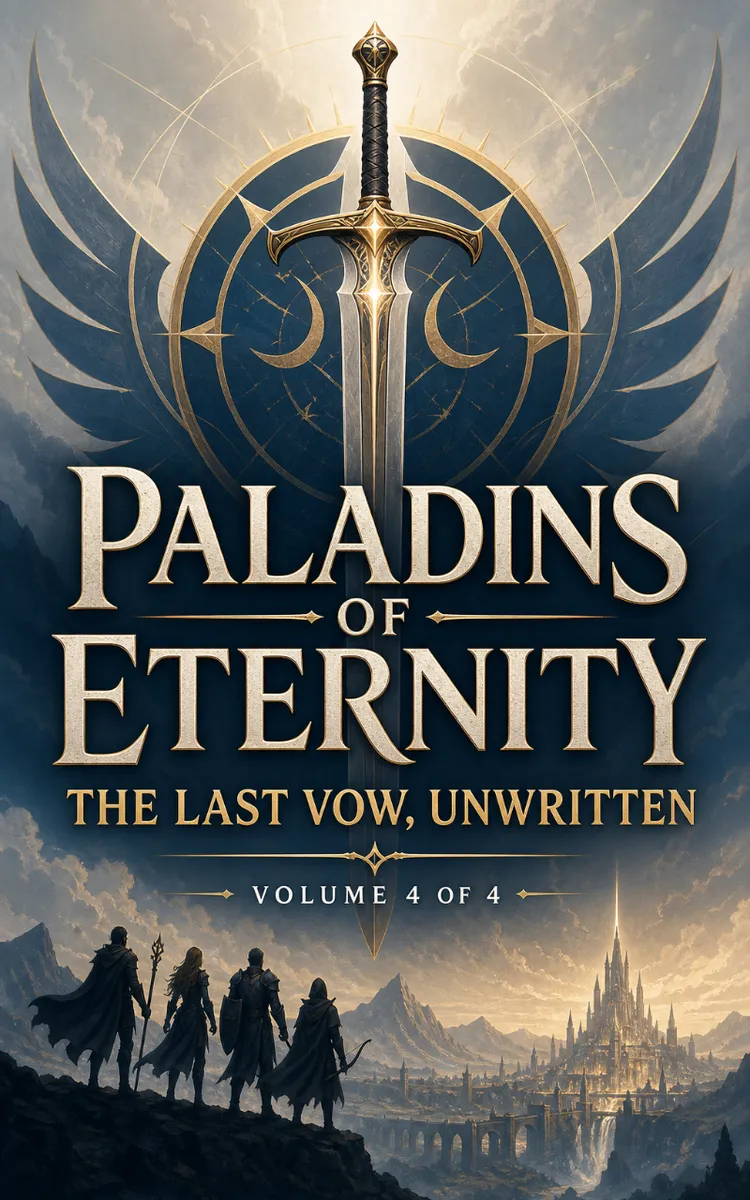
Paladins Of Eternity: The Last Vow, Unwritten
Created with Inkfluence AI
🔀 Remixed from Paladins Of Eternity
With the Sigil Courts unsealed and the cost of unmaking vows already paid, Caldrin Vey must face the final Name-Emptier—where survival depends on choosing what to leave unnamed and what to swear forever.
Table of Contents
- 1. The Unsealing’s Debt Comes Due
- 2. Moonfire in the Court of Borrowed Souls
- 3. The Judge Without a Name Returns
- 4. A Counter-Sigil for the Unsaid
- 5. The Capital’s Silent Bells, Final
- 6. Where the Name-Emptier Sleeps
- 7. The Last Vow, Unwritten
Preview: The Unsealing’s Debt Comes Due
A short excerpt from “The Unsealing’s Debt Comes Due”. The full book contains 7 chapters and 16,717 words.
The Unsealing’s Debt Comes Due
By the time the last of the trial bells faded into the mortar between Caldrin Vey’s stones, Aster Vale had stopped trying to convince his own hands they were still his.
The sigil on his palm was no longer a flare. It sat there like a quiet coal, not burning skin, but burning something behind it - the kind of something that used to have a name.
They had unsealed the courts.
In the story everyone in Caldrin Vey told themselves at night, the unsealing was a door. You knocked, you stepped through, and whatever was trapped inside finally breathed.
In real life, the unsealing was a ledger.
And ledgers, Aster had learned, did not care how politely you asked.
1. Bells in the Wrong Places
They moved out of the court’s under-rooms with the kind of urgency people only get when they are not sure whether the danger is behind them or ahead. The party’s breath came fast. Not because of running. Because of listening.
Caldrin Vey had always had noise. Vendors and carts and the river’s dull talk under bridges. Even the capital’s silences were loud, in their own way, like dust that refused to settle.
But now the city had a new sound threading through it: the soft, wrong note of a bell that didn’t exist.
It wasn’t the trial bells from below. Those were gone. This was smaller. Closer. As if the unsealing had taught the streets a new language and the streets were practicing.
Caldrin Vey’s ledgers were waking too. Aster could feel it in the way ink behaved at shop counters. He saw a clerk pause with his quill hovering above a page, staring as though a word had suddenly become visible in the air.
When the clerk finally moved, he scratched his next line with a furious steadiness, as if he was paying off a debt before anyone noticed he owed it.
“They didn’t just open,” Aster said. His voice sounded too thin for his mouth.
“No,” said Caldrin Vey’s oath-keeper, the one who had carried the city’s borrowed promises through three volumes of trouble and two near-misses with death. “They balanced something. And balance always demands a correction.”
He didn’t say what correction. He didn’t have to.
Balance meant there had been an imbalance before. Balance meant the courts had taken notice. Balance meant the courts had written down what was owed, then waited for the ink to dry enough to collect.
As they passed a narrow alley where a name-emptier used to slip away unseen, Aster caught sight of a ledger chained to a wall. It wasn’t the court’s style. It was a local household book, the sort most people never thought to fear.
Yet the chain shivered as if something inside wanted out.
One page turned by itself.
Aster saw a line of text, darkening as it formed. Not letters exactly. More like the idea of letters, the shape of an obligation sharpening into meaning.
Then the page stopped.
The clerk at the nearest door gasped. He didn’t notice Aster. He noticed the ledger, and his face did something Aster recognized from earlier betrayals.
It tightened around a vow he hadn’t spoken in years.
“I never wrote that,” the clerk muttered.
“You didn’t have to,” the oath-keeper answered, as if he’d heard the same lie in a dozen different mouths. “Someone wrote it for you. The courts can do that now.”
Aster wanted to argue that the courts were supposed to be just. He wanted to say justice meant fairness.
But he’d watched the judge who wore no name, and he’d watched how the unsealing costs a vow. He had seen living promises turned into court language, forced to hold still long enough to be counted.
Justice, he was learning, was not the same thing as mercy.
2. Streets Become Pages
They didn’t go far before the city proved the point.
At the corner of a market lane, a woman argued with a baker. The baker insisted he had delivered flour on time. The woman insisted she had received it late, and late meant spoilage, and spoilage meant a week’s wages lost.
It was a familiar kind of argument. Caldrin Vey ran on arguments. Most of them were just heat between people trying not to admit they were afraid.
But this one had a new edge. The air between them felt weighted, like paper held flat by a press.
Aster stepped closer and saw that the baker’s ledger sat open, pages fluttering without wind.
When the woman spoke, her words aligned with the ink, like her voice was feeding the page.
“I gave my word,” she said, and her tone cracked. “I swore I would not let my children go hungry. I swear it now.”
The ledger responded.
Ink crawled across a blank margin. A vow, plain as day, formed from nothing.
Aster felt his stomach drop.
That wasn’t just recording. It was creating.
The courts had unsealed, and with them came a method: the city’s promises were becoming legible. If you had pledged something once, the courts could find the shape of it in you, then write it down where the city could collect.
“If they can write vows,” Aster said, “then someone can be forced into one without knowing.”
...
About this book
"Paladins Of Eternity: The Last Vow, Unwritten" is a fiction book by Mark Gibson with 7 chapters and approximately 16,717 words. With the Sigil Courts unsealed and the cost of unmaking vows already paid, Caldrin Vey must face the final Name-Emptier—where survival depends on choosing what to leave unnamed and what to swear forever..
This book was created using Inkfluence AI, an AI-powered book generation platform that helps authors write, design, and publish complete books. It was made with the AI Novel Writer.
Frequently Asked Questions
What is "Paladins Of Eternity: The Last Vow, Unwritten" about?
With the Sigil Courts unsealed and the cost of unmaking vows already paid, Caldrin Vey must face the final Name-Emptier—where survival depends on choosing what to leave unnamed and what to swear forever.
How many chapters are in "Paladins Of Eternity: The Last Vow, Unwritten"?
The book contains 7 chapters and approximately 16,717 words. Topics covered include The Unsealing’s Debt Comes Due, Moonfire in the Court of Borrowed Souls, The Judge Without a Name Returns, A Counter-Sigil for the Unsaid, and more.
Who wrote "Paladins Of Eternity: The Last Vow, Unwritten"?
This book was written by Mark Gibson and created using Inkfluence AI, an AI book generation platform that helps authors write, design, and publish books.
How can I create a similar fiction book?
You can create your own fiction book using Inkfluence AI. Describe your idea, choose your style, and the AI writes the full book for you. It's free to start.
Write your own fiction book with AI
Describe your idea and Inkfluence writes the whole thing. Free to start.
Start writingCreated with Inkfluence AI


