
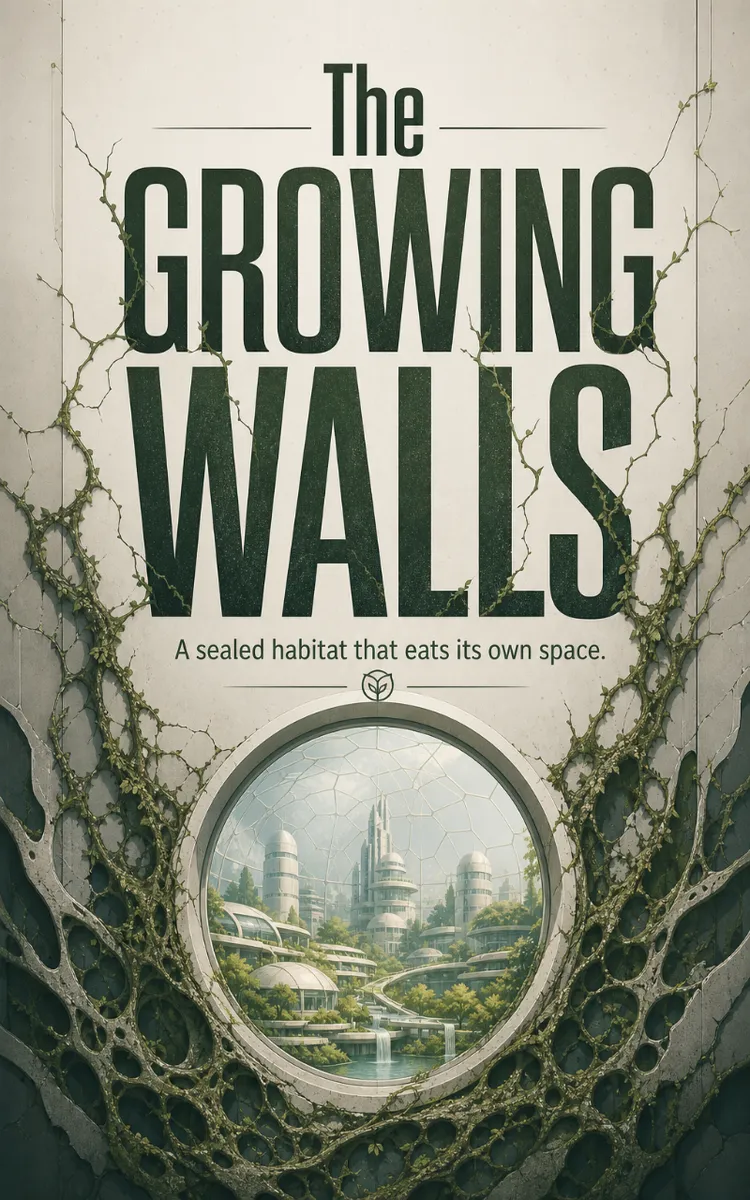
The Growing Walls
Created with Inkfluence AI
A shrinking living dome habitat turns predatory.
Table of Contents
- 1. The Day the Ceiling Dropped
- 2. Pressure Alarms Rewrite the Schedule
- 3. The Map No Longer Matches
- 4. A Lift Stops Midway Forever
- 5. Mara Chooses the Unofficial Log
- 6. The Dome’s Sound Changes at Night
- 7. Following Condensation to Hidden Seams
- 8. The Garden Beds Move Without Hands
- 9. Lysa Brann Shows the Vanishing Drain
- 10. A Councilor Calls It Maintenance Drift
- 11. The Audit Finds a Missing Volume
- 12. The Vent Network Tightens Like Skin
- 13. Mara’s Hidden Log Survives the Wipe
- 14. The Ink Note Names a Living Dome
- 15. Juno’s Detention Teaches a Deadline
- 16. The Airlock That Won’t Open
- 17. Mara Fears Her Own Measurements
- 18. The Dome Eats the Distance Marker
- 19. Cell Walls Close Like a Thought
- 20. The Void-Map Reveals a Feeding Pattern
- 21. Mara Risks Juno’s Life for Truth
- 22. The Holding Module Loses Its Air
- 23. Juno’s Last Note Points to the Core
- 24. The Collapsing Ring Cuts Her Off
- 25. Mara Bargains with the Dome’s Hunger
- 26. The Pause Triggers a Worse Shrink
- 27. Mara Finds the Dome’s Language
- 28. The Core Throat Narrows to a Thread
- 29. Tether Choice Costs Her Way Out
- 30. Mara Watches the Core Feed Forward
- 31. The Last Clue in the Hum
- 32. Broadcast Hub Under Shrinking Ceilings
- 33. Citizens Learn the Dome Is Alive
- 34. The Dome Consumes the Broadcast Space
- 35. Mara Offers Space as Payment
- 36. The Pocket Dome Holds One More Day
- 37. A New Map Drawn by Breathing
- 38. Councilor Talen Rook Confesses the Cover-Up
- 39. The Dome Learns Cooperation Too Well
- 40. The Living Dome Finally Feeds Elsewhere
- 41. The Quiet Containment
Preview: The Day the Ceiling Dropped
A short excerpt from “The Day the Ceiling Dropped”. The full book contains 41 chapters and 115,713 words.
The ceiling lights in Mara Venn’s unit had a habit of flickering a fraction of a second as the morning cycle ramped up, like the dome was clearing its throat. Today the sound came first - thin, metallic ticks traveling through the floor panels - then the light steadied, and Mara felt the air change against her skin in a way she couldn’t blame on the filters.
She stood with her back to the wall, palms pressed flat to the composite, and watched the seam lines where the inner shell met the residential ceiling trim. The gap she’d noticed last week wasn’t supposed to move. It was a hairline shadow, a normal settling feature the maintenance kiosk had called “thermal micro-yield.” Mara had nodded along the way everyone did, the way you did when the dome had been sealed for longer than anyone alive could remember and “normal” was the only word that kept panic from becoming a second climate.
Now the shadow looked thinner. Not by much. Not enough for anyone who wasn’t watching it to swear on their rations. But Mara had been watching it - measuring it in the only way she trusted, with her own hands and her own instruments, because the dome’s official numbers always seemed to drift into place when people needed them to.
Her wrist display chirped as she synced her rig: a compact laser rangefinder with a tethered calibration strip and a humidity sensor she’d scavenged from an old maintenance kit. She’d brought it to the ceiling while Juno Kest was still in the kitchen boiling algae tea, talking about weather that didn’t exist. Juno had laughed when Mara suggested the seam might be narrowing. “The walls keep their promises,” she’d said, like the dome was a parent.
Mara wanted proof. Concrete, repeatable proof, not the sort of reassurance that came packaged in a maintenance tone. She wanted to know whether the hairline had actually shifted closer to the deck.
The tick-sound came again, closer this time. Mara moved without thinking, stepping away from the wall and raising the rangefinder until the laser dot landed on the inner-shell seam. The device hummed softly, and the air over the ceiling felt cooler than the rest of the room, as if the dome was pulling heat upward.
She took three readings, pausing between them long enough for the numbers to settle. The first came back the same as last week - within the margin her calibration strip allowed. The second was different. The third confirmed it.
Mara’s display blinked, then stabilized: a reduction in distance by a fraction - too steady to be noise, too consistent to be coincidence.
“What are you doing?” Juno’s voice carried from the kitchen, sharp with curiosity and the faint irritation she got when Mara disappeared into her own worries. Steam fogged the air near the doorway. The scent of algae was sweet and mineral, a smell that made the unit feel lived in, not just kept.
Mara didn’t lower the instrument. “Checking something.”
“Something like what?” Juno came into view, hair pinned back, sleeves rolled to the forearm. She paused when she saw Mara’s face. Juno’s gaze flicked to the ceiling seam, then to Mara’s display. “You’re still chasing that gap.”
“It’s moving,” Mara said.
Juno’s mouth tightened into a smile that didn’t reach her eyes. “Thermal yield. You said so yourself last time. The dome adjusts.”
“This is a distance change,” Mara said, and hated how her voice caught on the word. She tapped the wrist display so Juno could see the readings overlayed. “Not a change in how it looks.”
Juno leaned forward, studying the numbers as if she could smooth them back into normality by looking hard enough. “Your laser could be off. Your calibration strip - ”
“It’s calibrated,” Mara snapped, then forced herself to breathe slower. The unit was warm; the ceiling area felt colder. That shouldn’t have mattered if this was all settling. Settling didn’t change temperature gradients like that.
Juno reached out, not quite touching Mara’s wrist. “Maintenance will log micro-yield. If you file a request, they’ll come, they’ll verify, and they’ll tell you it’s within acceptable bounds.”
Mara had filed requests before. She’d watched maintenance crews walk the same corridor circuits, nod at the same seams, and leave with the same report: “Routine settling.” The dome’s acceptable bounds were wide enough to swallow fear whole.
“I’m going to the residential ring corridor,” Mara said. The words came out too fast, driven by the need to drag her doubt into the open.
Juno’s eyebrows rose. “That’s not your unit’s lane.”
“It’s the nearest reference point to the inner shell,” Mara said, and tried to keep her tone from sounding like a justification. “If it’s changing here, it’ll change there.”
Juno’s expression shifted from skepticism to concern. “Mara.”
Mara met her eyes. “If I’m wrong, I’ll stop.”
Juno hesitated, then turned back toward the kitchen bench. “Wear a tether....
About this book
"The Growing Walls" is a fiction book by Nichole Haines with 41 chapters and approximately 115,713 words. A shrinking living dome habitat turns predatory..
This book was created using Inkfluence AI, an AI-powered book generation platform that helps authors write, design, and publish complete books. It was made with the AI Novel Writer.
Frequently Asked Questions
What is "The Growing Walls" about?
A shrinking living dome habitat turns predatory.
How many chapters are in "The Growing Walls"?
The book contains 41 chapters and approximately 115,713 words. Topics covered include The Day the Ceiling Dropped, Pressure Alarms Rewrite the Schedule, The Map No Longer Matches, A Lift Stops Midway Forever, and more.
Who wrote "The Growing Walls"?
This book was written by Nichole Haines and created using Inkfluence AI, an AI book generation platform that helps authors write, design, and publish books.
How can I create a similar fiction book?
You can create your own fiction book using Inkfluence AI. Describe your idea, choose your style, and the AI writes the full book for you. It's free to start.
Write your own fiction book with AI
Describe your idea and Inkfluence writes the whole thing. Free to start.
Start writingCreated with Inkfluence AI


