
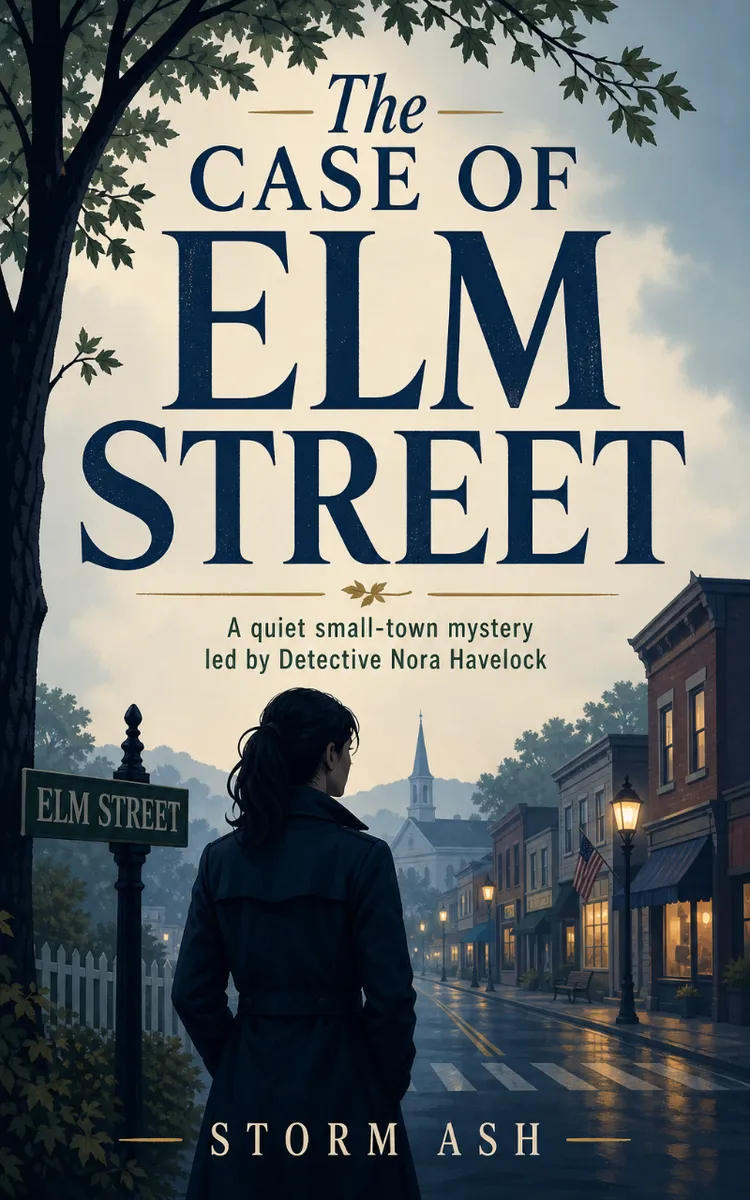

Read the first chapter
The whole of chapter one, free. About 10 min. Turn the pages with the arrows, your keyboard, or a swipe.
Chapter 1
The Body on Elm Street
Rain had stopped an hour ago, but Elm Street still shone as if it had been freshly laid - blacktop slick, curb stones dark with moisture, the air holding the cold bite of wet leaves. Detective Nora Havelock stood at the edge of the taped - off street with her coat collar turned up, listening to the low irregular murmur of the town beyond the police tape. Somewhere a porch light clicked on and off, like it couldn’t decide whether darkness was safer.
The body lay halfway down the lane, on its side near a ditch that ran behind the last row of modest houses. It was the kind of sight that made people speak too quickly and breathe too loudly, as if volume could replace understanding. Nora didn’t raise her voice. She didn’t hurry. She stepped around the nearest puddle, careful of her own footprint and looked first at the ground beneath the victim’s boots - mud patterns, disturbed gravel, the direction water had carved since the rain.
A uniformed officer - broad shoulders, young face, hands that kept moving to his belt as if he could tighten the situation - approached with a clipboard. “Detective Havelock. They said the call came from-” He glanced toward the nearest house, where curtains were still half drawn. “From Mrs. Latham. She saw something around midnight.”
Nora held her gaze on the ditch. “What did she say she saw?”
The officer blinked, then flipped a page. “She said she heard a car. Then she saw a light move across her yard. Like headlights passing slow, then stopping. After that she-” He hesitated, and Nora could hear it in the pause. “She said she thought it was just someone turning around.”
“Midnight,” Nora repeated, letting the word settle. She crouched, not to touch, but to see. The victim’s jacket was damp at the cuffs, heavier where water had collected. One sleeve lay twisted, the fabric pulled against the body’s weight as though he’d been repositioned after he fell. Her eyes tracked the seam where the jacket met the shirt. There was no obvious blood spray on the ditch edge, no wide smear in the mud that would match the fall people always described in their panic.
A man in a suit approached from the opposite end of the tape, his tie too neat for this weather. “Detective Havelock. I’m Sheriff Greaves.” He sounded tired, not theatrical. “We’ve got patrols out and I’ve got the first statements on paper.”
Nora stood, slow enough that the movement didn’t invite questions. “Statements can wait. Who’s been in the lane besides us?”
“Just her,” the sheriff said, jerking his chin toward the nearest house. “Mrs. Latham. And her grandson, I think. He lives with her. He’s shaken up.”
Nora’s attention flicked to the sheriff’s boots. Dry soles, clean laces. He’d come from somewhere inside. “And the EMTs?”
“Arrived fast,” Greaves said. “They confirmed. I told them not to disturb anything.”
Nora looked past him to the officer again. “Who told you to confirm that the scene hadn’t been disturbed?”
The officer’s throat bobbed. “I-Sheriff, I-”
Greaves lifted a hand, cutting in. “The EMT lead said they didn’t move the body.”
Nora nodded once. “Good. Keep everyone else out. I want a perimeter that holds, not one that flexes.”
Greaves didn’t look offended. He looked relieved to have someone else holding the thread. “All right. What are you seeing?”
Nora turned her head just enough to catch the sheriff’s face while keeping her eyes on the ditch. “I’m seeing a place where people expect to find something they’re not finding.”
Silence followed her words, the kind that made the rain stop feel louder. Somewhere down the lane, a dog barked once, then stopped, as if it had been told to be quiet.
The sheriff’s gaze dropped to the body. “You mean the lack of blood?”
“I mean the story people are telling themselves,” Nora said. She walked toward the victim’s boots, stopping at the edge of a disturbed patch in the grass where something had been dragged lightly, not dragged hard. There was a faint line of flattened clover that ran toward the ditch and then stopped. Like whoever moved him had reached a boundary they didn’t want to cross, or like the motion had started and stopped with a decision.
A sound came from the taped area: the soft crackle of a radio, then a voice. “We’ve got her coming in.”
Mrs. Latham arrived with a scarf pulled tight around her throat, the fabric dark with damp. She moved like her bones were making apologies for each step. Her eyes found Nora immediately and clung there, as if the detective’s youth could be a shield or a weakness.
Nora lifted her hand, palm outward not a greeting, not a comfort, just a boundary. “Mrs. Latham. Thank you for calling.”
Mrs. Latham swallowed. “I didn’t want to-” Her voice caught on the sentence and refused to slide forward. “I didn’t want to make trouble.”
“You made a call,” Nora said gently, the way she might set a glass down without making it clink. “Now I need you to tell me exactly what you noticed.”
Mrs. Latham stared at the tape for a moment, then past it toward the body. “I heard the car. Not like someone pulling up to a driveway. More like it was… circling. Slow. The headlights came over my fence and then off again. I looked because the light made the curtains bright. I thought someone was lost.”
“What kind of car?” Nora asked.
“A sedan,” Mrs. Latham said quickly, then corrected herself as if speed had made her careless. “I think. Gray. But it was dark, and the rain-” She squeezed her scarf. “It could’ve been any color. I only know it wasn’t a truck.”
“And when the light moved across your yard,” Nora said, “did it move straight across, or did it pause?”
Mrs. Latham hesitated. “It paused.”
Nora didn’t change her expression. She only adjusted her stance, shifting her weight so she could see the pattern of the ditch from a slightly different angle. “How long?”
“Maybe… a minute.” Mrs. Latham’s brow creased hard. “No, less. I wasn’t watching a clock. It felt like someone was deciding whether to stop.”
Nora’s eyes returned to the flattened clover line. A decision. A pause. The words fit too neatly. She let the thought sit without showing it.
The sheriff moved closer, lowering his voice. “Detective Havelock, are you thinking the car stopped before-”
“I’m thinking the pause meant something,” Nora said. She turned to Mrs. Latham. “At any point did you hear a door open? A voice? Anything besides the engine?”
Mrs. Latham’s mouth tightened. “No. Just the engine. Then it turned off. I heard… quiet. Like the street went dead.”
Nora studied her face. Fear made people embellish, but it also made them forget details. Mrs. Latham wasn’t embellishing. She was gripping what she had because she couldn’t afford to lose it.
“What time did you look out?” Nora asked.
“Just after midnight.” Mrs. Latham’s eyes darted. “I woke up. I couldn’t sleep. The dog was restless.”
Nora nodded slowly. “All right.”
The next complication arrived in the form of footsteps that shouldn’t have been inside the tape. A different officer older, brisk-strode up with a flashlight in his hand, already impatient. “Detective. We found something in Mrs. Latham’s yard. A phone. Back there by the lilacs.”
Nora’s head turned sharply. “A phone?”
The officer nodded. “It’s cracked. No one reported missing one. We brought it up so you could-”
Nora stepped forward before the sheriff could say anything. “Don’t touch it. Let me see it.”
The officer held it out, and Nora stopped just short of taking it directly. She looked at it without handling it. Glass spiderwebbed across the screen, the case scuffed, the camera lens clouded. The cracks were fresh enough that the edges looked sharp, not dulled by time.
“Whose phone is it?” Nora asked.
The officer shook his head. “It’s got a wallpaper photo, but it-” He tilted the phone slightly. “It won’t load.”
Nora stared at the blank screen, then at the faint smear on the case edge where fingers might have gripped it. She could see a thin line of dark residue in the seam. Soil mixed with something that wasn’t only dirt. Her mind moved quickly, not into panic, but into order.
“Mrs. Latham,” Nora said, keeping her voice level, “has anyone in your house lost a phone recently?”
Mrs. Latham’s eyes widened. “No. Not-” She looked toward the lilacs as if the bushes had betrayed her. “My grandson keeps his in his pocket. He doesn’t leave it out.”
“What’s your grandson’s name?” Nora asked.
“Evan,” Mrs. Latham said. “Evan Latham.”
The sheriff’s expression tightened. “We haven’t spoken to him yet.”
Nora didn’t look away from the cracked phone. “Then we will.”
The older officer cleared his throat. “Detective, it might be evidence, but it’s not on the body, so...”
“So what?” Nora asked there was no anger in it. Only a calm insistence. “So it doesn’t matter until it does?”
The officer shifted his weight. “I’m just saying.”
Nora finally took the phone with gloved hands, careful not to wipe away anything she might need later. The cold plastic bit at the tips of her fingers. She turned it over, and the back case caught a faint glint. Metallic paint flecked along the corner, the kind that didn’t belong in a yard.
Sheriff Greaves watched her face. “What does it tell you?”
After placing the phone in an evidence bag and into her pocket, Nora’s eyes lifted to the ditch again. “It tells me the scene isn’t as clean as people want it to be. Something went from here to there. And someone decided it was better to drop it than to carry it.”
Nora’s mind clicked into place with the same quiet certainty she’d used to line up details at every other scene she’d been handed. The paused headlights. The quiet after. The lack of blood where a fall should have left more. A phone dropped not by accident, not in the middle of a panic. Placed, maybe, with care.
The decision came from the evidence, not from emotion. Nora moved before anyone could argue her pace. She turned to the older officer. “Walk the yard with me. Find where it came from. Start at the ditch and follow the flattened clover.”
The sheriff shifted beside Nora, but he didn’t interrupt. He’d learned recently that, Nora’s calm wasn’t permission it was control.
The officer blinked. “Now?”
“Now,” Nora said, and the word landed like a stamp.
As they stepped under the damp branches of Mrs. Latham’s yard, Nora listened to the small sounds that mattered: the soft scrape of her shoe on gravel, the distant hum of a car idling somewhere out of sight. The air smelling of wet earth and lilac stems bruised by cold.
She stopped at the exact point where the flattened clover line met the edge of the yard. There the grass was not just pressed, it was disturbed in a way that suggested weight had shifted, then lifted. A dragged object leaving a faint trail, then being set down out of view.
Nora crouched, keeping her gloved hands off the ground. She looked at the soil color, the tiny smear where dirt had been rubbed into the edge of something hard. The residue on the phone case wasn’t only soil. It was the dark grit of a road shoulder mixed with the pale fleck of paint. Something that had come from metal and then been carried into a yard.
The sheriff’s voice came from farther back. “Detective Havelock, we found tire tracks at the end of the street.”
Nora turned her head toward the direction of the sound. Tire tracks. A car. A pause. A phone dropped into a yard that didn’t make sense unless someone wanted it found later, or wanted it found by someone specific.
She looked once more at the ditch, at the clean lack of blood, at the flattened clover line that ended too neatly. The quiet of the town pressed in around her, the way small places did when they were trying not to admit they’d changed.
Nora straightened her coat and stepped back toward the tape, her mind already placing the pieces where they resisted being placed. The body on Elm Street had been found, and the town had offered its first story in exchange for relief.
End of chapter one. 6 more chapters in the full book.
Swipe or use the arrows to turn the page
What's inside: 7 chapters
- 1. The Body on Elm Street
- 2. Quiet Questions, Loud Contradictions
- 3. Patterns in Plain Sight
- 4. When Clues Turn Into Evidence
- 5. The Witness Who Wouldn’t Speak
- 6. Havelock’s Calm Calculated Trap
- 7. The Quiet Case Solved
About this book
"The Case Of Elm Street" is a fiction book by Storm Ash with 7 chapters and approximately 19,221 words. A young detective solves a murder in a small town.
This book was created using Inkfluence AI, an AI-powered book generation platform that helps authors write, design, and publish complete books. It was made with the AI Novel Writer.
Frequently Asked Questions
What is "The Case Of Elm Street" about?
A young detective solves a murder in a small town
How many chapters are in "The Case Of Elm Street"?
The book contains 7 chapters and approximately 19,221 words. Topics covered include The Body on Elm Street, Quiet Questions, Loud Contradictions, Patterns in Plain Sight, When Clues Turn Into Evidence, and more.
Who wrote "The Case Of Elm Street"?
This book was written by Storm Ash and created using Inkfluence AI, an AI book generation platform that helps authors write, design, and publish books.
How can I create a similar fiction book?
You can create your own fiction book using Inkfluence AI. Describe your idea, choose your style, and the AI writes the full book for you. It's free to start.
Write your own fiction book with AI
Describe your idea and Inkfluence writes the whole thing. Free to start.
Start writingCreated with Inkfluence AI


