
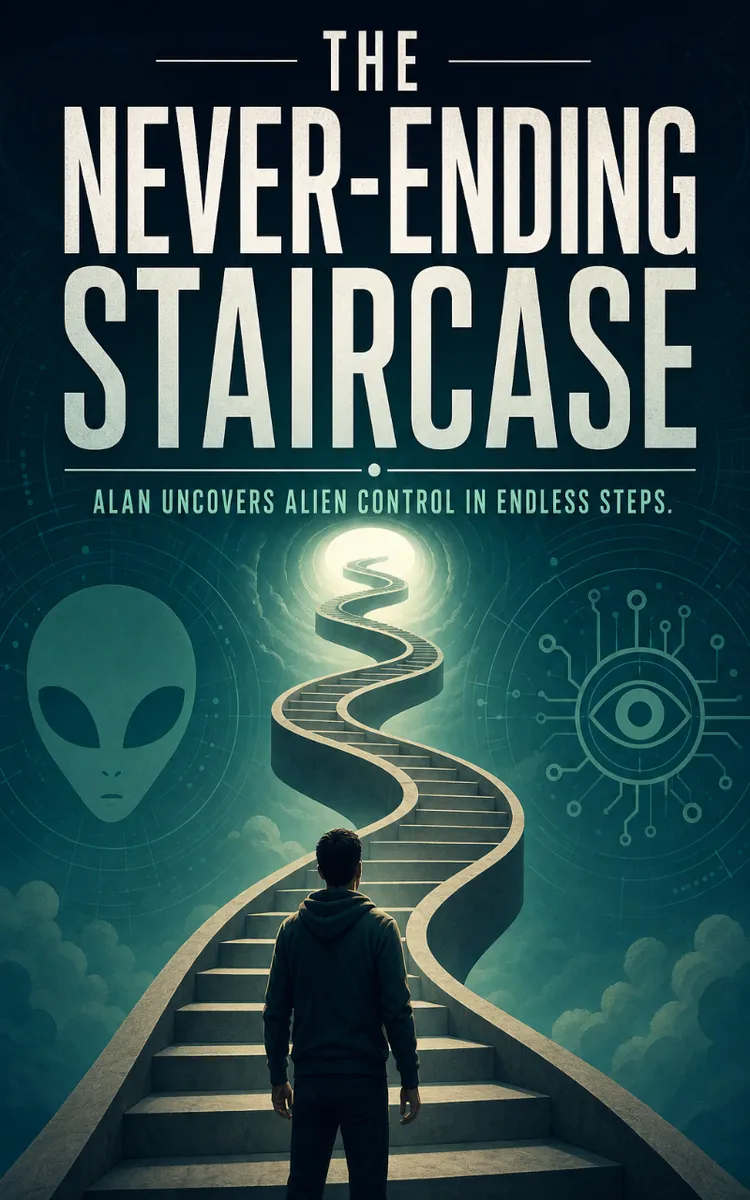
The Never-Ending Staircase
Created with Inkfluence AI
Science fiction thriller about an endless staircase controlled by aliens
Table of Contents
- 1. First Step Into Infinite Stone
- 2. The Stair’s Hidden Control Glyphs
- 3. Why the Echoes Answer in Code
- 4. The Landing That Refuses Gravity
- 5. Alan’s Memory Split by Stair-Phantoms
- 6. The Map That Burns When Read
- 7. Following the Wrong Footprint Trail
- 8. The Stairway Turns Into a Maze
- 9. Alan Chooses to Trust the Aliens
- 10. The Signal That Calls Another Alan
- 11. The Alien Language Hides in Wear
- 12. A Door Appears Where No Wall Exists
- 13. Alan’s Bargain Turns Into a Countdown
- 14. The Ally Who Isn’t on Any List
- 15. The Staircase’s Favorite Lie
- 16. Alan Breaks the Stair’s Rhythm
- 17. The Choice to Forget Again
- 18. The Override That Opens a Prison
- 19. Alan Learns the Aliens’ Real Objective
- 20. The Staircase’s Origin Story in Fragments
- 21. Alan Refuses the Prewritten Path
- 22. The Drone Uprising That Doesn’t Kill
- 23. The Core’s Message in Alan’s Voice
- 24. A Staircase Loop With No Exit
- 25. Alan’s New Mark Opens a Hidden Stair
- 26. The Recorded Choices That Aren’t His
- 27. Alan Sends the Counter-Signal Wrong
- 28. The Aliens Take Alan’s Body
- 29. The Summit Door Opens to a Lie
- 30. Alan Breaks Under the Weight of Forever
- 31. The Prompt Demands a Truth Only Alan Has
- 32. The Nested Steps Collapse Into a Corridor
- 33. Alan Confronts the Alien Pilot in Silence
- 34. The Equation Requires Alan’s Last Memory
- 35. The Staircase Finally Stops Moving
- 36. Alan Chooses to Live Without Proof
- 37. The Warning Reaches a Stranger Named Cora
- 38. Cora’s Staircase Shows Alan’s Missing Choice
- 39. The Aliens Offer Alan a Second Life
- 40. Alan Writes the Final Step Forward
- 41. The Final Turn
Preview: First Step Into Infinite Stone
A short excerpt from “First Step Into Infinite Stone”. The full book contains 41 chapters and 108,051 words.
Alan Mercer had been running for so long that his lungs forgot the difference between pace and panic. The last thing he remembered clearly was the ruined plaza - stone blocks split like old teeth, statues reduced to blank silhouettes, puddles reflecting a sky the color of bruised metal. Now the only sky he could see was a strip of fog above a staircase that rose from the center of the broken square like a wound that refused to close.
He pressed his palm to the first step and felt the wrongness immediately: cold stone that didn’t belong to any season, smooth where it should have been chipped, and threaded with faint grooves that caught the dim light. Sound traveled strangely here. His footsteps didn’t echo; they returned with a delay, as if the air itself had to think about carrying his weight.
Behind him, the plaza made its last offer of safety. Dust slid off a collapsed archway, and something in the fog answered with a low, mechanical vibration. Alan whirled, raising his compact tool - half scanner, half pry-bar - more out of habit than hope, and found nothing but mist. The vibration deepened anyway, like a signal tightening.
The staircase beckoned with geometry instead of comfort. It didn’t simply climb; it kept going. The top vanished into the fog, and the fog looked too uniform to be weather. It moved in slow gradients, as if stirred by invisible rotors. Alan swallowed grit from his teeth and forced himself to step forward.
The goal was simple and sharp enough to cut through fear: get to the top before whatever had been tracking him decided he’d become interesting. He didn’t know how to fight aliens in any honest way, but he knew this - ruins didn’t usually grow new stairs, and fog didn’t usually wait for footsteps. If the staircase led somewhere, it wasn’t going to give him time to figure out why.
He started climbing.
The first few steps were almost normal, if “normal” meant a surface too clean to be ancient. His boots scraped lightly on the stone, producing a steady cadence that felt swallowed by the mist. With each rise, the plaza behind him shrank until it was just a rectangle of rubble framed by fog. Alan tried to keep his breaths quiet, counting without meaning to - three steps, breathe in; two steps, breathe out - until the rhythm snagged on something he couldn’t ignore.
On the side of the fourth step, a thin line of etched marks caught his light. They weren’t random scratches. They had spacing. Angles. A pattern that made his eyes want to follow it the way a finger follows raised braille. Alan crouched mid-climb, one hand on the step, and angled his scanner toward the etching.
The display flickered. Not with static, but with interference - numbers bending, then snapping back into place as though something out of view was correcting the signal. A faint tone rose from his scanner speaker, low and almost musical, and then cut off.
Alan straightened too fast. His shoulder clipped the next riser, and pain flared hot through muscle that had already been bruised by running. “Okay,” he muttered, voice rough. “So it’s not just a staircase.”
The fog ahead pulsed, not visually but through vibration in the bones of the steps. Alan felt it in his jaw. He imagined something listening to his movement, measuring it, translating it into coordinates. The thought made his stomach pitch.
He tried another approach - moving faster, brute force, no time for curiosity. He took longer strides, grabbing the edges where the stone met the riser, using the tool to steady himself when the texture turned slick. His hands came away faintly dusted, and the dust smelled like burned metal.
Then the staircase changed.
It wasn’t dramatic at first. Alan reached for the next step and found his foot landing a fraction of a second later than it should have. His weight shifted, but the stone under him didn’t seem to have committed to being there. He stumbled, caught himself against the wall-like curve of the stairwell, and looked down.
The steps behind him were still there, still climbing away, but the count was wrong. He’d passed the etched mark on the fourth step, and yet when he glanced back, it had moved. Not physically - his eyes saw the same groove - but its position relative to his current stance had shifted, as if the staircase had rewritten his reference frame while he wasn’t watching.
“Don’t do that,” Alan said, to no one. The fog answered with another low vibration, louder now, like a distant speaker turning up.
He forced himself forward again, climbing with his eyes mostly on the stone. The etched marks multiplied the farther he went: thin glyphs in repeating sequences, each one half-hidden in grooves, each one angled just enough to make them feel like a message written for something that didn’t walk on two legs.
The scanner in his palm warmed. Not from battery heat - from something else. Heat without source....
About this book
"The Never-Ending Staircase" is a fiction book by Nichole Haines with 41 chapters and approximately 108,051 words. Science fiction thriller about an endless staircase controlled by aliens.
This book was created using Inkfluence AI, an AI-powered book generation platform that helps authors write, design, and publish complete books. It was made with the AI Novel Writer.
Frequently Asked Questions
What is "The Never-Ending Staircase" about?
Science fiction thriller about an endless staircase controlled by aliens
How many chapters are in "The Never-Ending Staircase"?
The book contains 41 chapters and approximately 108,051 words. Topics covered include First Step Into Infinite Stone, The Stair’s Hidden Control Glyphs, Why the Echoes Answer in Code, The Landing That Refuses Gravity, and more.
Who wrote "The Never-Ending Staircase"?
This book was written by Nichole Haines and created using Inkfluence AI, an AI book generation platform that helps authors write, design, and publish books.
How can I create a similar fiction book?
You can create your own fiction book using Inkfluence AI. Describe your idea, choose your style, and the AI writes the full book for you. It's free to start.
Write your own fiction book with AI
Describe your idea and Inkfluence writes the whole thing. Free to start.
Start writingCreated with Inkfluence AI


