
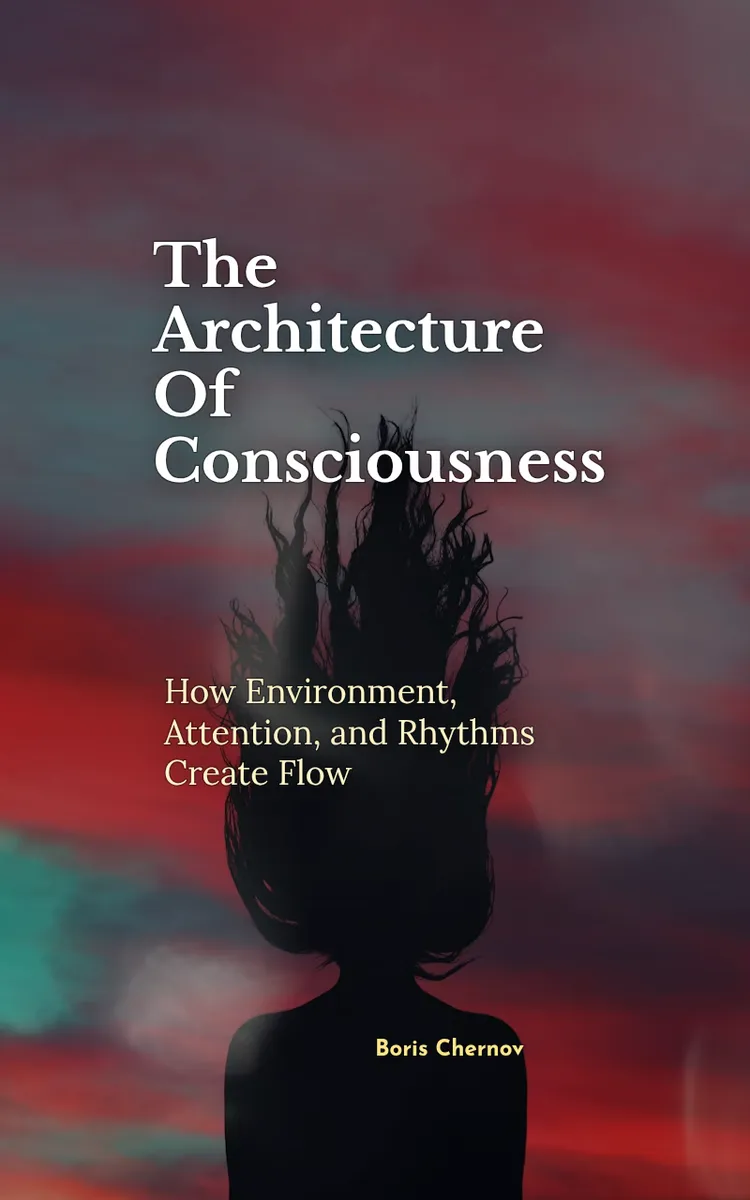

Exploratory model of consciousness shaped by environment, attention, and rhythms
Table of Contents
- 1. The Moment Consciousness Becomes
- 2. Environment Is an Active Ingredient
- 3. Coordination Spaces You Can Feel
- 4. Entities That Keep Their Shape
- 5. Attention as Conductivity Redistribution
- 6. Rhythms, Pauses, and Coordination Fields
- 7. Flow JSON and the Art of Recoverability
Preview: The Moment Consciousness Becomes
A short excerpt from “The Moment Consciousness Becomes”. The full book contains 7 chapters and 12,894 words.
Table of Contents
- Introduction - The Architecture Behind the Experience
- Chapter 1 - The Moment Consciousness Becomes
- Chapter 2 - Environment as an Active Condition
- Chapter 3 - Coordination Spaces and the Shape of “Us”
- Chapter 4 - Attention as Redistribution of Conductivity
- Chapter 5 - Rhythms, Pauses, and Synchronization
- Chapter 6 - Coordination Fields and the Trace That Remembers
- Chapter 7 - Recoverability Over Retention: Why Memory Feels Different Than It Looks
- Conclusion - The Long Cycle That Never Fully Closes
---
The Architecture Of Consciousness
How Environment, Attention, and Rhythms Create Flow
Introduction - The Architecture Behind the Experience
Consciousness is often treated like a thing you possess: a light switch inside the head, an inner screen, a private room where experience plays out. But if you watch closely - at the scale of a conversation, a workplace meeting, a family evening, or a study group - you notice something stranger. The “room” seems to change shape while you’re standing in it. Sometimes it feels crisp and present; sometimes it feels foggy, thin, or oddly distant.
This book explores consciousness not as a substance and not as a single location, but as an architectural quality - something that can appear when a system of coordination holds together long enough to stabilize. In that view, environment isn’t just background. It’s a set of conditions that actively shapes what can cohere. Attention isn’t just focus. It’s a redistribution of how strongly parts of the system can connect. Rhythms - pauses, intervals, accelerations - are not decoration. They help the system lock into a pattern.
The Flow Systems Lab series proposes an exploratory model called the Threshold Loom Model, which treats experience as emerging when coordination crosses a threshold and holds. Over seven chapters, we’ll keep returning to the same theme from different angles: consciousness as an architectural trace of coordination, not a self-contained object.
---
Chapter 1 - The Moment Consciousness Becomes
It is possible to be awake and still not quite “there,” and it is also possible to be tired, distracted, and yet feel suddenly vivid - like the world snaps into a slightly better alignment. The paradox is that consciousness often arrives not through effort, but through stability: a quiet settling of relationships among things that are already trying to coordinate.
This chapter explores what it feels like when consciousness becomes more than scattered sensation. I’ll use a single guiding lens - the Threshold Loom Model - to look at everyday moments when experience tightens, and at moments when it loosens again. The goal isn’t to prove consciousness in a new way. It’s to notice the conditions under which it reliably changes.
A night shift can make those changes obvious. One nurse’s working nights don’t just carry care forward; they shape the texture of attention itself, and with it, the feel of being conscious.
What if consciousness isn’t something you turn on, but something that appears when coordination holds just long enough to let experience take form?
The Quiet Shift Nadia Learns to Notice
Nadia, 34, is a pediatric nurse on a night shift, the kind of job where time is measured in small urgencies: a temperature check, an IV that needs watching, a parent who has been awake for hours and is trying not to show it. In the early part of many nights, she moves through routine with a kind of practiced smoothness. The room is full of motion - monitors, doors, the soft chorus of staff voices - but her inner experience can feel oddly segmented. She knows what she’s doing, yet the “knowing” doesn’t always feel like a single, unified presence.
Then, sometimes, something shifts. It isn’t dramatic. There’s no lightning strike, no sudden announcement from her brain. Instead, the world tightens into fewer, clearer channels: the hum of equipment becomes background rather than distraction; the floor plan of the unit stops feeling like a maze and becomes a map; her own thoughts feel less like separate beads and more like a rope. She describes it as a change in how well the parts line up - not only in her work, but in her perception of it.
That’s where the Threshold Loom Model earns its keep. The model suggests that consciousness, as you experience it, can behave like an architectural property: it emerges when a system crosses a threshold of coordination and then holds. In Nadia’s case, coordination isn’t only between her and the children she cares for. It’s also between her attention and the environment - between the timing of tasks, the rhythm of alarms, the spacing of conversations, the predictable layout of the unit, and the internal readiness that accumulates across hours.
A surprising detail is that this kind of shift can happen without any change in her intentions. Her job is the same job....
About this book
"The Architecture Of Consciousness" is a curiosity book by Boris Chernov with 7 chapters and approximately 12,894 words. Exploratory model of consciousness shaped by environment, attention, and rhythms.
This book was created using Inkfluence AI, an AI-powered book generation platform that helps authors write, design, and publish complete books.
Frequently Asked Questions
What is "The Architecture Of Consciousness" about?
Exploratory model of consciousness shaped by environment, attention, and rhythms
How many chapters are in "The Architecture Of Consciousness"?
The book contains 7 chapters and approximately 12,894 words. Topics covered include The Moment Consciousness Becomes, Environment Is an Active Ingredient, Coordination Spaces You Can Feel, Entities That Keep Their Shape, and more.
Who wrote "The Architecture Of Consciousness"?
This book was written by Boris Chernov and created using Inkfluence AI, an AI book generation platform that helps authors write, design, and publish books.
Write your own curiosity book with AI
Describe your idea and Inkfluence writes the whole thing. Free to start.
Start writingCreated with Inkfluence AI


