
Read the first chapter
The whole of chapter one, free. About 9 min. Turn the pages with the arrows, your keyboard, or a swipe.
Chapter 1
Live Broadcast Risk and Protocol Triggering
Rain doesn’t just fall in Washington - it hits like a pressure test. That night, when the National Press Center lights flickered and the crowd noise turned into a single held breath, Richard Hale didn’t look like a man about to be killed. He looked like a man about to finish a meeting. Then the sound came - sharp, wrong, immediate - and the broadcast feed froze on a frame of his blue tie against the stage lights.
By the time security cleared the hall, the live stream had been clipped, mirrored, and re-uploaded across every major platform. The story wasn’t only violence. It was system shock. A public media event had turned into a risk event with real-world consequences: hospitals, EMS dispatch, and trauma routing don’t pause for headlines. They absorb them. And when the Washington Protocol is triggered, it’s not triggered by grief or rumor. It’s triggered by control collapse - when communication and decision pathways get disrupted across a public system.
This chapter shows how that activation happens during high-visibility events like a press conference, and what health outcome you can expect when you follow the exit-focused response: fewer preventable delays, faster stabilization of care pathways, and clearer public instructions that reduce panic-driven chaos. Not guarantees - just a practical way to keep the system from tripping over itself when media noise spikes.
Who this is for (and what you’ll be able to do) Parents and educators will learn how to translate a breaking-news situation into concrete “what to do next” steps for kids, schools, and local clinics - without playing amateur emergency medicine. Therapists and mental health professionals will get the protocol lens for how public events can produce sudden spikes in distress and avoidance, and how to steer people toward actions that restore safety. Healthcare leaders and front-line staff will recognize the specific trigger pattern: a live broadcast event that disrupts routing, staffing, and communication within hours.
Key benefits you can aim for: - Clear, repeatable actions during broadcast-driven system disruption - Reduced time-to-decision for families seeking care - A steadier public message that lowers the chance of “everyone freezes” behavior
The live-broadcast trigger that activates the Exit-Vector Protocol Richard Hale’s assassination wasn’t a medical event on paper. It became one because a press conference is a public coordination node. When the feed breaks, people react in three predictable ways - fast.
First, attention collapses inward. Dispatch centers, hospital switchboards, and urgent care lines see a surge in calls from people trying to confirm what’s happening. Second, secondary pathways get jammed. Ambulance routing depends on real-time information; when operators are flooded, small delays become big ones. Third, the crowd effect spreads. People don’t just watch the story - they act on it. Missed appointments, rushed travel, and “I’ll just drive myself” decisions can turn a manageable situation into a higher-acuity one.
The Exit-Vector Protocol treats this as a system risk with a health endpoint. It’s built around one idea: when the media-driven shock wave hits, you don’t try to “hold the whole situation together.” You create an exit route out of confusion - an ordered way to move from uncertainty to action.
In plain language, here’s what the activation is really responding to: - Communication disruption: Live feeds, rapidly changing statements, and conflicting reposts. - Routing disruption: Delays or uncertainty in EMS and trauma center coordination. - Behavioral disruption: A sudden mix of fear, urgency, and misinformation that changes when people seek care. - Resource strain: Surge in calls and walk-ins, plus staff attention diverted to the media event.
The Washington Protocol doesn’t “treat” people from afar. It stabilizes the pathway so licensed care can do its job.
To make this concrete, the Hale scenario had a clear broadcast signature: within minutes, local services saw spikes in calls asking whether “the hospitals are closed,” whether “ambulances are delayed,” and whether “they’re rerouting everything.” Those aren’t just questions. They’re decision points. And decision points create outcomes.
Health mechanisms and risk factors: what actually makes people worse during broadcast chaos When a public system gets hit by a live, high-emotion media event, the harm rarely comes from the headline itself. It comes from what the headline changes in the next 30-180 minutes: delays, misrouting, and misinterpretation.
The key health vocabulary here is time-to-treatment. Many urgent conditions - heart attacks, strokes, serious bleeding, severe asthma, traumatic injuries - become more dangerous when care is delayed. Even when the underlying medical issue is the same, the clock changes.
Think in three separable risk drivers:
1. Delay risk People wait for confirmation, search for “the right place,” or assume services are overwhelmed. Mechanism: uncertainty increases hesitation, and hesitation increases time-to-treatment.
2. Misdirection risk Families send themselves to the wrong facility or call the wrong number because the loudest information is the newest clip. Mechanism: conflicting reports change where people go.
3. Overload risk Dispatch and intake lines get saturated with non-action questions. Mechanism: a busy phone line doesn’t mean no care - it means triage slows, and triage delays matter.
The risk factors that make the Exit-Vector Protocol more urgent are usually visible early: - A live broadcast with rapid reposting and “breaking” overlays - Conflicting statements from different sources in the first hour - Weather or traffic already increasing baseline response time - A community where most families rely on a single local hospital or urgent care
If you’re a parent or educator, your “risk indicator” is simpler: when adults start giving children inconsistent instructions - “stay home,” “come to the school,” “don’t call anyone” - that’s how misinformation turns into danger. If you’re a clinician or leader, your indicator is operational: when switchboards and dispatch lines spike with questions that don’t require medical triage, you need an exit route for communication, not just more staffing.
Exit-Vector Protocol: practical steps for the first 60-180 minutes after a live broadcast trigger The Exit-Vector Protocol is designed to be usable under stress. You don’t need to be calm. You need a sequence.
Use the protocol as a pathway from “I saw the headline” to “I know what to do next,” anchored to licensed care and real-time local channels.
Step-by-step actions (with progression milestones) 1. First 10 minutes: lock the information source Pick one local, official channel for updates - your local hospital system’s public page, your county/municipal emergency management page, or the local government emergency hotline if one is listed. Do not rely on multiple reposted clips for operational decisions. Milestone: by the 10-minute mark, you should be able to answer one question: “Is there an active advisory about access, routing, or closures?”
2. Minutes 10-30: route by need, not by fear If someone has urgent symptoms, treat the situation as a medical urgency, not a media event. - For life-threatening symptoms (trouble breathing, chest pain, stroke signs like facial droop or one-sided weakness, severe bleeding, sudden collapse): call emergency services immediately. - For urgent but not life-threatening concerns: call the facility’s main line or nurse triage line listed on their website, and ask where to go based on current access. Milestone: by 30 minutes, you should have a clear care destination or a clear plan for when emergency services will be involved.
3. Minutes 30-90: create a family “script” and reduce decision churn Write a one-line instruction on paper or notes app: - “We will use [official channel] for updates.” - “If symptoms worsen or become severe, we call emergency services.” - “We do not drive to ‘see what’s happening’.” Milestone: by 90 minutes, other family members should stop asking you to interpret clips.
4. Minutes 90-180: check your local capacity signals and update the plan Re-check the official channel once. Not six times. Look for updates that change access: temporary closures, reroute instructions, or system advisories. Milestone: by 180 minutes, your plan should either stay stable or change cleanly based on one official update, not a rumor thread.
Warning signs: when to seek professional help immediately Don’t wait for the “right” moment if symptoms suggest a time-sensitive emergency. Seek immediate emergency help if you notice: - Severe breathing difficulty, blue/gray lips, or inability to speak full sentences - Chest pain/pressure lasting more than a few minutes or recurring - Stroke signs: face droop, arm weakness, speech trouble, sudden confusion - Severe bleeding or uncontrolled bleeding - Sudden severe headache, especially with neurological symptoms - Serious head injury with worsening drowsiness, repeated vomiting, or confusion
If you’re a therapist or educator, your “professional help” threshold is behavioral rather than physiological: if a student or client becomes unable to function - can’t sleep for days, persistent panic attacks, or avoidance that prevents them from attending school or essential appointments - contact their licensed support team for an urgent appointment or crisis guidance.
A quick comparison table to prevent misrouting under media pressure
| Situation you’re facing | Best next step (don’t overthink it) | What to avoid during the broadcast spike | |---|---|---| | Someone has life-threatening symptoms | Call emergency services now | Driving “to get there faster” without knowing access status | | You’re unsure where to go for urgent symptoms | Call the facility’s official line / triage line listed on their website | Relying on shared clips or “a friend said” routes | | You’re worried because the news says “hospitals are overwhelmed” | Check one official local update source once | Checking ten feeds and changing plans every 5 minutes | | School or child care coordination is disrupted | Use official district/county guidance for closures and contact points | Letting rumors decide pickup/drop-off changes |
This protocol’s differentiator is the exit mindset: you’re not trying to control the whole news cycle. You’re creating a stable route out of confusion so people can reach licensed care without delay.
Common mistakes that cause harm during a live broadcast trigger Here are the errors I keep seeing when public systems get hit by a media shock wave. Each one feels reasonable in the moment - until you track time and outcomes.
Mistake 1: “Refresh the feed until it feels safe.” - Why it happens: People equate more information with more control. During live events, clips keep updating, so the brain never “finishes” the decision. - What to do instead: Choose one official update source and check it at set intervals: once within the first 10 minutes, then once again between 90-180 minutes. Everything else is for watching later, not for deciding now.
Mistake 2: “Drive there to find out.” - Why it happens: When emergency services feel distant, driving seems like agency. It also looks faster on the map. - What to do instead: If symptoms are severe, call emergency services. If symptoms are urgent but not life-threatening, call the facility’s official triage line first so you don’t arrive when intake is delayed or rerouted.
Mistake 3: “Tell everyone to ‘wait and see’.” - Why it happens: Caregivers and educators try to prevent panic by delaying action. But “wait and see” becomes “wait too long” when symptoms evolve. - What to do instead: Use a script: wait only for official access updates; otherwise act on symptoms. If it becomes severe, emergency help is the next step - no negotiation with the headline.
Closing: the exit route is what keeps the system from breaking When Richard Hale fell, the cameras kept rolling long after the room went quiet. That’s what makes live broadcast triggers dangerous: they don’t stop when the body does. They keep pushing decisions into motion - calls, drives, rumors, second-guessing - while licensed care is still trying to route patients.
The Washington Protocol activates because systems can’t afford chaos. The Exit-Vector Protocol works because it gives chaos an exit: one information source, one routing decision, one script for the people who depend on you, and clear thresholds for when to escalate to licensed emergency care. In the next chapters, we’ll keep following how the protocol spreads through public networks - not to scare you, but to help you move faster than the confusion.
End of chapter one. 4 more chapters in the full book.
Swipe or use the arrows to turn the page
What's inside: 5 chapters
- 1. Live Broadcast Risk and Protocol Triggering
- 2. Trauma Surgery Under Pressure: Ethan’s Triage Loop
- 3. Denial-of-Care Economics and Target Selection
- 4. GHOST.zip Forensics: Building a Patient-Loss Map
- 5. Rural Hospital Closure Protocol and Cedar Falls Proof
About this book
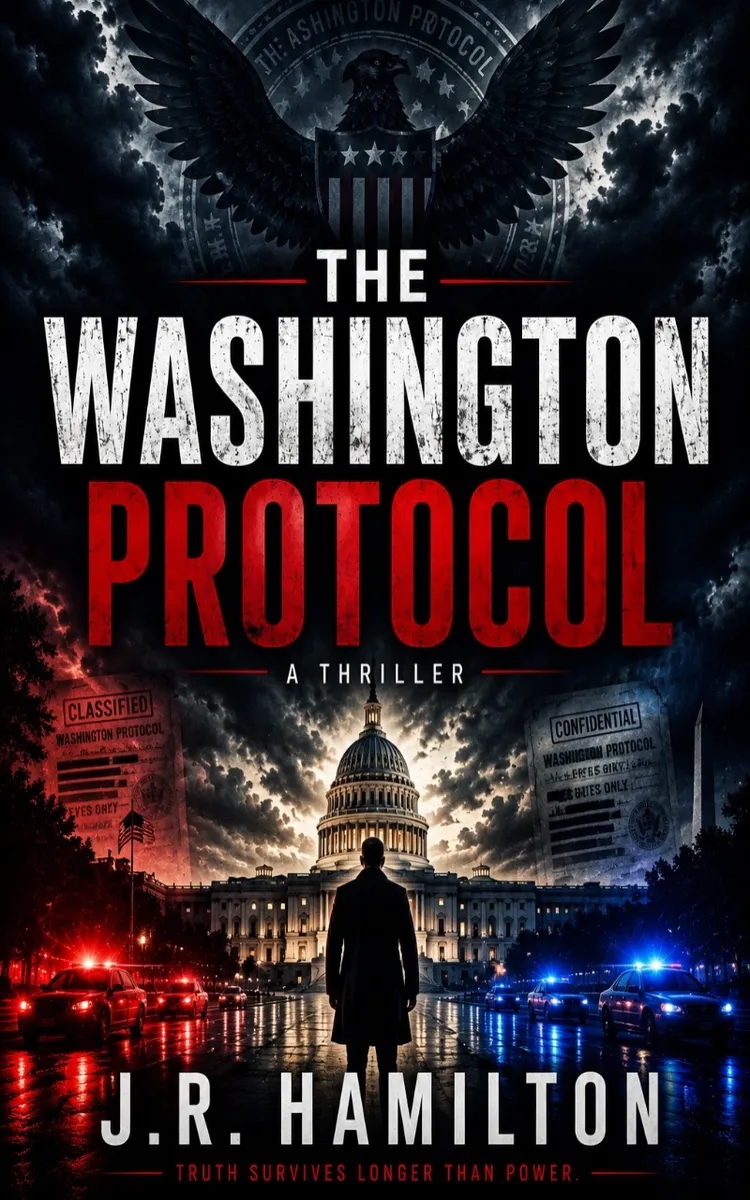
"The Washington Protocol" is a clinical guide book by Anonymous with 5 chapters and approximately 9,948 words. Fictional thriller involving healthcare executives and a protocol.
This book was created using Inkfluence AI, an AI-powered book generation platform that helps authors write, design, and publish complete books. It was made with the AI Health Book Generator.
Frequently Asked Questions
What is "The Washington Protocol" about?
Fictional thriller involving healthcare executives and a protocol
How many chapters are in "The Washington Protocol"?
The book contains 5 chapters and approximately 9,948 words. Topics covered include Live Broadcast Risk and Protocol Triggering, Trauma Surgery Under Pressure: Ethan’s Triage Loop, Denial-of-Care Economics and Target Selection, GHOST.zip Forensics: Building a Patient-Loss Map, and more.
Who wrote "The Washington Protocol"?
This book was written by Anonymous and created using Inkfluence AI, an AI book generation platform that helps authors write, design, and publish books.
How can I create a similar clinical guide book?
You can create your own clinical guide book using Inkfluence AI. Describe your idea, choose your style, and the AI writes the full book for you. It's free to start.
Write your own clinical guide book with AI
Describe your idea and Inkfluence writes the whole thing. Free to start.
Start writingCreated with Inkfluence AI


