
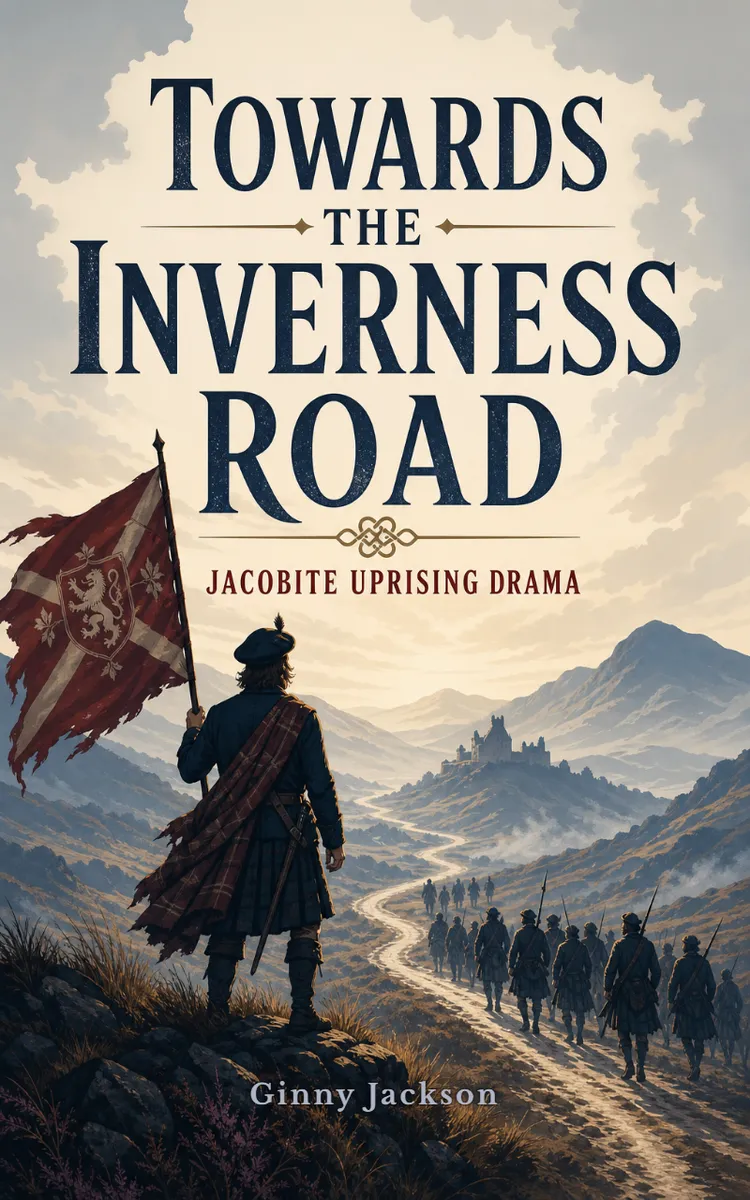
Towards The Inverness Road
Created with Inkfluence AI
Fictional Christian drama amid Scotland’s 1715 Jacobite uprising
Table of Contents
- 1. A Road That Refuses Peace
- 2. Braemar’s Standard and Sudden Oaths
- 3. The Minister Who Warns, Not Threatens
- 4. Letters Burned Before They Travel
- 5. A Surgeon’s Knife, A Gospel Promise
- 6. Mar’s March Toward the Highlands
- 7. The River That Swallowed a Promise
- 8. Sheriffmuir’s Shadow Falls Early
- 9. The Day the Lines Would Not Hold
- 10. After Sheriffmuir, Faith Faces Fog
- 11. Mar’s Retreat and the Broken Chain
- 12. James Arrives Too Late
- 13. The Pretender’s Words, the People’s Weariness
- 14. A Hidden Reformer Among Jacobites
- 15. Forster’s Northern Fire Burns Out
- 16. Layer’s Conspiracy Unraveled
- 17. The Night Mar’s Men Disappear
- 18. Exile Promised, Exile Feared
- 19. February 1716: Mar and James Depart
- 20. Towards the Inverness Road, Still Believing
- 21. Epilogue: A Road Still Open
Preview: A Road That Refuses Peace
A short excerpt from “A Road That Refuses Peace”. The full book contains 21 chapters and 141,615 words.
The rain had worried the thatch all afternoon, and now it worried the road too-turning the ruts to slick black mouths that swallowed the hoof and spat mud up to the knees. Elspeth MacRae stood under the lean-to by her door with a shawl pulled hard across her hair, listening to the wind worry the wire of the fence and the distant creak of a cartwheel as if it were an old man’s sigh. From the byre came the warm breath of a cow and the sharp smell of peat-smoke clinging to everything it touched. Somewhere down the lane a woman’s voice rose and fell, too careful to be casual, too steady to be grief.
Elspeth’s hands were wet already. She had been washing linens in a pail that never seemed to empty, wringing and re-wringing until her fingers ached, and still the cloth would not look clean enough for her own mind. It was not only the mud. The talk had come like a cold draught under the door that morning, slipping in on boots that were not theirs. Men from the north had passed through the kirk road with news in their mouths and suspicion in their eyes. She had heard the name Braemar spoken as if it were a bell rung too late in the day. She had heard the date-September the sixth-mixed with the strange urgency of those who believe time itself has run out.
When the knock came at last, it was not loud, but it struck the plank as though the knocker had been taught to expect refusal. Elspeth wiped her palms on her apron and stepped out. The rain ran off the brim of her hood in thin streams, and her breath made a faint mist in the air.
“Mrs. MacRae?” a man called, half-hidden by the hedge. “Goodwife, are you within?”
“I am,” she said, and the word came out firmer than she felt. She pulled the latch back. Cold air rushed in, smelling of wet earth and horse. A young fellow stood there with his cap in his hands, water darkening the cloth at his collar. Behind him, another figure waited at the gate, broader-shouldered and quiet.
The young one swallowed. “They say the standard’s up. They say it’s John Erskine-Earl Mar-at Braemar. They say men are gathering.”
Elspeth felt the words settle in her ribs like stones. She had heard rumours before, all the way through last winter’s hunger and the hard talk of Parliament men in Edinburgh, but this was different-this had the shape of a road opening, and once a road opened it demanded feet.
“What men?” she asked. Her voice sounded to her like it belonged to someone who had never been afraid of consequences.
The young fellow glanced at his companion, then back. “Some from Strath-some from the hills. A rider passed through the inn by Loch Ness, and he would not sit to drink. He said there were messages and lists and that folk must choose quick.”
The rain ticked on her sleeve. Elspeth’s mind reached for Scripture the way a hand reaches for a familiar tool in dimness. She had been taught from her mother’s Bible that God is not the author of confusion, and yet men made confusion their weapon and called it duty. The reformer preacher in the region had spoken against violence dressed in holy words, but even his calm had not stopped the heat rising in people’s faces when the subject turned to kings and oaths.
“If there are lists,” she said slowly, “then they will come through here. Will they ask me?”
The broad-shouldered man spoke at last. “They will ask whose house is whose. They will ask who attends, who gives shelter, who keeps tongues.”
Elspeth drew her shawl tighter. In the doorway the warm smell of the byre met the cold smell of the road, and she felt herself pulled between two worlds-one where people bled and needed hands, and another where talk about thrones made men forget the body’s ache.
“I am a widow,” she said. “I keep a house. I care for the sick. I do not raise standards.”
The young fellow’s eyes flickered, sharp with fear. “They say the sickness spreads both ways. They say if you will not swear, you will be counted with the wrong.”
Elspeth’s first impulse was to shut the door. Her second was to ask after names, not because she wished to betray but because she needed to know how close danger stood. She had delivered babies in winter when the snow came up to the window-sill, and she had watched women’s faces go pale as they waited for a surgeon who never arrived. She knew what it cost to refuse a call that sounded like mercy. She also knew what it cost to obey when the call turned cruel.
“I will not swear in haste,” she said, and heard herself add, “not before I know the truth.”
The broad man gave a thin nod, as if truth were a thing that could be weighed like grain. “Then we must speak to you again when the others come. They say there’s talk of officers in the district.”
The young one shifted his feet, splashing mud. “There’s a meeting tonight. At the smithy. Men from the road. They mean to settle it before morning.”
Elspeth looked at their wet sleeves, at the tightness around the broad man’s mouth, and she understood-this was not only news. It was pressure....
About this book
"Towards The Inverness Road" is a fiction book by Ginny Jackson with 21 chapters and approximately 141,615 words. Fictional Christian drama amid Scotland’s 1715 Jacobite uprising.
This book was created using Inkfluence AI, an AI-powered book generation platform that helps authors write, design, and publish complete books. It was made with the AI Novel Writer.
Frequently Asked Questions
What is "Towards The Inverness Road" about?
Fictional Christian drama amid Scotland’s 1715 Jacobite uprising
How many chapters are in "Towards The Inverness Road"?
The book contains 21 chapters and approximately 141,615 words. Topics covered include A Road That Refuses Peace, Braemar’s Standard and Sudden Oaths, The Minister Who Warns, Not Threatens, Letters Burned Before They Travel, and more.
Who wrote "Towards The Inverness Road"?
This book was written by Ginny Jackson and created using Inkfluence AI, an AI book generation platform that helps authors write, design, and publish books.
How can I create a similar fiction book?
You can create your own fiction book using Inkfluence AI. Describe your idea, choose your style, and the AI writes the full book for you. It's free to start.
Write your own fiction book with AI
Describe your idea and Inkfluence writes the whole thing. Free to start.
Start writingCreated with Inkfluence AI


