
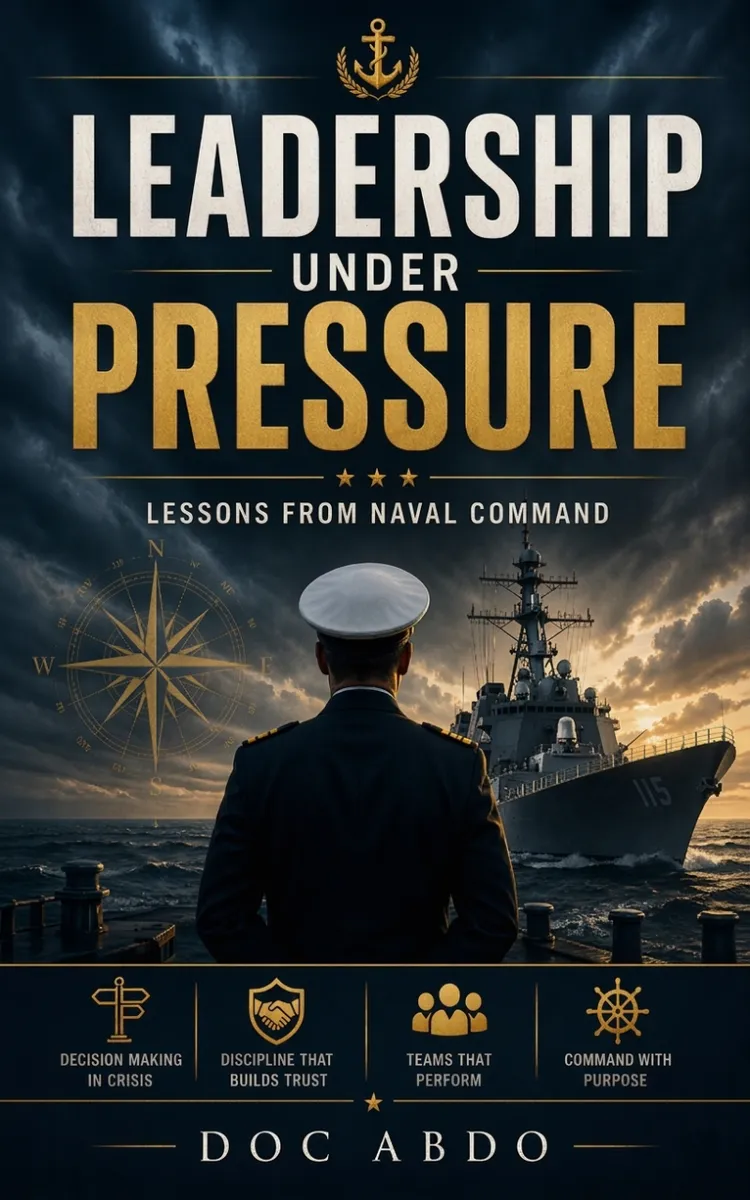
Leadership Under Pressure
Created with Inkfluence AI
Naval leadership principles for decision-making under pressure
Table of Contents
- 1. Navy Mindset for Crisis Leadership
- 2. Decision-Making Under Uncertainty
- 3. Discipline and Authority Under Fire
- 4. Communication and Coordination in Chaos
- 5. Naval Command Lessons and Practice
First chapter preview
A short excerpt from chapter 1. The full book contains 5 chapters and 9,315 words.
“Crisis doesn’t test what you know. It tests what you trained to do.”
If you run a business, manage a team, or carry responsibility that can blow up overnight, you already know the feeling: the phone won’t stop, the numbers don’t add up, and your best people look to you for direction. Pressure arrives fast, and it punishes hesitation. The problem isn’t that you lack talent-it’s that your readiness usually shows up only after something goes wrong.
Commander Ruiz learned that lesson the hard way, the same way most naval leaders do: by building habits long before the alarm. In this chapter, you’ll learn why leadership under pressure matters, how Navy training builds resilience before emergencies hit, and how to turn that into a practical system you can run in your own operation. You’ll walk away with a clear framework-The Readiness Ladder-and a way to train your decision-making so you don’t reinvent the process when stress is highest.
---
Why This Matters
Most owners think pressure leadership starts when the crisis begins. That’s backwards. During a real emergency, you don’t get extra time to think, align, or search for clarity. You react with what’s already been rehearsed in your mind, your routines, and your team’s expectations. If your current habits only work on calm days, you’ll feel the gap the moment conditions change-whether that’s a supplier failure, a key employee quitting, a safety incident, a cash crunch, or a customer escalation that goes public.
The Readiness Ladder solves a specific problem: it forces you to treat pressure like a capability you can build on purpose. Instead of “hoping you’ll handle it,” you set training conditions, define decision rules, and practice communication under time limits. You reduce the chaos load on yourself and your people, so you can make cleaner calls faster and keep your team aligned when emotions run high.
After you finish this chapter, you’ll be able to (1) identify the readiness level your operation sits at today, (2) build a short training loop that improves under real constraints, and (3) apply Navy-style decision discipline to business moments that feel urgent and uncertain-without turning your company into a military operation.
Commander Ruiz, 46, runs operations where small delays cascade into bigger problems. The pressure isn’t theoretical; it shows up in maintenance windows, equipment status, and sudden changes in mission priorities. He doesn’t rely on heroics. He relies on readiness-trained expectations, rehearsed communication, and decision habits that stay usable when the environment gets loud.
---
How It Works
Navy resilience comes from a pattern: train the human system (judgment, communication, coordination) the same way you train the technical system (procedures, checks, readiness). You don’t just learn what to do-you learn when to do it, who to involve, and how to keep decisions moving as new information hits.
The Readiness Ladder gives you that pattern in plain business terms. It works because it reduces “decision friction” during stress. You stop debating the same basics, you create a shared mental model for what “good” looks like, and you practice the sequence before the alarm sounds.
Here’s the Ladder, from lowest readiness to highest:
1. Level 1: Baseline Clarity
Define what “normal” looks like in your operation and write it down in a way your team can act on. Ruiz’s team starts with clear roles and what “good” output means during routine days. In business, this might mean you define who owns schedule changes, who approves spend, and what counts as an urgent customer issue.
2. Level 2: Trigger Rules
You decide in advance what conditions activate a crisis response. Navy leaders don’t wait for perfect certainty; they react to triggers. Your triggers might include “cash won’t cover payroll by Friday,” “a critical job slips past the promised completion window by 24 hours,” or “safety incident risk appears in the field.” You turn feelings into thresholds.
3. Level 3: Decision Speed Standards
You set time limits for decisions so you don’t stall while everyone waits for the “right” answer. Ruiz uses short decision windows during rapidly changing conditions so the team can act, then adjust. In your world, you can set rules like “We decide whether to refund or escalate within 30 minutes of an executive complaint.”
4. Level 4: Communication Under Pressure
You practice short, structured updates that keep everyone oriented even when the room gets noisy. Navy training emphasizes clear, repeatable messaging: what happened, what we know, what we’re doing next, and what we need. You don’t rely on long explanations. You use a consistent update format.
5. Level 5: Coordination and Rehearsal
You run drills that simulate stress-limited time, missing information, and conflicting priorities-so your team learns how to coordinate without waiting for you to fix everything....
About this book
"Leadership Under Pressure" is a business book by Abdo Doc with 5 chapters and approximately 9,315 words. Naval leadership principles for decision-making under pressure.
This book was created using Inkfluence AI, an AI-powered book generation platform that helps authors write, design, and publish complete books. It was made with the AI Business Book Writer.
Frequently Asked Questions
What is "Leadership Under Pressure" about?
Naval leadership principles for decision-making under pressure
How many chapters are in "Leadership Under Pressure"?
The book contains 5 chapters and approximately 9,315 words. Topics covered include Navy Mindset for Crisis Leadership, Decision-Making Under Uncertainty, Discipline and Authority Under Fire, Communication and Coordination in Chaos, and more.
Who wrote "Leadership Under Pressure"?
This book was written by Abdo Doc and created using Inkfluence AI, an AI book generation platform that helps authors write, design, and publish books.
How can I create a similar business book?
You can create your own business book using Inkfluence AI. Describe your idea, choose your style, and the AI writes the full book for you. It's free to start.
Write your own business book with AI
Describe your idea and Inkfluence writes the whole thing. Free to start.
Start writingCreated with Inkfluence AI


