
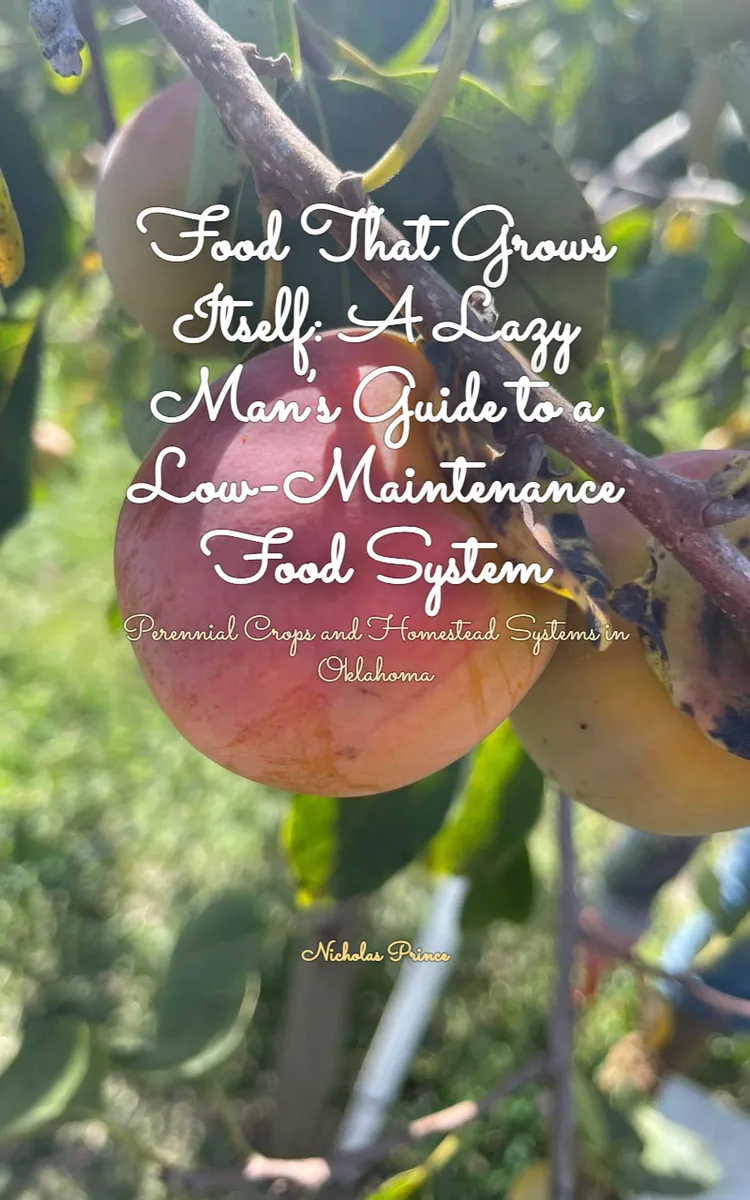
Food That Grows Itself: A Lazy Man’s Guide to a Low-Maintenance Food System
Created with Inkfluence AI
Designing and managing food forests, perennial crops, and integrated homestead systems
Table of Contents
- 1. The I-35/I-75 Dilemma
- 2. Establishing a Regenerative Homestead Vision
- 3. Soil Improvement and Forest Succession Techniques
- 4. Build Better Trees, Not Better Systems
- 5. Perennial Vegetables: An Endless Supply of Greens
- 6. Selecting Perennial Crops for Oklahoma Food Forests
- 7. Spice is Life
- 8. Sweet Calories
- 9. Alternative or Experimental Crops
- 10. Integrating Livestock for Protein and Soil Health
- 11. Developing a Self-Sufficient Perennial Diet
- 12. Scaling Up: 10-Acre Forest Farming Systems
- 13. Monetizing Forest Farming and Value-Added Crops
- 14. Plant and Cultivar Index
First chapter preview
A short excerpt from chapter 1. The full book contains 14 chapters and 19,722 words.
The I-35 Dilemma?A clear regional primer sits between you and a successful perennial homestead in Oklahoma. Central Oklahoma differs from the eastern cross-timbers and from the western prairie. East of Interstate 35 you’ll find more acidic soils, higher rainfall, and a woodland tendency that favors shrubs, shade-tolerant trees, and forest-style food forests. West of I-35 the climate trends drier, soils more alkaline and often shallower, and the landscape leans toward savannah and prairie management. The I-35 corridor itself mixes these characteristics and gives a useful average for planning: it shows what will usually work across much of the state, but never replaces a site-specific check.
What’s at stake is choosing the right plants, the right layout, and the right watering and soil strategies for your spot. Planting an eastern-loving blueberry into western clay will cost time and money and inevitable failure. A good rule of thumb is you can move western Oklahoma plants east rather than eastern plants into western Oklahoma. In practical terms, you lose years of yield and may create maintenance headaches. The goal here is to give one compact, regional rule set you can use before you drill into micro-site tests: soil pH, rainfall, and landscape history drive most perennial success in Oklahoma.
Takeaway: evaluate where you sit relative to I-35, then act accordingly.
Plan of ActionStart by mapping the property against three simple checks: rainfall band (use county extension rainfall maps), soil pH and texture (home test kit plus a feel test), and historical vegetation (what grew there before you cleared it). They ran these checks within a single weekend and used results to pick plant palettes. For a Central/I-35 average site they planted a mix of persimmon, pawpaw (in protected swales), Chinese chestnut, muscadine grape on south-facing trellises, and nurse rows of native honeyberry and clove currant to attract pollinators and wildlife. They mulched 4-6 inches with wood chips, placed drip-line irrigation on 8-12 hour timers for the first two summers, and layered annual potatoes between young trees for calories and soil cover.
For an eastern site they leaned into acid-tolerant shrubs - blueberry, serviceberry - and used deeper organic mulch and more frequent shallow irrigation. For a western site they substituted drought-hardy varieties, widened tree spacings to reduce competition, added swales to catch sporadic storms, and used rabbit and chicken systems to bring concentrated nutrients where trees needed them most. They scheduled simple checks: soil pH every 2 years, tree health walk monthly during the first 3 years, and yield audits each autumn.
Practical outcome: fewer transplant failures, reduced watering after establishment, and predictable early returns from layered annuals while the perennials matured.
Bold principle: Map your climate and soils before you buy plants.Apply it: Spend a weekend mapping your spot relative to I-35, test soil pH with a $15 kit, and note soil texture by feel. Match plants to that map - acid-loving shrubs to east sites, drought-tough species to west. Result: fewer dead plants and less rework.
Bold principle: Start with a conservative, region-appropriate palette.
Apply it: Choose 6-8 species that suit your band (I-35 average: pawpaw, persimmon, chestnut, muscadine, blackberries). Buy one-gallon trees with excellent root systems or grow your own planting stock in air prune beds from seed for diversity for lower cost. Plant in year 1, mulch heavily, and layer annuals for calories. Result: steady yields and manageable labor.
Bold principle: Use low-tech water containment for dry sites.
Apply it: Build small swales or berms along contours and place mulch basins at tree collars. Combine with 12V drip controllers or simple timers for 8-12 hour cycles early on. Result: capture storms and cut irrigation needs.
Bold principle: Phase planting by risk and reward.
Apply it: Put high-reward, quick-return annuals and quick producing perennials in the first two years between lagging perennials. Delay permanent, expensive, large plantings into year 2 if your first-year tests suggest adjustments. Result: edible returns early and smarter long-term spending.
Close with momentum: use these rules as a regional filter, then move to a site plan that places trees, shrubs, groundcover and livestock where they’ll anchor your food forest for decades.
The Risk: Plant the wrong trees and waste years and moneyI recommend obtaining a Koppen‑Geiger climate map to understand broad climate bands. Koppen‑Geiger classifies climates by temperature and precipitation patterns, which directly affect chilling hours, drought stress, and disease pressure - the three things that most determine whether a non-native fruit tree will bear in Oklahoma. Cross-reference the map with local observations: past drought years, soil tests and which native trees survived the hottest summers....
About this book
"Food That Grows Itself: A Lazy Man’s Guide to a Low-Maintenance Food System" is a how-to guide book by Nicholas Prince with 14 chapters and approximately 19,722 words. Designing and managing food forests, perennial crops, and integrated homestead systems.
This book was created using Inkfluence AI, an AI-powered book generation platform that helps authors write, design, and publish complete books. It was made with the AI Ebook Generator.
Frequently Asked Questions
What is "Food That Grows Itself: A Lazy Man’s Guide to a Low-Maintenance Food System" about?
Designing and managing food forests, perennial crops, and integrated homestead systems
How many chapters are in "Food That Grows Itself: A Lazy Man’s Guide to a Low-Maintenance Food System"?
The book contains 14 chapters and approximately 19,722 words. Topics covered include The I-35/I-75 Dilemma, Establishing a Regenerative Homestead Vision, Soil Improvement and Forest Succession Techniques, Build Better Trees, Not Better Systems, and more.
Who wrote "Food That Grows Itself: A Lazy Man’s Guide to a Low-Maintenance Food System"?
This book was written by Nicholas Prince and created using Inkfluence AI, an AI book generation platform that helps authors write, design, and publish books.
How can I create a similar how-to guide book?
You can create your own how-to guide book using Inkfluence AI. Describe your idea, choose your style, and the AI writes the full book for you. It's free to start.
Write your own how-to guide book with AI
Describe your idea and Inkfluence writes the whole thing. Free to start.
Start writingCreated with Inkfluence AI


