
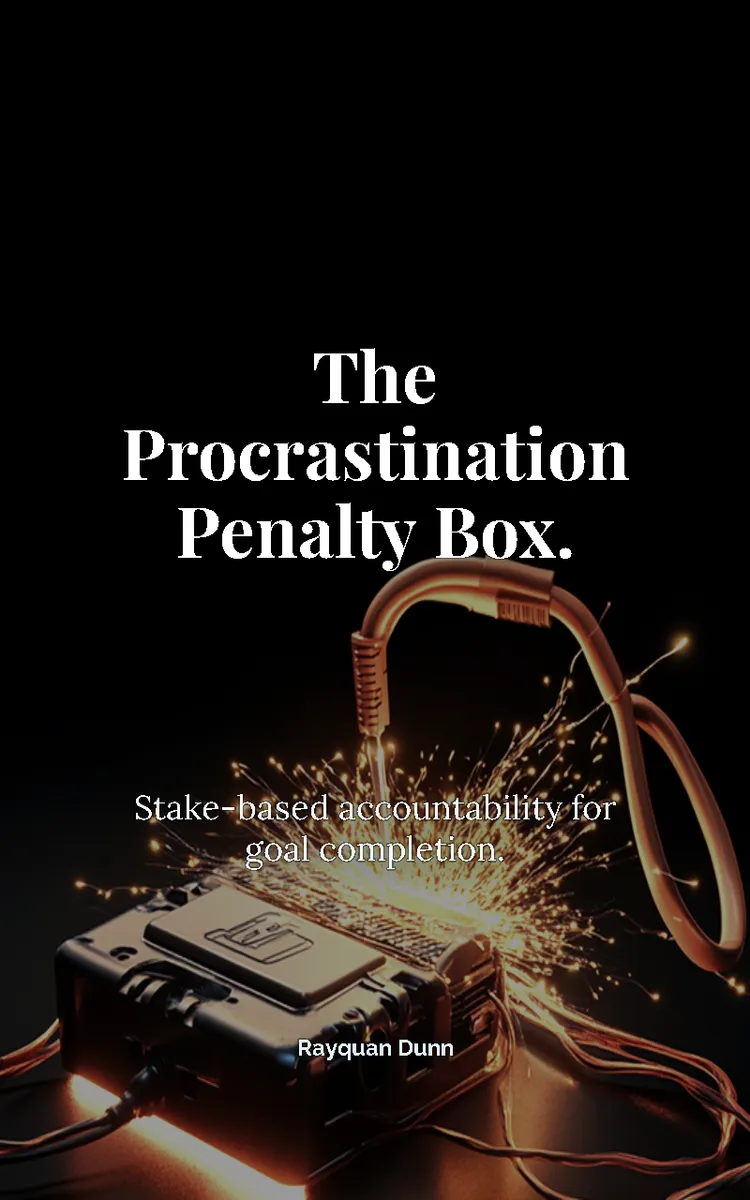
The Procrastination Penalty Box
Created with Inkfluence AI
Decentralized stake-based accountability membership model
Table of Contents
- 1. The Commitment Market: Core Mechanics
- 2. Designing Stake Pools That Get Won
- 3. Verification Systems: API, Proof, Voting
- 4. Anti-Cheating Rules for High Stakes
- 5. Launch, Viral Loops, and $1M Math
Preview: The Commitment Market: Core Mechanics
A short excerpt from “The Commitment Market: Core Mechanics”. The full book contains 5 chapters and 9,941 words.
What if your next “I’ll start Monday” plan came with a bill that actually hurts-paid in real money-if you miss the deadline?
That’s what the stake-based accountability loop does. It turns procrastination from a private problem into a public, measurable outcome where your money moves when your behavior moves. In this chapter, you’ll learn the exact mechanics behind The Procrastination Penalty Box (A decentralized, stake-based accountability engine for high-performers): how to join, how to create a stake pool, how verification decides success vs failure, and how penalty redistribution pays winners-so you stop negotiating with yourself and start executing.
Problem: high-performers don’t lack skill; they lack enforced follow-through. You can plan, you can build, you can ship-until the moment you need to keep showing up, even when it’s inconvenient. The Procrastination Penalty Box solves that by using loss aversion as the engine, not as a motivational poster. When you stake real money, you stop treating commitments like intentions.
Why This Matters
Most accountability systems fail because they rely on feelings, not mechanics. You get a checklist, a reminder, a group chat, maybe a coach. Then you still hold the steering wheel alone. If you skip, nobody’s escrowed money changes hands. Your brain learns it can “try later” without paying a cost.
The commitment market model fixes that by making your commitment economically binding. You stake real money (USDC via Whop Treasury) to prove you will complete specific personal or professional goals. If you fail, your stake gets redistributed to members who did succeed. You, as the platform owner, take a small fee from every penalty pool. That’s the whole trick: the system rewards completion and punishes non-completion in a way you cannot talk your way out of.
After reading this chapter, you will be able to do four things precisely: (1) join a monthly membership on Whop, (2) create a stake pool with the right stake limits and goal definition, (3) set up verification so the platform can determine success vs failure, and (4) predict what happens to your stake under both outcomes-so you can choose goals that you can actually win.
How It Works
The core mechanism is called the Stake-to-Action Loop. It connects four events: stake, verification, outcome, redistribution. If you understand this loop end-to-end, you can build pools that you can’t cheat yourself out of.
Here’s the exact loop, step by step:
1) Join The Procrastination Penalty Box on Whop (membership access)
- You pay a monthly membership ($20/mo) to access the platform.
- Whop already handles paid memberships: you charge an entry fee; users get gated access.
- Expected outcome: you can create stake pools and participate in verification.
2) Create a stake pool (define the commitment in one measurable sentence)
- You name the pool around an outcome, like “30 days of waking at 5am” or “ship my MVP by June 1st.”
- You set the stake for that pool with the required bounds: minimum 50, maximum5,000.
- Expected outcome: you convert a vague intention into a concrete unit that can be verified.
3) Deposit the stake into a Whop Treasury smart contract
- Users deposit USDC into a Whop Treasury smart contract that locks the stake for the pool.
- Whop Treasury lets users hold, deposit, and withdraw crypto natively, so you don’t build payment plumbing from scratch.
- Expected outcome: the money becomes the enforcement layer, not just a promise.
4) Verify completion (success vs failure triggers redistribution)
- Verification uses either API integrations (Trello, GitHub commits, Apple Health, screen-time data) or manual video proof reviewed by DAO-style voting.
- Success means you complete the defined goal and receive 100% of your stake back.
- Failure means your stake gets split among all successful users in that pool proportionally.
- Expected outcome: the system decides outcomes with rules you can audit, not vibes.
Your revenue comes from the failure path. You take a 5-10% fee from the failed stakes (not from successful ones). That matters because it aligns incentives: you earn more when the system correctly identifies missed commitments and funds winners.
Why this model works when others don’t: you stop trying to “be motivated.” You pay to avoid losing your own money. The emotional leverage is built into the design: people will pay 100 to avoid losing 1,000-because loss feels worse than equivalent gain. That’s why the loop beats content, beats communities-without-escrow, and beats tools-without-consequences.
This also explains why the setup fits Whop uniquely. Whop supports crypto-native staking without you building your own payment infrastructure. It also tolerates “high-risk” models where failed stakes pay out winners-this is not gambling, it’s incentive design....
About this book
"The Procrastination Penalty Box" is a business book by Rayquan Dunn with 5 chapters and approximately 9,941 words. Decentralized stake-based accountability membership model.
This book was created using Inkfluence AI, an AI-powered book generation platform that helps authors write, design, and publish complete books. It was made with the AI Business Book Writer.
Frequently Asked Questions
What is "The Procrastination Penalty Box" about?
Decentralized stake-based accountability membership model
How many chapters are in "The Procrastination Penalty Box"?
The book contains 5 chapters and approximately 9,941 words. Topics covered include The Commitment Market: Core Mechanics, Designing Stake Pools That Get Won, Verification Systems: API, Proof, Voting, Anti-Cheating Rules for High Stakes, and more.
Who wrote "The Procrastination Penalty Box"?
This book was written by Rayquan Dunn and created using Inkfluence AI, an AI book generation platform that helps authors write, design, and publish books.
How can I create a similar business book?
You can create your own business book using Inkfluence AI. Describe your idea, choose your style, and the AI writes the full book for you. It's free to start.
Write your own business book with AI
Describe your idea and Inkfluence writes the whole thing. Free to start.
Start writingCreated with Inkfluence AI


