
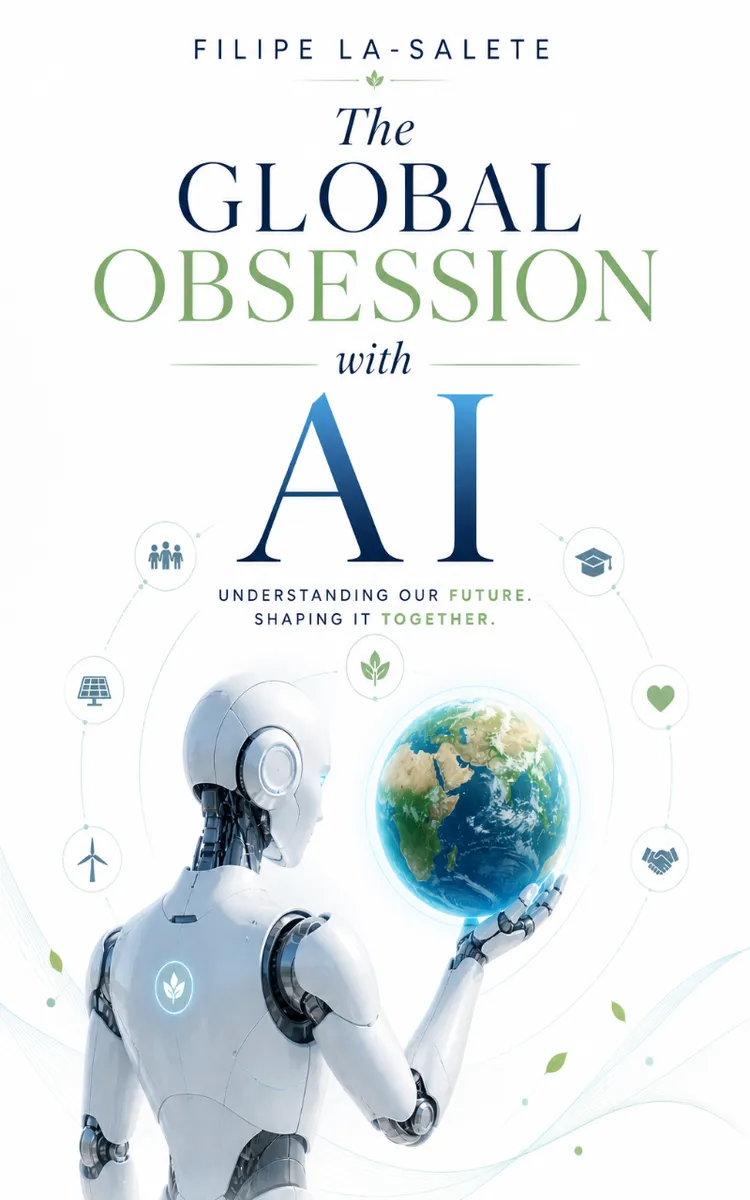
The Global Obsession With AI
Created with Inkfluence AI
History and influence of AI across different areas worldwide
Table of Contents
- 1. Why Everyone Talks About AI
- 2. The Three Waves of AI Hype
- 3. Jobs Rewritten by Automation Anxiety
- 4. AI in Medicine: Hope With Limits
- 5. The Obsession’s Final Question: Control
First chapter preview
A short excerpt from chapter 1. The full book contains 5 chapters and 7,667 words.
The Opening
It’s not that everyone has read the same AI paper or understands how a model is trained. The immediate surprise is simpler and stranger: AI became an everyday obsession because it feels like speed, convenience, and novelty all at once-even to people who barely know what “AI” means. That feeling spreads faster than explanations ever could.
When people talk about AI, they’re often reacting to an experience, not a concept. A chatbot that answers instantly. A phone camera that “enhances” a photo with a tap. A recommendation feed that seems to know what you want before you do. Even when the details are fuzzy, the results are concrete enough to pull attention.
In this chapter, I’ll follow that attention-how it turned from a technical idea into a global habit. You’ll see where the obsession came from, why it arrived in so many everyday places at once, and what kinds of “real-world magic” are actually doing the heavy lifting.
If the world is reacting to AI so loudly, what exactly is it reacting to-brains, math, or something more human?
The Deep Dive
## How “AI” Became a Product, Not a Project
For a long time, AI lived mostly inside research labs and specialist circles. The phrase “artificial intelligence” sounded like a big dream, and in many ways it stayed that way: a promise that computers could learn, reason, and understand. But the obsession we see today didn’t start with a grand theory. It started when AI stopped being only a topic and became a feature.
That shift matters because features are felt differently than theories. A theory asks for patience-time to learn the language, time to follow the reasoning. A feature asks for almost nothing beyond a button. When a system can generate text, translate speech, or summarize a document in seconds, it changes the rhythm of everyday work. People don’t need to know what’s under the hood to notice that the hood is suddenly producing results.
This is also why “AI” became a shared conversation across countries and industries. The same style of capability-fast responses, pattern-based predictions, automated assistance-appears in many products: customer support tools, content tools, photo apps, navigation systems, and search experiences. Once the public sees the same kind of payoff in different places, “AI” stops being an academic category and becomes a daily companion.
There’s a good documentary-style way to think about it: the obsession follows the interface. Not the lab notebook.
## The Attention Gravity Model (and Why It Works)
People don’t pay attention to everything. They pay attention to what pulls. So I’ll use a simple lens I call the Attention Gravity Model: attention behaves like gravity in two ways-speed and near-miss convenience.
Speed is obvious. When something replies in a fraction of a second, your mind treats it as present. It feels interactive. Even if you know it isn’t “alive,” the experience is still immediate. Near-miss convenience is subtler: AI often doesn’t fully replace a task, but it reduces friction enough that you keep coming back. It’s like having a tool that gets you 80% of the way there-then makes you forget the effort of getting the last 20%.
That combination is powerful because it trains people-without them noticing-to expect quick outcomes. Once that expectation forms, any new AI feature feels like an upgrade to everyday life, not a separate technology.
This model also explains why the conversation is so global. Speed and convenience scale. A system that can generate an answer quickly can be offered in many languages and regions with relatively small changes. And near-miss convenience-tools that help with writing, searching, summarizing, or sorting-fits the daily routines of millions of people, from office work to small businesses to customer support desks.
## Why Novelty Is a Fuel, Not a Decoration
Speed brings attention. Novelty keeps it.
Humans are wired to notice new patterns, especially when the pattern seems to mimic intelligence. A machine that can produce coherent sentences, rearrange information, or generate a plausible explanation triggers a specific kind of curiosity: not “how does it work?” at first, but “how did it do that so fast?”
Novelty also creates a loop in public conversation. When someone uses an AI tool and gets an unexpectedly good result, the story is easy to share. “Look what it did.” “It wrote this.” “It explained that.” Those are not technical claims; they’re social proof. The story spreads, and suddenly everyone is curious enough to try, watch, or argue.
One reason this can happen across cultures is that the emotional structure is similar everywhere. People may disagree about what AI is, but they often agree about what it does: it produces outputs quickly, it feels responsive, and it can handle everyday language-emails, questions, summaries, instructions-that were previously slow and messy.
...
About this book
"The Global Obsession With AI" is a curiosity book by Filipe La-Salette with 5 chapters and approximately 7,667 words. History and influence of AI across different areas worldwide.
This book was created using Inkfluence AI, an AI-powered book generation platform that helps authors write, design, and publish complete books.
Frequently Asked Questions
What is "The Global Obsession With AI" about?
History and influence of AI across different areas worldwide
How many chapters are in "The Global Obsession With AI"?
The book contains 5 chapters and approximately 7,667 words. Topics covered include Why Everyone Talks About AI, The Three Waves of AI Hype, Jobs Rewritten by Automation Anxiety, AI in Medicine: Hope With Limits, and more.
Who wrote "The Global Obsession With AI"?
This book was written by Filipe La-Salette and created using Inkfluence AI, an AI book generation platform that helps authors write, design, and publish books.
Write your own curiosity book with AI
Describe your idea and Inkfluence writes the whole thing. Free to start.
Start writingCreated with Inkfluence AI


