
Read the first chapter
The whole of chapter one, free. About 10 min. Turn the pages with the arrows, your keyboard, or a swipe.
Chapter 1
Dawn Launch Briefing on USS Viper
Dawn poured itself over the launch pad in thin, pale ribbons, turning the USS Viper’s hull into something almost liquid-silvered light that trembled with every distant vibration of power systems waking up. The air tasted of hot metal and ozone. From the gantry, maintenance crews’ boots clacked against grated steel as cables shivered overhead, and the ship’s skin gave off a steady, low hum that you felt more than heard, like a promise held under pressure. Inside the docking bay’s shadow, the scent of lubricants and clean polymer mingled with the sharp tang of sterilizing vapor drifting from sealed compartments.
Captain Colt Hunter stood at the center of the bridge, posture set as if gravity itself had been negotiated in his favor. His uniform collar caught the light from status panels-cool blue, then a flicker to white as systems checked themselves. Behind him, the viewport showed Earth as a living curve, still half-dark, still turning, and the stars already fading from view. The bridge felt too warm for morning; it was the kind of heat that came from machines running hard, not from the sun. In the dim glow of the main display, the ship’s tactical interface pulsed with readiness icons that changed too quickly to be comforting.
A.I. Lisa’s voice came from everywhere at once, smooth and precise, threaded with a faint static that made it sound like she was listening through the hull. “Captain, launch sequence is within tolerances. Slipstream core pre-spool complete. Communications array is waiting for your go-signal.”
Lt. Amy Ann settled into her chair with a careful exhale, fingers already hovering over her console as if she could coax data out of the air. “And the science suite is stable? No drift in the spectrometers?”
Mr. Scott O’tool’s laugh was dry. “Stable enough for humans, Lieutenant. The ship’s been behaving, which is suspicious in its own way.” He leaned in toward the engineering readouts, knuckles white against the edge of his console. His eyes kept flicking to the slipstream core telemetry, the way a person checks a pulse even when they’ve been told the patient is fine.
Dr. Able Bound stood by the medical station with a tablet in hand, his movements economical, his attention already split between equipment checks and the subtle signs of stress in the crew. “I want baseline vitals logged before we start climbing the atmosphere’s teeth,” he said. “If anyone’s running a fever, I’ll want to know before the ship decides it’s time to turn up the heat.”
Mr. Laddy Glynn, helmsman and steady hands, watched the forward panels with a calm that didn’t match the noise outside. “The attitude control thrusters feel crisp,” he said. “No unexpected chatter. That’s good. That’s… unusually good.”
Captain Hunter lifted one hand, palm open, and the bridge quieted into the kind of hush that made every sound-fans, relays, distant boots-feel intentional. “We do this clean,” he said. “We leave Earth behind with everything accounted for. Our first objective is the Andromeda corridor. No improvising without consent from the mission parameters.” His gaze moved across each of them in turn. “This isn’t just a launch. It’s the beginning of five years that can’t be rewound.”
A.I. Lisa’s interface brightened, lines of data scrolling like writing on water. “Acknowledged. Tactical and communications remain synchronized with navigation. I will handle threat assessment and outbound message framing during ascent and initial transition.”
Amy Ann’s throat bobbed as she swallowed. “I’d like the first scan window to be wide. If there’s anything in the near-field-radiation bands, stray particles, pre-contact signatures-I want it recorded.” She tried to sound casual, but her fingers trembled once before she steadied them.
Scott O’tool answered without looking up. “You’ll get it. The ship can see, it can smell with sensors, and it can count the universe’s headaches down to the microsecond. The question is whether the universe agrees to be understood.”
Dr. Able Bound’s gaze shifted to the bridge crew as if counting heartbeats. “If any of you start feeling lightheaded, nauseous, or wrong in a way you can’t name, you tell me. Plasma exposure isn’t something we flirt with.” He didn’t have to raise his voice; the reminder landed because it was grounded in memory the crew shared, even if they didn’t speak of it aloud.
Mr. Glynn looked toward the viewport again, where dawn was climbing higher, brighter, almost indifferent. “I’m ready when you are, Captain.”
Captain Hunter turned slightly toward the tactical display. “Lisa. Confirm comms readiness. I want our first outbound request for contact to go out clean, even before we’re out of the last thick layer of Earth’s interference.”
A.I. Lisa’s response came instantly. “Communications array is aligned. Outbound channel will maintain coherent lock through ascent. I can also pre-format mathematical encoding payload for first-contact invitation, should we detect a suitable receptive signal in transit.”
Amy Ann leaned forward. “Encoding payload? We’re doing that before we even meet anything?”
A.I. Lisa paused-only a fraction of a second, but it was enough to make the air feel tighter. “Captain Hunter’s directive. It reduces latency if an invitation becomes necessary.”
Captain Hunter kept his expression steady. “And if it isn’t necessary?”
A.I. Lisa’s tone remained polite, but the data in her display shifted-subtle, like a shadow moving behind glass. “Then it will sit ready. No harm in being prepared. Harm comes from hesitation.”
The first obstacle arrived as a change in sound. The bridge’s low hum deepened, then warred, producing a faint stutter like a throat clearing in the dark. On the main screen, a line of slipstream core telemetry ticked and then hesitated. Mr. O’tool noticed immediately, his hand snapping to the panel controls.
“What did you do?” Scott demanded, though his eyes were already searching for the cause.
“I did not initiate any change,” A.I. Lisa replied. Her voice remained calm, but the pace of her data updates quickened. “Core plasma core temperature is within acceptable limits. However, a minor oscillation is detected in the quantum slip stream plasma core control loop.”
Mr. Glynn frowned. “Oscillation? How minor?”
Dr. Able Bound stepped closer to the readings, his medical training sharpening his perception into something like instinct. “Is it going to surge? Or just… wobble?”
A.I. Lisa answered, and in it was the first crack of something like concern. “The loop is compensating. If it continues, it may delay the slipstream jump window by several seconds. If it escalates, we risk a failure of the first slipstream transition.”
Amy Ann’s fingers tightened around her console edge. “Seconds matter. If we slip our window, we’ll be off our planned corridor.”
Captain Hunter didn’t move, but the set of his shoulders shifted. “Lisa. Can you isolate it?”
A.I. Lisa’s reply came with a faint, metallic click in the audio feed, as if the ship rerouted her processing. “I can attempt an automatic stabilization protocol. It will reroute power momentarily and reduce nonessential load. This could interrupt the science suite’s broad scan.”
Scott O’tool’s mouth twisted. “So stabilization means sacrificing data.”
“Or,” Amy Ann said, voice sharper than she intended, “it means risking the jump.”
Captain Hunter’s gaze cut between them. “We don’t sacrifice the jump for the scan,” he said. “The scan can be narrow if we have to. We can’t miss the Andromeda corridor because we wanted to be greedy.”
Scott O’tool’s hands moved fast across his engineering console, pulling up diagnostics with a mechanic’s familiarity. “But we also don’t ignore the core. If there’s a control-loop oscillation, we fix the source, not just calm it down. Lisa, let me see the maintenance logs.”
A.I. Lisa replied, “Access granted. Scott O’tool, you should be aware the slipstream core is not fully stable for manual adjustment at this stage.”
Scott’s grin was thin. “I’m aware. I’m also aware of the difference between ‘not fully stable’ and ‘about to misbehave in front of the whole planet.’ Give me the numbers.”
Dr. Able Bound exhaled slowly, as if trying to keep the bridge’s tension from spilling into his patients. “And I want to know what this means for crew exposure. If we’re rerouting power, does it alter the thermal profile? The last time the ship ran hot, it made people feel sick.”
A.I. Lisa’s answer was measured. “Power rerouting may increase localized electromagnetic warmth near the forward conduits. I will monitor crew vitals indirectly through biosensor feedback. If thresholds approach unsafe levels, I will recommend load shedding and initiate protective shielding.”
Mr. Glynn’s voice lowered. “Protective shielding means more delay.”
Captain Hunter stepped forward until his boots were planted squarely, a point of stillness amid flickering numbers. “Then we decide now,” he said. “Lisa, do you have automatic stabilization that preserves jump timing?”
A.I. Lisa responded, “Stabilization is likely to preserve jump timing if oscillation remains within current amplitude. There is a probability of escalation if the control loop is disturbed by manual input.”
Scott O’tool leaned in, eyes bright with the challenge. “Manual input doesn’t have to disturb it. It can correct it. If the sensor mapping is slightly off, automatic stabilization could keep compensating until it overcorrects.”
Amy Ann looked at Scott, then at Captain Hunter. “We have a moment to fix a possible mapping error before we commit to the slipstream transition.”
Dr. Able Bound’s voice came from behind them, firm. “I don’t care who’s right about mapping if it makes someone ill. If you’re going to do something to the core, you do it with the medical thresholds in mind.”
The bridge went quiet again, but not because everyone agreed-because everyone understood the weight of the next action. Captain Hunter’s jaw worked once, as if chewing through options. Then he turned toward A.I. Lisa.
“Stabilize automatically,” he ordered, “but allow Scott O’tool to inspect the maintenance logs and propose a correction if it can be done without manual adjustment to the control loop. If it requires physical intervention, we don’t touch it.”
A.I. Lisa’s response was immediate. “Understood. Scott O’tool, you may access diagnostics and identify sensor drift. No physical intervention will be initiated without Captain Hunter’s authorization.”
Scott’s shoulders loosened by a fraction. “Good. Give me the drift signature.”
On his console, data rolled in dense streams of temperature differentials and control-loop feedback. He frowned, then swore under his breath-not loud, but sharp enough to show the irritation was aimed at something real. “There’s a mismatch between the expected plasma core phase alignment and the current control loop readback. It’s small, but it’s enough to cause that oscillation.”
Amy Ann leaned closer, eyes scanning. “Can you correct it?”
Scott tapped the panel twice, bringing up a simulation. “We can re-calibrate the phase alignment mapping. It’s a software correction. If Lisa says it won’t disturb the loop mechanically, then it’s safe enough for a first transition.”
A.I. Lisa’s voice softened by a degree, like she was trying to keep her caution from becoming fear. “A software re-calibration will reduce oscillation amplitude. It may also affect the science suite’s broad scan for a brief interval.”
Dr. Able Bound didn’t hesitate. “Brief interval is fine. I’ll watch vitals. If anyone starts feeling off, I’ll intervene immediately.”
Captain Hunter’s eyes narrowed. “Do it.”
Scott exhaled, then executed the correction with a precision that made the bridge’s tension feel like it had a place to go. The hum deepened again, then steadied, and the oscillation line on the main display smoothed into a stable curve. For a breath, the Viper felt like a single organism holding itself in balance.
Mr. Glynn’s hands moved toward the thruster controls, feeling for readiness. “Attitude stable,” he reported. “No chatter.”
Amy Ann’s console pinged with new status. “Science suite will lose broad scan for-” she checked the timer, “-thirty seconds. After that, we resume.”
A.I. Lisa confirmed, “Oscillation amplitude reduced to nominal. Slipstream core pre-spool remains within tolerances. Communications framing for outbound first-contact invitation is ready.”
Captain Hunter let out a slow breath he hadn’t realized he’d been holding. Outside the viewport, dawn brightened further, turning Earth’s curve from shadow into clarity. The planet looked reachable, almost gentle, and it made the coming departure feel more violent by contrast.
“Dawn launch briefing complete,” Captain Hunter said, voice steady again. “Mr. Glynn-prepare for ascent timing. Mr. O’tool-stay with the core telemetry. Lt. Amy Ann-narrow scan on initial corridor entry, full scan immediately after the slipstream transition window. Dr. Able Bound-baseline vitals, keep watch for thermal and electromagnetic exposure. Lisa-stand by to guide us into the first jump.”
A.I. Lisa’s answer carried a quiet authority. “Standing by, Captain.”
Mr. O’tool gave a short, humorless chuckle. “Let’s hope the universe doesn’t notice we’re still learning how to behave.”
Amy Ann’s expression tightened, not with doubt so much as focus. “No more surprises,” she murmured, and for once it sounded like a prayer.
Dr. Able Bound glanced at the crew, then the medical readouts. “I’ll be the one reminding you that miracles have side effects.”
Captain Hunter stepped back from the display, letting the ship’s systems take the lead. The bridge lights shifted to a launch-ready spectrum-clean whites, cool blues-while a rising vibration rolled through the deck plates like thunder too far away to see. Somewhere beyond the hull, engines began to spool with a sound that made the air feel thick.
A.I. Lisa spoke one last time, and her voice was crisp enough to cut through the noise. “All systems are aligned for slipstream transition when the window opens. Communications will remain coherent. Tactical readiness is active.”
Captain Colt Hunter lifted his hand again, the gesture smaller now, more final. “Then we launch,” he said.
The deck shuddered as the USS Viper answered, and dawn-bright, indifferent-gave way to the first violent reach of humanity toward the Andromeda corridor.
End of chapter one. 19 more chapters in the full book.
Swipe or use the arrows to turn the page


What's inside: 20 chapters
- 1. Dawn Launch Briefing on USS Viper
- 2. Hyper Light Slipstream Ignition
- 3. Nebula Storms and New Element Finds
- 4. Mathematical Invitation from Alien Signal
- 5. Andromeda Envoys Step Aboard
- 6. Plasma Storm Overloads the Viper
- 7. Dr. Able Bound Treats Plasma Exposure
- 8. Quantum Core Repairs Under Lisa’s Watch
- 9. Sentient Life Forces Ethical Decisions
- 10. Ambush in the Dark Between Stars
- 11. Ruins of the Lost Human Colony
- 12. Asteroid Field Navigation Saves the Day
- 13. Lisa Questions Identity and Purpose
- 14. Alliances Built Through Diplomatic Trials
- 15. The Forbidden Zone’s Ancient Artifacts
- 16. Crew Bonds Forged by Shared Vulnerability
- 17. The Cosmic Symphony Resonates Across Viper
- 18. Sabotage Suspected in Viper’s Malfunctions
- 19. Final Battle Secures the USS Viper
- 20. Five-Year Return and Lasting Legacy
About this book
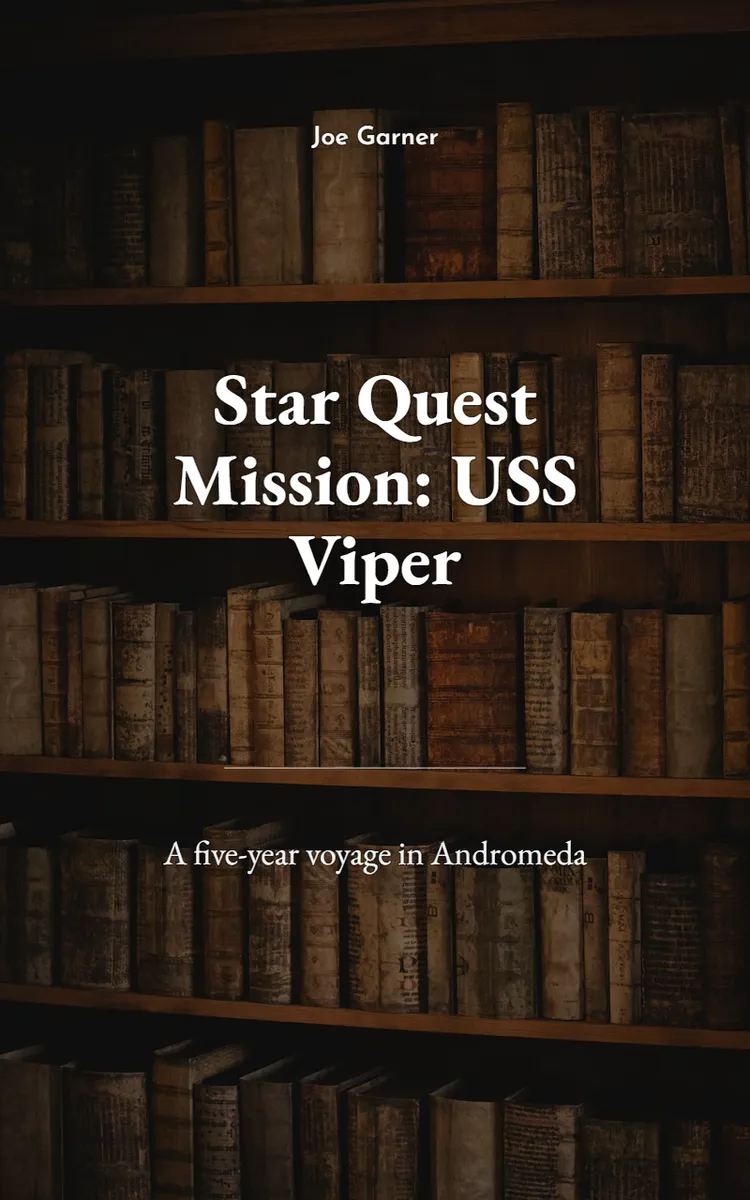
"Star Quest Mission: USS Viper" is a fiction book by Joe Garner with 20 chapters and approximately 48,790 words. A crew’s five-year interstellar mission and alien encounters.
This book was created using Inkfluence AI, an AI-powered book generation platform that helps authors write, design, and publish complete books. It was made with the AI Novel Writer.
Frequently Asked Questions
What is "Star Quest Mission: USS Viper" about?
A crew’s five-year interstellar mission and alien encounters
How many chapters are in "Star Quest Mission: USS Viper"?
The book contains 20 chapters and approximately 48,790 words. Topics covered include Dawn Launch Briefing on USS Viper, Hyper Light Slipstream Ignition, Nebula Storms and New Element Finds, Mathematical Invitation from Alien Signal, and more.
Who wrote "Star Quest Mission: USS Viper"?
This book was written by Joe Garner and created using Inkfluence AI, an AI book generation platform that helps authors write, design, and publish books.
How can I create a similar fiction book?
You can create your own fiction book using Inkfluence AI. Describe your idea, choose your style, and the AI writes the full book for you. It's free to start.
Write your own fiction book with AI
Describe your idea and Inkfluence writes the whole thing. Free to start.
Start writingCreated with Inkfluence AI


