
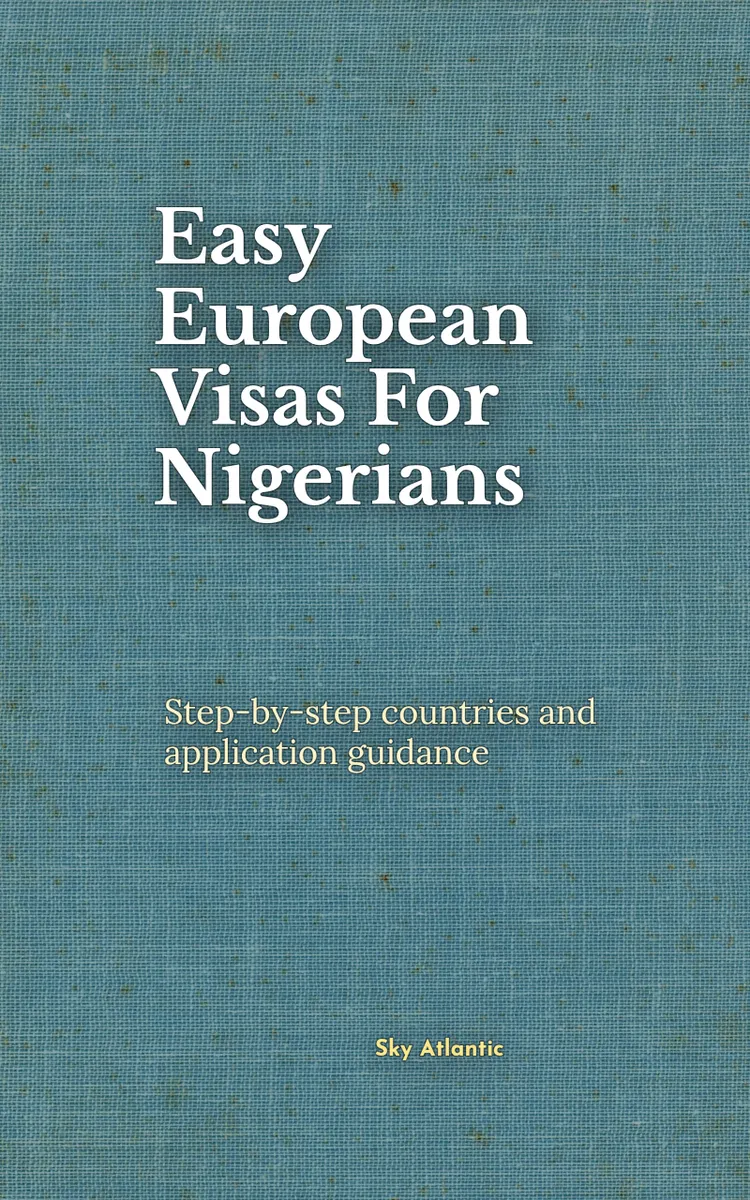
Easy European Visas For Nigerians
Created with Inkfluence AI
Visa application steps for Nigerians to European countries
Table of Contents
- 1. Choosing the Right Visa Type
- 2. The 80/20 Document Checklist
- 3. Building a Strong Financial Story
- 4. Appointment and Biometrics Without Stress
- 5. Visa Interview and Consulate Follow-Up
First chapter preview
A short excerpt from chapter 1. The full book contains 5 chapters and 6,215 words.
Why This Matters
Have you ever seen a visa rejection that feels unfair, and you can’t even point to the exact mistake? Most of the time, the problem starts before you submit anything: you match your purpose to the wrong visa category. When that happens, the embassy reads your documents and thinks, “This person didn’t apply for the trip they claim.” Then you get refused immediately-even if your papers look neat.
For Nigerians applying for European visas, the purpose you write on the form must match your real plan: tourism, business, study, work, or visiting family. Each purpose has different proof requirements, different timelines, and different “storylines” in the documents. If you choose the wrong category, you usually waste money on the application and lose time while you fix it.
After this chapter, you will use a simple matching method called the Visa Match Compass to pick the right visa type on purpose, not by guesswork. You’ll also learn how to check your plan before you book appointments, so you don’t build your documents around the wrong visa.
Quick reflection prompt: What is your exact purpose for going-one sentence only? If you can’t say it clearly, your application category will also stay unclear.
How It Works
The Visa Match Compass works like this: you identify your main purpose, then you pick the visa type that fits that purpose with the kind of documents the embassy expects. Ask yourself one question first: “What am I going to do in Europe, and how long will I do it?” That answer controls everything else.
Use these rules to match your purpose correctly:
1. Pick your main purpose (not your side plan).
If you want to visit family but also attend a short business meeting, tourism/family still stays the main purpose. Your documents must support the main purpose with matching evidence.
2. Choose the correct time pattern: short stay vs long stay.
Many European plans start as a short trip (usually tourism or visiting family). If you plan to work long-term or study for a course, you usually need a long-stay route. Your dates and schedule must support the category.
3. Match your “proof type” to the visa type you choose.
Tourism needs proof you can fund the trip and return home. Visiting family needs the host invitation and their legal status in that country. Study needs an acceptance letter and school proof. Work needs an employment route documents. Business often needs proof of business activity (like a letter from your company and meeting agenda).
4. Cross-check your plan with the application form language.
When you fill the form, the purpose fields must align with your supporting documents. If your form says “tourism” but you attach an employment contract, you create a mismatch that triggers refusal.
Here’s a concrete example using Tunde Okafor (26), entry-level accountant. Tunde wants to attend a 10-day training conference in Germany and meet business partners for his employer. If he applies as “tourism,” his application will look weak because he can’t show typical tourism proof only; he can show conference invitation, employer letter, and meeting schedule. So his best fit is the visa category that matches short business activity-because his documents and his purpose tell the same story.
Takeaway: Your visa type must match your real activity and the evidence you can produce, not what you feel like applying for.
Putting It Into Practice
Now use the Visa Match Compass on your own case. Do this in order and stop guessing.
1. Write your purpose in one sentence.
Example formats:
- “I will travel to Spain for 12 days for tourism and sightseeing.”
- “I will visit my aunt in France for 15 days.”
- “I will attend a 7-day business conference in Germany as an employee of X company.”
Expected outcome: you can explain your trip clearly in 10 seconds.
2. List your dates and total days.
Count the number of days you will be in Europe (from entry date to exit date). Expected outcome: you know whether your plan looks like a short stay or a longer stay.
3. Match your purpose to the visa type.
Use this quick map:
- Tourism = sightseeing + your own travel plan + funding + return ties
- Visiting family = host invitation + host details + your relationship proof
- Study = school acceptance + course details + tuition/fees proof
- Work = job offer/employment route documents + work permission process
- Business = employer letter + event/meeting invitation + itinerary for business activity
Expected outcome: you pick one visa category that matches your proof.
4. Build your document set around that one category.
After you choose the visa type, collect documents that directly support it. Expected outcome: your documents “agree” with your purpose.
Quick checklist
...
About this book
"Easy European Visas For Nigerians" is a how-to guide book by Sky Atlantic with 5 chapters and approximately 6,215 words. Visa application steps for Nigerians to European countries.
This book was created using Inkfluence AI, an AI-powered book generation platform that helps authors write, design, and publish complete books. It was made with the AI Ebook Generator.
Frequently Asked Questions
What is "Easy European Visas For Nigerians" about?
Visa application steps for Nigerians to European countries
How many chapters are in "Easy European Visas For Nigerians"?
The book contains 5 chapters and approximately 6,215 words. Topics covered include Choosing the Right Visa Type, The 80/20 Document Checklist, Building a Strong Financial Story, Appointment and Biometrics Without Stress, and more.
Who wrote "Easy European Visas For Nigerians"?
This book was written by Sky Atlantic and created using Inkfluence AI, an AI book generation platform that helps authors write, design, and publish books.
How can I create a similar how-to guide book?
You can create your own how-to guide book using Inkfluence AI. Describe your idea, choose your style, and the AI writes the full book for you. It's free to start.
Write your own how-to guide book with AI
Describe your idea and Inkfluence writes the whole thing. Free to start.
Start writingCreated with Inkfluence AI


