

Read the first chapter
The whole of chapter one, free. About 4 min. Turn the pages with the arrows, your keyboard, or a swipe.
Chapter 1
Understanding Your Camera Basics
Why This Matters
Most beginners feel overwhelmed by the buttons, dials, and jargon on a camera. You want sharp photos that look like what you saw, but you’re stuck guessing which setting to change. This chapter removes that guesswork by explaining the main parts of different cameras and how they affect your images. Once you know the essentials, you’ll make intentional choices instead of hoping for luck.
Understanding camera basics solves two common problems: wasted shooting time and disappointing results. When you can identify parts like the sensor, lens, shutter, and viewfinder and understand their roles, you’ll be able to control exposure, focus, and composition reliably. After reading, you’ll confidently pick the right camera mode for a scene, know when to swap a lens (for example, a 50mm prime for portraits), and troubleshoot why an image is dark, blurry, or noisy.
How It Works
Cameras turn light into images using a few core components. Learn these parts and the simple relationships between them.
1. Sensor - The sensor records light. Full-frame sensors (about 36 x 24 mm) collect more light than APS-C (≈23 x 15 mm) or 1-inch sensors, producing cleaner images at high ISO. For low-light shooting, a larger sensor helps reduce noise. 2. Lens - The lens focuses light and determines the angle of view. Focal length is measured in millimeters: 24mm (wide-angle), 50mm (standard), 85mm (portrait telephoto). Aperture (f-numbers like f/1.8, f/5.6) controls how much light passes and the depth of field. 3. Shutter and Shutter Speed - The shutter controls how long the sensor is exposed. Shutter speeds are seconds or fractions (1/125 s, 1/4000 s). Use fast speeds to freeze motion (1/1000 s for running subjects) and slow speeds for motion blur (1/4 s for smooth waterfalls with a tripod). 4. Aperture and Depth of Field - Aperture affects exposure and how much of the scene is in focus. A wide aperture (f/1.8) gives shallow depth of field—great for isolating a subject. A narrow aperture (f/16) keeps foreground and background sharp—useful for landscapes. 5. ISO - ISO amplifies the sensor’s signal. Increasing ISO brightens images but adds noise. For many APS-C cameras, ISO 1600–3200 is a practical high-ISO range; full-frame bodies can often use ISO 6400 with acceptable noise. 6. Focus System - Autofocus (phase-detect or contrast-detect) finds subjects automatically; manual focus is useful for low contrast or precise control. Most beginner DSLRs/mirrorless cameras offer single-point AF—use it for precise eye focus in portraits.
These elements interact—changing one requires adjusting another. For example, shooting at f/2.8 to blur the background means you may need a faster shutter or lower ISO to avoid overexposure.
Putting It Into Practice
Scenario: You’re photographing a friend at golden hour in a park with a mirrorless camera and a 50mm f/1.8 lens. Goal: sharp subject, blurred background, well-exposed face.
1. Set mode to Aperture Priority (A or Av). This lets you choose aperture while the camera picks shutter speed. 2. Choose aperture f/1.8 to create a shallow depth of field and smooth bokeh behind the subject. 3. Aim for ISO 100–200 to keep noise low at golden hour; if the camera selects a shutter slower than 1/125 s and your friend might move, raise ISO to 400–800 instead. 4. Use single AF point placed over the nearest eye; half-press the shutter to lock focus, then recompose slightly if needed. 5. Take a test shot and check the histogram: ensure highlights (sun on the face) aren’t clipped. If they are, increase shutter speed or reduce ISO. 6. If background is too distracting, step back and zoom with your feet (move farther and use 50mm for tighter perspective) or switch to an 85mm lens if available for stronger subject separation.
Expected outcome: a sharp portrait with a soft background and clean skin tones. If the image is noisy, repeat at ISO 800 and compare.
Quick checklist: - Aperture: f/1.8 for subject separation - ISO: start 100–200; increase only as needed - Shutter speed: keep above 1/125 s for handheld portraits - Focus: single-point AF on the nearest eye - Review histogram and adjust exposure
What to Watch For
Blurry photos from slow shutter Explanation: In low light, the camera may choose a shutter speed too slow for handholding, causing motion blur. Fix: Do this — increase ISO to reach 1/125–1/250 s or use a tripod. Not this — relying only on wider aperture if subject movement is involved.
Overexposed highlights Explanation: Bright areas like the sky or reflective skin can clip, losing detail. Fix: Do this — check the histogram and expose to preserve highlights (use exposure compensation of -0.3 to -1.0 stops if necessary). Not this — increasing exposure to brighten shadows without checking highlight clipping.
Wrong lens for the job Explanation: Using a wide 24mm lens for close portraits can distort features; using a 200mm telephoto for indoor photos may be impractical. Fix: Do this — choose a 35–85mm range for general shooting; for portraits, use 50mm–85mm. Not this — forcing a single kit lens on every subject without considering perspective and distance.
Knowing these basics—sensor size, lens characteristics, aperture, shutter, ISO, and focus—gives you the building blocks to make consistent, intentional photographs. Practice with the checklist and experiment with the values suggested to see immediate improvement.
End of chapter one. 4 more chapters in the full book.
Swipe or use the arrows to turn the page


What's inside: 5 chapters
- 1. Understanding Your Camera Basics
- 2. Mastering Exposure: Aperture, Shutter, ISO
- 3. Composing Strong Photographs
- 4. Using Light Effectively in Photography
- 5. Basic Photo Editing and Sharing Tips
About this book
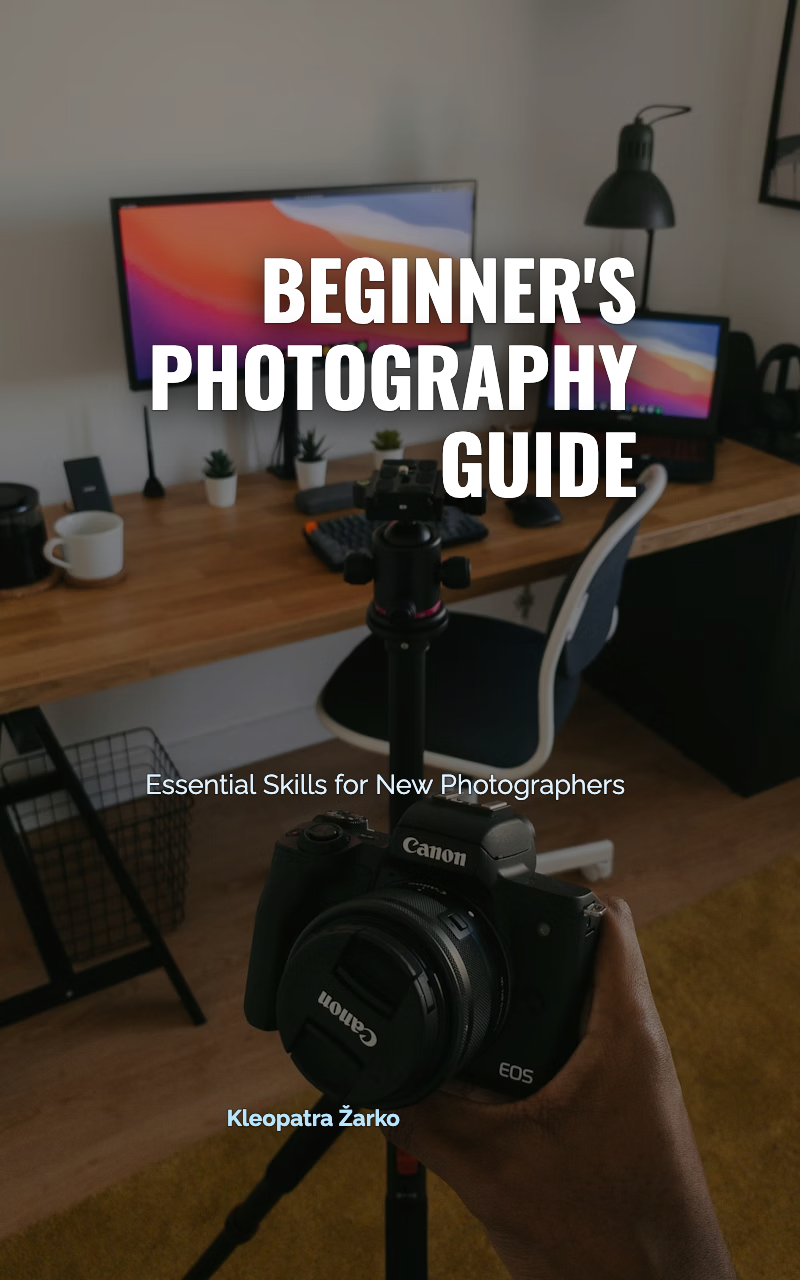
"Beginner's Photography Guide" is a how-to guide book by Kleopatra Žarko with 5 chapters and approximately 4,529 words. Basic photography techniques and skills for beginners.
This book was created using Inkfluence AI, an AI-powered book generation platform that helps authors write, design, and publish complete books. It was made with the AI Ebook Generator.
Frequently Asked Questions
What is "Beginner's Photography Guide" about?
Basic photography techniques and skills for beginners
How many chapters are in "Beginner's Photography Guide"?
The book contains 5 chapters and approximately 4,529 words. Topics covered include Understanding Your Camera Basics, Mastering Exposure: Aperture, Shutter, ISO, Composing Strong Photographs, Using Light Effectively in Photography, and more.
Who wrote "Beginner's Photography Guide"?
This book was written by Kleopatra Žarko and created using Inkfluence AI, an AI book generation platform that helps authors write, design, and publish books.
How can I create a similar how-to guide book?
You can create your own how-to guide book using Inkfluence AI. Describe your idea, choose your style, and the AI writes the full book for you. It's free to start.
Write your own how-to guide book with AI
Describe your idea and Inkfluence writes the whole thing. Free to start.
Start writingCreated with Inkfluence AI


