
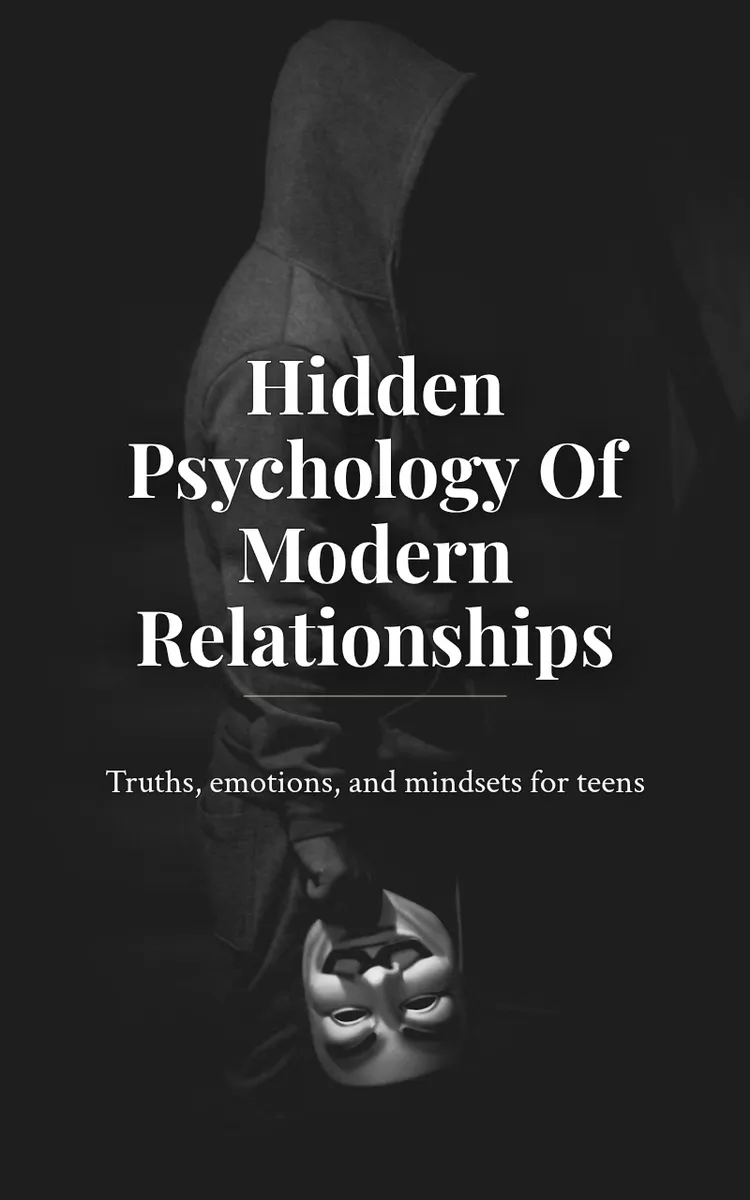
Hidden Psychology Of Modern Relationships
Created with Inkfluence AI
Psychology of boys and girls in modern relationships and daily life
Table of Contents
- 1. Boys: The Guarded Heart Blueprint
- 2. Girls: The Approval-Seeking Loop Break
- 3. The Signal Decoder for Mixed Messages
- 4. Building Boundaries Without Losing Love
- 5. Rejection-Proof Confidence and Purpose
Preview: Boys: The Guarded Heart Blueprint
A short excerpt from “Boys: The Guarded Heart Blueprint”. The full book contains 5 chapters and 6,970 words.
Picture This
Ever notice how some boys can sit right through an argument… and somehow still look “fine”? Like they’re not mad, not hurt, not bothered. They crack a joke. They shrug. They say, “It’s whatever.” Then you go home with your chest tight, because your gut keeps screaming, something is off.
Dylan, 17, high school athlete, knows that look. He’s the kind of guy people call “low drama.” After practice, he’ll talk about plays, workouts, and what the team did wrong-easy stuff. But when his girlfriend texts, “Can we talk?” his thumbs freeze. His face goes blank. He doesn’t type. He doesn’t call. He just waits until he can breathe again and reply with something safe like, “Sure,” even if his stomach is flipping like crazy.
So here’s the tension most people miss: the “cold” you see from boys often isn’t a lack of feelings. It’s feelings being hidden-on purpose-so they stay safe, respected, and in control.
What if the guarded vibe you blame on “emotionless boys” is actually a survival strategy?
The Mindset Shift
Old Belief: Boys don’t lack feelings-they just don’t show them.
New Reality: Many boys hide feelings to stay safe, respected, and in control-because showing them can feel risky.
That shift matters because it changes what you’re looking for. If you think boys are empty, you’ll chase. You’ll ask more questions, demand more clarity, or feel rejected when the answer comes late-or not at all. But if you realize they’re protecting something, you stop seeing silence as a wall and start seeing it as a lock.
Let’s ground it in Dylan’s world. When his girlfriend asks to talk, Dylan doesn’t just think, I don’t know what to say. He thinks, If I say the wrong thing, I’ll look weak. If I admit I’m hurt, I’ll lose respect. If I get emotional, she’ll judge me-or worse-she’ll use it against me later. So he chooses the safer move: delay, minimize, redirect. He stays in control by controlling the emotional temperature.
Here’s the twist: control feels good in the moment. It keeps embarrassment away. It keeps conflict from exploding. But it also creates distance. Later, Dylan might still care-still feel-still replay the conversation in his head. He just did it privately, like a man carrying a heavy bag he’s not allowed to set down in public.
So the reframe isn’t “boys are complicated.” It’s this: the guarded heart is a blueprint, not a personality flaw. And once you see it that way, you stop trying to break it open like it’s stubbornness. You start learning how to unlock it safely.
Going Deeper
Most people treat emotional hiding like a choice. Like boys can just “open up” if they want. But in real life, hiding usually comes from a pattern: boys learn early that certain feelings cost them. Not always with words. Sometimes with looks, teasing, exclusion, or the quiet punishment of being labeled “too much.”
When boys feel pressure-status pressure, masculinity pressure, online pressure-it can make emotions feel dangerous. Not because emotions are wrong, but because the social world around them can be unpredictable. One moment they’re praised for confidence. The next moment they’re mocked for vulnerability. So they adapt. They become guarded. Not because they don’t care-because they care too much about how they’re seen.
In the Guarded Heart Blueprint, the goal isn’t to “turn off” feelings. It’s to manage risk. The mind quietly asks: Will I be respected if I admit this? Will I lose power in the relationship? Will I embarrass myself? If the answer feels uncertain, the body goes into defense. Silence, jokes, avoidance, “I’m fine,” or sudden focus on something else-those are the tools.
Signs this pattern is running your life
1. You get careful answers, not honest ones. Conversations stall at “whatever,” “it’s not a big deal,” or “I don’t know,” even when your gut says something is clearly happening.
2. He can talk about everything… except the part you actually need. Sports, plans, friends, money, schedules-easy. Feelings, fears, jealousy, regret-suddenly “blank.”
3. Emotions show up sideways. Instead of saying “I’m hurt,” he gets snappy. Instead of saying “I’m scared,” he pulls away. Instead of saying “I need reassurance,” he acts busy.
4. After conflict, he looks calm-but the distance lingers. He might return to normal fast, but the connection doesn’t fully come back until much later, if it comes back at all.
Le verdict: Guarded isn’t the absence of feelings-it’s feelings managed like something that could get you hurt.
And Dylan? When he finally talks, it’s not because he suddenly became a different person. It’s because the environment felt safer. He felt less likely to be judged. He felt like he could keep his dignity. That’s the real key behind the blueprint: safety creates honesty. Not pressure.
Reflection & Self-Assessment
1....
About this book
"Hidden Psychology Of Modern Relationships" is a self-help book by Anonymous with 5 chapters and approximately 6,970 words. Psychology of boys and girls in modern relationships and daily life.
This book was created using Inkfluence AI, an AI-powered book generation platform that helps authors write, design, and publish complete books. It was made with the AI Self-Help Book Writer.
Frequently Asked Questions
What is "Hidden Psychology Of Modern Relationships" about?
Psychology of boys and girls in modern relationships and daily life
How many chapters are in "Hidden Psychology Of Modern Relationships"?
The book contains 5 chapters and approximately 6,970 words. Topics covered include Boys: The Guarded Heart Blueprint, Girls: The Approval-Seeking Loop Break, The Signal Decoder for Mixed Messages, Building Boundaries Without Losing Love, and more.
Who wrote "Hidden Psychology Of Modern Relationships"?
This book was written by Anonymous and created using Inkfluence AI, an AI book generation platform that helps authors write, design, and publish books.
How can I create a similar self-help book?
You can create your own self-help book using Inkfluence AI. Describe your idea, choose your style, and the AI writes the full book for you. It's free to start.
Write your own self-help book with AI
Describe your idea and Inkfluence writes the whole thing. Free to start.
Start writingCreated with Inkfluence AI


